by Daniel Brouse
Derived from the Nonlinear Acceleration Framework
Model Time Horizon:
2026–2226
Outcome Categories:
- Climate Stabilization / Managed Transition
- Increasing Climate Disruption
- Regional Habitability Stress
- Global System Stress
- Civilization-Scale Contraction
- Human Extinction Boundary
Probability Distribution (Model Scenario)
| Future State (2026–2226) | Probability Range | Framework Interpretation |
|---|---|---|
| 1. Managed Transition / Relative Stability | 10% | Feedback amplification remains limited; adaptation, technology, and resilience offset increasing climate pressures |
| 2. Persistent Climate Disruption | 35% | More frequent extreme events, economic losses, infrastructure stress, ecosystem degradation |
| 3. Regional Habitability Stress | 30% | Increasing areas experience dangerous heat, water stress, agricultural disruption, migration pressures |
| 4. Global System Stress | 15% | Multiple interacting disruptions overwhelm some adaptive systems; significant geopolitical and economic instability |
| 5. Civilization-Scale Contraction | 8% | Large-scale failures of infrastructure, agriculture, energy, and governance systems |
| 6. Human Extinction Boundary | 2% | Extreme theoretical outcome requiring multiple simultaneous catastrophic failures |
Probability Envelope Visualization
Probability of Future States (2026–2226)

Managed Transition
██████████ 10%

Persistent Disruption
███████████████████████████████████ 35%

Regional Habitability Stress
██████████████████████████████ 30%

Global System Stress
███████████████ 15%

Civilization Contraction
████████ 8%

Human Extinction Boundary
██ 2%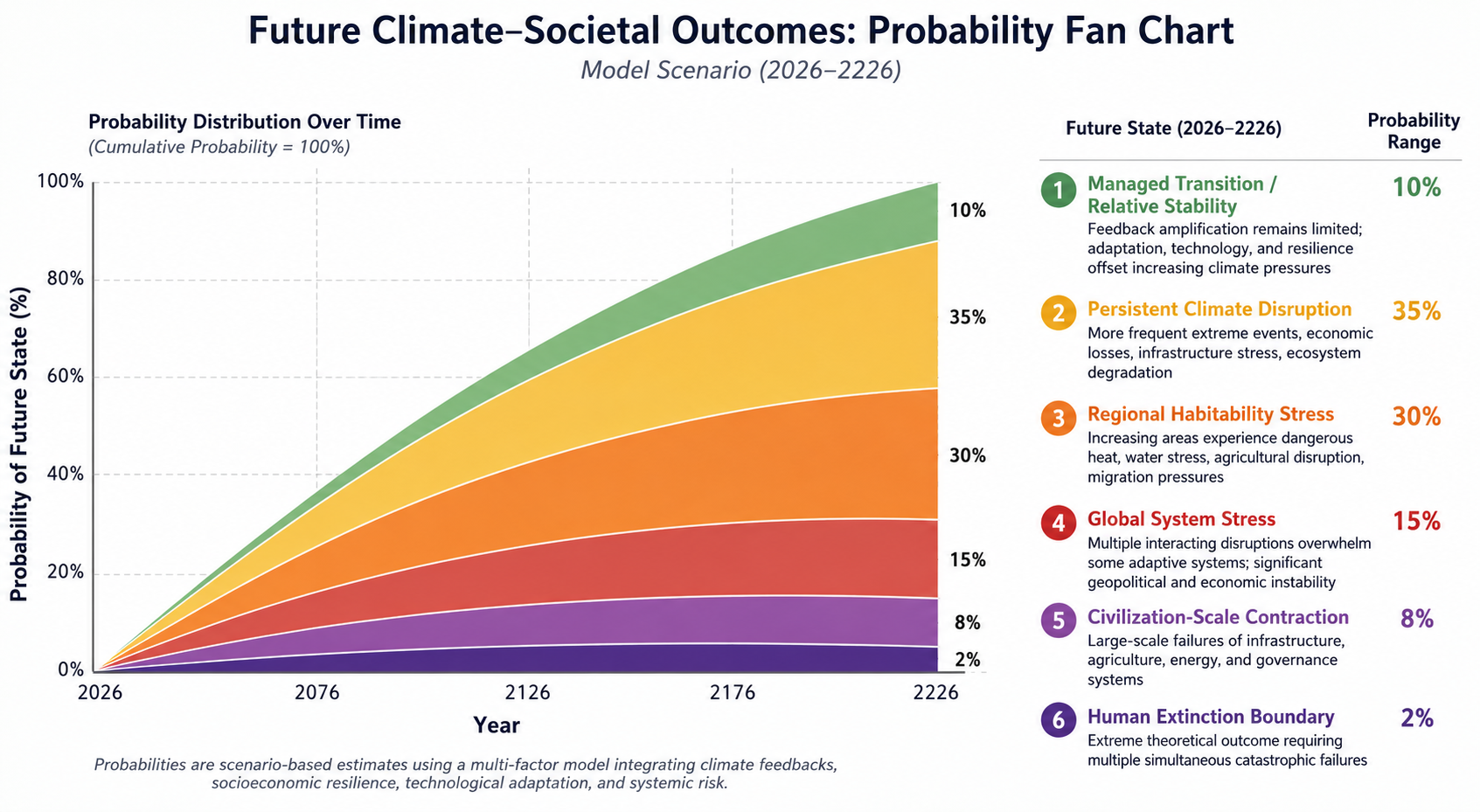
How the Distribution Changes Over Time
The framework assumes that probability is not static.
The distribution evolves as system coupling changes.
Period 1: 2026–2050
Early Acceleration Phase
Dominant processes:
Climate Stress → Extreme Events → Infrastructure Costs → Adaptation Pressure
Estimated distribution:
| Outcome | Probability |
|---|---|
| Managed transition | 20% |
| Persistent disruption | 50% |
| Regional stress | 25% |
| Global stress | 5% |
| Civilization contraction | <1% |
| Extinction boundary | <1% |
Interpretation:
The system remains largely within existing civilization structures, but disruption increases.
Period 2: 2050–2100
Coupling Expansion Phase
Dominant processes:
Multiple Feedbacks → Compound Events → Reduced Recovery Time → Greater System Sensitivity
Estimated distribution:
| Outcome | Probability |
|---|---|
| Managed transition | 10% |
| Persistent disruption | 40% |
| Regional stress | 35% |
| Global stress | 12% |
| Civilization contraction | 3% |
| Extinction boundary | <1% |
Interpretation:
The primary shift is from isolated events toward interacting disruptions.
Period 3: 2100–2200
System Transition Phase
Dominant processes:
Climate Stress × Ecosystem Stress × Infrastructure Stress
Estimated distribution:
| Outcome | Probability |
|---|---|
| Managed transition | 5% |
| Persistent disruption | 25% |
| Regional stress | 35% |
| Global stress | 25% |
| Civilization contraction | 9% |
| Extinction boundary | 1% |
Interpretation:
The probability envelope broadens because uncertainty increases as multiple systems interact.
Period 4: 2200–2226
Long-Term Equilibrium Selection
Possible pathways:
Pathway A: Adapted Earth System
Outcome:
Stable but transformed civilization
Pathway B: High-Stress Earth System
Outcome:
Persistent disruption and regional instability
Pathway C: Cascading Failure
Outcome:
Civilization contraction
The Framework’s Core Equation
A simplified representation:
Interpretation of the Upper Boundary
The framework separates:
Planetary Habitability
from:
Human Civilization
The probability hierarchy is:
The model therefore treats human extinction as a low-probability upper boundary, not the central pathway.
The more probable outcome under increasing nonlinear acceleration is:
A progressively more difficult Earth for existing human systems to operate within.
Sensitivity Analysis
The largest factors shifting the probability envelope would be:
| Variable | Effect |
|---|---|
| Feedback coupling increases | Moves probability toward disruption |
| Acceleration increases | Compresses response time |
| Ecosystem degradation increases | Raises vulnerability |
| Adaptation improves | Moves probability toward stability |
| Resilience declines | Raises systemic risk |
| Feedbacks weaken | Moves probability toward stabilization |
Summary Distribution
The theoretical 200-year envelope:
Most Probable Region:

Persistent Disruption
        ↓
Regional Habitability Stress


Less Probable:

Global System Stress
        ↓
Civilization Contraction


Extreme Upper Boundary:

Human Extinction
Framework Conclusion
Under the Nonlinear Acceleration Framework, the primary risk is not a sudden transition from a habitable Earth to an uninhabitable planet.
The dominant theoretical risk pathway is:
Increasing Feedback Coupling → Accelerating Impacts → Reduced Recovery Time → Growing System Stress → Progressive Civilization Challenges
The extinction boundary exists as the extreme edge of the probability envelope, while the central concern is the increasing probability of a world where human systems must operate under rapidly changing environmental conditions.