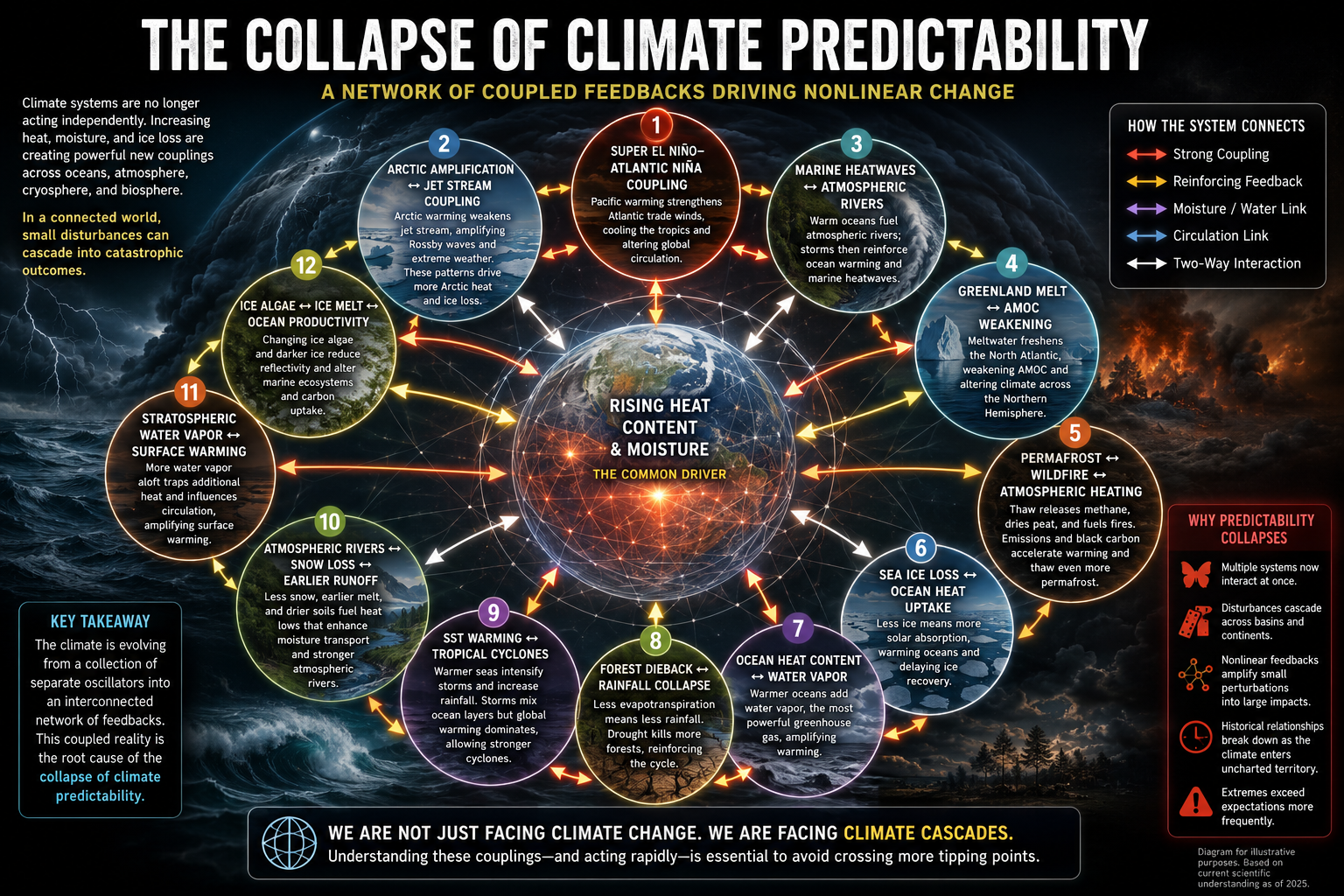
The Super El Niño–Atlantic Niña coupling is one of the clearest examples of how formerly semi-independent climate oscillations are becoming more tightly linked in a warmer world. But it is far from the only coupling now being observed. Increasing ocean heat content, declining sea ice, changing atmospheric circulation, and enhanced moisture transport are creating new interactions that reduce the reliability of historical climate relationships.
Here’s a framework of the most important coupled systems contributing to the collapse of climate predictability.
1. Super El Niño ↔ Atlantic Niña
(Cross-basin ocean-atmosphere coupling)
Mechanism
- Exceptional warming in the equatorial Pacific alters the Walker Circulation.
- Atmospheric teleconnections strengthen Atlantic trade winds.
- Stronger trades cool the eastern tropical Atlantic.
- The Atlantic then feeds back into global circulation.
Consequences
- Hurricane seasons become less predictable.
- African monsoon shifts.
- Amazon rainfall changes.
- Jet streams reorganize globally.
This is no longer simply ENSO affecting the Atlantic—it becomes a two-way coupled system.
2. Arctic Amplification ↔ Jet Stream Coupling


6
As the Arctic warms 3–4 times faster than the global average:
- temperature gradients weaken
- jet stream slows
- Rossby waves amplify
- blocking patterns persist longer
The weakened jet stream then:
- allows additional Arctic heat transport
- increases sea ice melt
- reinforces Arctic amplification
This positive feedback produces
- prolonged heat domes
- stalled atmospheric rivers
- persistent droughts
- multi-day flooding events
3. Marine Heatwaves ↔ Atmospheric Rivers
Warm oceans increase
- evaporation
- atmospheric water vapor
- latent heat release
That additional moisture intensifies atmospheric rivers.
The storms themselves:
- warm coastal oceans
- reduce ocean mixing
- reinforce marine heatwaves
Result:
- stronger flooding
- stronger coastal storms
- longer marine heatwaves
4. Greenland Melt ↔ AMOC Weakening


5
Greenland melt adds enormous volumes of freshwater.
Freshwater reduces salinity.
Lower salinity reduces deep water formation.
The Atlantic Meridional Overturning Circulation (AMOC) weakens.
A weaker AMOC then alters
- North Atlantic temperatures
- European weather
- tropical rainfall
- hurricane development
Those changes affect Greenland snowfall and melting, completing another coupled feedback.
5. Permafrost ↔ Wildfire ↔ Atmospheric Heating
One of the fastest emerging feedbacks.
Warming causes:
- permafrost thaw
- methane release
- peat drying
Dry peat fuels zombie fires.
Wildfires release
- CO₂
- methane
- black carbon
Black carbon settles on Arctic snow.
Lower albedo accelerates melting.
Additional warming thaws even more permafrost.
6. Sea Ice Loss ↔ Ocean Heat Uptake
Sea ice reflects sunlight.
Open ocean absorbs sunlight.
As sea ice retreats:
- solar absorption increases dramatically
- upper ocean warms
- autumn freeze is delayed
- winter ice becomes thinner
The thinner ice melts faster the following year.
This coupling is one reason Arctic warming has accelerated so rapidly.
7. Ocean Heat Content ↔ Water Vapor
This is perhaps the most fundamental coupling.
Warmer oceans
↓
greater evaporation
↓
more atmospheric water vapor
↓
stronger greenhouse effect
↓
warmer oceans
Water vapor also fuels:
- heavier rainfall
- stronger hurricanes
- more latent heat release
- explosive convection
8. Forest Dieback ↔ Rainfall Collapse


5
Forests recycle enormous amounts of moisture.
Loss of forests means
- less evapotranspiration
- less rainfall
- longer droughts
Drought kills more forests.
This coupling is becoming increasingly important in
- Amazon
- Boreal Canada
- Siberia
9. Sea Surface Temperature ↔ Tropical Cyclones
Warmer oceans produce
- stronger hurricanes
- slower-moving hurricanes
- greater rainfall
Storms mix the upper ocean.
Sometimes mixing cools local waters.
But globally, warming oceans increasingly outweigh this cooling, allowing storms to intensify more rapidly and maintain higher rainfall rates.
10. Atmospheric Rivers ↔ Snow Loss ↔ Earlier Runoff
Reduced mountain snowpack means
- less spring melt
- drier soils
- warmer land surfaces
Warmer land strengthens heat lows.
Heat lows enhance moisture transport.
Atmospheric rivers become stronger.
11. Stratospheric Water Vapor ↔ Surface Warming
Increasing methane oxidation and occasional injections of water vapor into the stratosphere increase its greenhouse effect.
Additional warming raises sea surface temperatures, which increase evaporation and atmospheric moisture, further reinforcing warming.
12. Ice Algae ↔ Ice Melt ↔ Ocean Productivity
Melting sea ice changes the timing and distribution of ice algae blooms.
Dark algal communities can reduce ice reflectivity locally, while shifts in marine ecosystems affect carbon uptake. Although smaller than many other feedbacks, these biological changes interact with physical ice loss and ocean warming.
Why This Leads to the Collapse of Climate Predictability
Historically, climate scientists often analyzed these systems as largely independent oscillations:
- ENSO
- AMOC
- Arctic Oscillation
- Pacific Decadal Oscillation
- Indian Ocean Dipole
- Atlantic Niño/Niña
Increasing evidence shows they are interacting more strongly through shared reservoirs of heat, moisture, ice, and atmospheric circulation. As coupling strengthens, disturbances in one region can propagate across multiple climate systems, creating cascading responses that are difficult to anticipate with historical relationships alone.
Instead of isolated oscillators, the climate increasingly behaves as a network of coupled nonlinear feedbacks. In such systems, modest perturbations can cascade through multiple connected processes, producing responses much larger than the initial forcing. This interconnected behavior helps explain why recent extremes have often exceeded expectations based on past climate variability and why forecasting becomes more challenging as the system evolves.