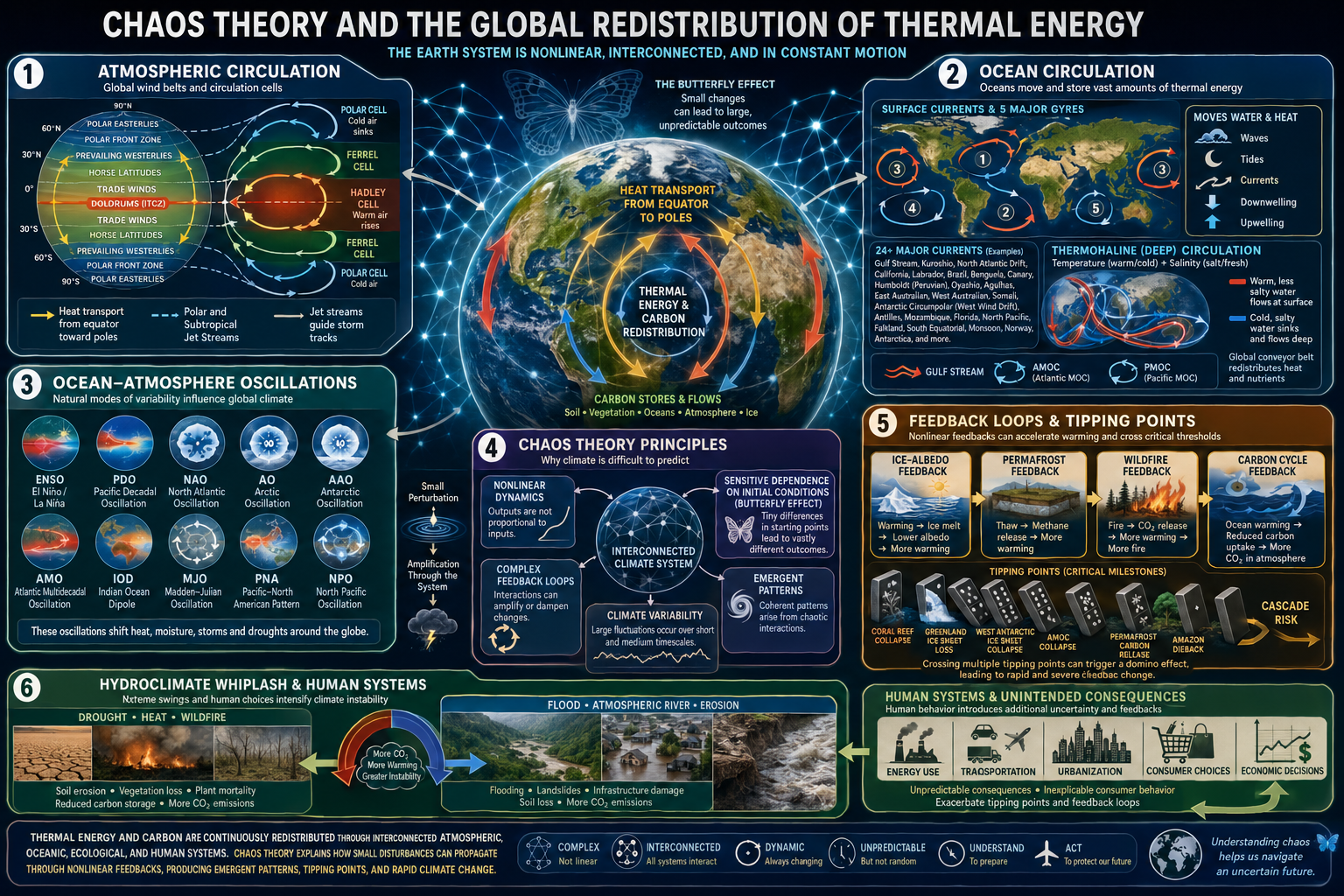
“General Circulation Models (GCMs) of Earth’s climate are nonlinear and highly teleconnected. That means a small change in temperature or pressure or humidity in one small area on the globe can cause _large_ changes in conditions _anywhere_ on the globe. This phenomenon is often referred to as the Butterfly Effect — the idea that a butterfly flapping its wings in China could ultimately contribute to a hurricane forming in the Atlantic. The complexity of these models can lead to chaotic behavior. Climate science must grapple with these models and extract results in spite of the mathematical difficulties, and there have been remarkable successes in some cases and sad failures in others. Nevertheless we must proceed.”
by Daniel Brouse and Sidd Mukherjee
The Earth’s climate is a nonlinear, coupled dynamical system consisting of the atmosphere, oceans, cryosphere, lithosphere, biosphere, and human systems. Rather than operating independently, these components continuously exchange thermal energy, moisture, carbon, momentum, and chemical constituents across multiple spatial and temporal scales.
Global warming is fundamentally an increase in the total thermal energy stored within the Earth system. This additional energy does not remain uniformly distributed. Instead, it is constantly redistributed through complex interactions among atmospheric circulation, ocean currents, land-atmosphere exchanges, and biological processes. The result is a climate system characterized by variability, emergent behavior, and increasing instability.
Chaos theory provides a powerful framework for understanding these dynamics. It explains how nonlinear interactions, sensitive dependence on initial conditions, and interconnected feedbacks allow relatively small perturbations to propagate throughout the climate system, sometimes producing disproportionately large regional and global responses.
Fundamental Principle
Small changes in atmospheric temperature, pressure, humidity, ocean salinity, soil moisture, or surface reflectivity can trigger large-scale climate responses through nonlinear amplification and interconnected feedback loops. As additional thermal energy accumulates in the Earth system, these interactions become increasingly energetic, increasing the likelihood of extreme weather, abrupt transitions, and cascading tipping points.
Global Thermal Energy Redistribution
Thermal energy is continually redistributed through an interconnected network of atmospheric and oceanic circulation systems.
Atmospheric Circulation
Major atmospheric circulation includes:
- Hadley, Ferrel, and Polar circulation cells
- Intertropical Convergence Zone (ITCZ or “doldrums”)
- Trade winds
- Horse latitudes
- Prevailing westerlies
- Polar easterlies
- Polar front zone
- Subtropical and polar jet streams
- Atmospheric rivers
- Rossby waves
- Blocking highs and Omega blocks
These circulation systems transport heat and moisture from the tropics toward the poles while governing storm tracks, precipitation patterns, droughts, and heat waves.
Ocean Circulation
The oceans absorb more than 90% of the excess heat produced by greenhouse gas forcing, making them Earth’s primary thermal reservoir. Heat redistribution occurs through:
- Surface currents
- Deep-water thermohaline circulation
- Upwelling and downwelling
- Tides and wave-driven mixing
- Five major subtropical gyres
- The Antarctic Circumpolar Current
- More than two dozen major ocean currents, including the Gulf Stream, Kuroshio Current, Humboldt Current, California Current, Labrador Current, Benguela Current, Agulhas Current, Florida Current, Brazil Current, Canary Current, Norwegian Current, and Oyashio Current.
Large-scale overturning circulations—including the Atlantic Meridional Overturning Circulation (AMOC) and Pacific Meridional Overturning Circulation (PMOC)—play central roles in regulating long-term climate stability by transporting heat between the tropics and high latitudes.
Ocean-Atmosphere Oscillations
Coupled oscillations redistribute thermal energy over seasonal, interannual, and multidecadal timescales. Major oscillations include:
- El Niño-Southern Oscillation (ENSO)
- Pacific Decadal Oscillation (PDO)
- Atlantic Multidecadal Oscillation (AMO)
- North Atlantic Oscillation (NAO)
- Arctic Oscillation (AO)
- Antarctic Oscillation (AAO)
- Madden-Julian Oscillation (MJO)
- Indian Ocean Dipole (IOD)
- Pacific-North American (PNA) Pattern
- North Pacific Gyre Oscillation (NPGO)
- North Pacific Oscillation (NPO)
Although these oscillations have existed for millennia, increasing thermal energy alters their frequency, persistence, intensity, and interactions, contributing to more frequent climate extremes.
Chaos Theory and Climate Dynamics
Chaos theory helps explain why climate change is more than a gradual warming trend. As thermal energy accumulates, the climate system becomes increasingly nonlinear, allowing small disturbances to generate disproportionately large responses.
Sensitive Dependence on Initial Conditions
Often referred to as the “butterfly effect,” small differences in initial atmospheric or oceanic conditions can lead to vastly different weather and climate outcomes. Slight variations in sea surface temperatures, humidity, soil moisture, or atmospheric pressure may eventually influence hurricanes, atmospheric rivers, heat waves, droughts, or persistent blocking patterns thousands of kilometers away.
Nonlinear Feedback Loops
The Earth system contains numerous interacting positive and negative feedback mechanisms.
Examples include:
- Ice-albedo feedback
- Water vapor feedback
- Permafrost carbon release
- Forest dieback
- Ocean carbon uptake changes
- Cloud feedbacks
- Soil moisture-precipitation feedbacks
Positive feedbacks amplify warming by increasing the amount of thermal energy retained within the climate system, while negative feedbacks partially offset change. As warming continues, positive feedbacks increasingly dominate many regions.
Emergent Behavior
Despite underlying chaos, coherent climate patterns emerge naturally from nonlinear interactions. These include:
- El Niño and La Niña
- Madden-Julian Oscillation
- Atmospheric blocking events
- Heat domes
- Atmospheric rivers
- Polar vortex disruptions
These organized structures redistribute enormous amounts of thermal energy and moisture while influencing weather patterns across entire continents.
Climate Variability
Chaos theory explains why natural variability remains large even during long-term warming. Individual years may be cooler or warmer than expected, yet the long-term accumulation of thermal energy continues to drive rising temperatures, stronger hydrologic extremes, accelerating sea-level rise, and increasing ocean heat content.
Hydroclimate Whiplash
One consequence of increasing nonlinearity is hydroclimate whiplash—rapid transitions between prolonged drought and extreme flooding.
As the atmosphere warms, it can hold approximately 7% more water vapor for every 1°C of warming, increasing the potential for intense precipitation. At the same time, higher temperatures accelerate evaporation and soil drying, intensifying drought conditions.
Small shifts in atmospheric circulation can therefore produce abrupt swings between:
- severe drought,
- wildfire,
- atmospheric rivers,
- flash flooding,
- landslides, and
- repeated agricultural failures.
These extremes damage ecosystems, reduce vegetation recovery, erode soils, and release additional carbon dioxide and methane, reinforcing warming through additional positive feedback loops.
Human Systems as Part of the Climate System
Human societies have become an increasingly important component of the Earth’s coupled climate system.
Economic decisions, energy production, land-use change, urbanization, deforestation, agriculture, technological innovation, and public policy continuously alter greenhouse gas emissions and the Earth’s energy balance. Unlike physical processes, human behavior often exhibits nonlinear dynamics driven by psychology, economics, politics, and social networks.
Consequently, climate change results from the interaction of biogeophysical systems and socio-economic systems, each capable of amplifying or moderating climate feedbacks.
Cascading Feedbacks and Climate Tipping Points
A climate tipping point is a critical threshold beyond which part of the Earth system undergoes a self-sustaining and often irreversible transition to a new state.
Examples include:
- Greenland Ice Sheet destabilization
- West Antarctic Ice Sheet collapse
- AMOC weakening or collapse
- Boreal forest dieback
- Amazon rainforest dieback
- Permafrost thaw
- Coral reef collapse
Crossing one tipping point can increase the probability of triggering others, producing cascading tipping events that accelerate the redistribution of thermal energy and carbon throughout the Earth system.
Rather than responding linearly to continued warming, the climate may increasingly behave as a complex adaptive system in which multiple interacting feedbacks generate abrupt transitions, emergent behavior, and nonlinear acceleration. Understanding these interactions is essential for improving climate projections, identifying early warning signals, and developing effective mitigation and adaptation strategies.