by Daniel Brouse
ABSTRACT
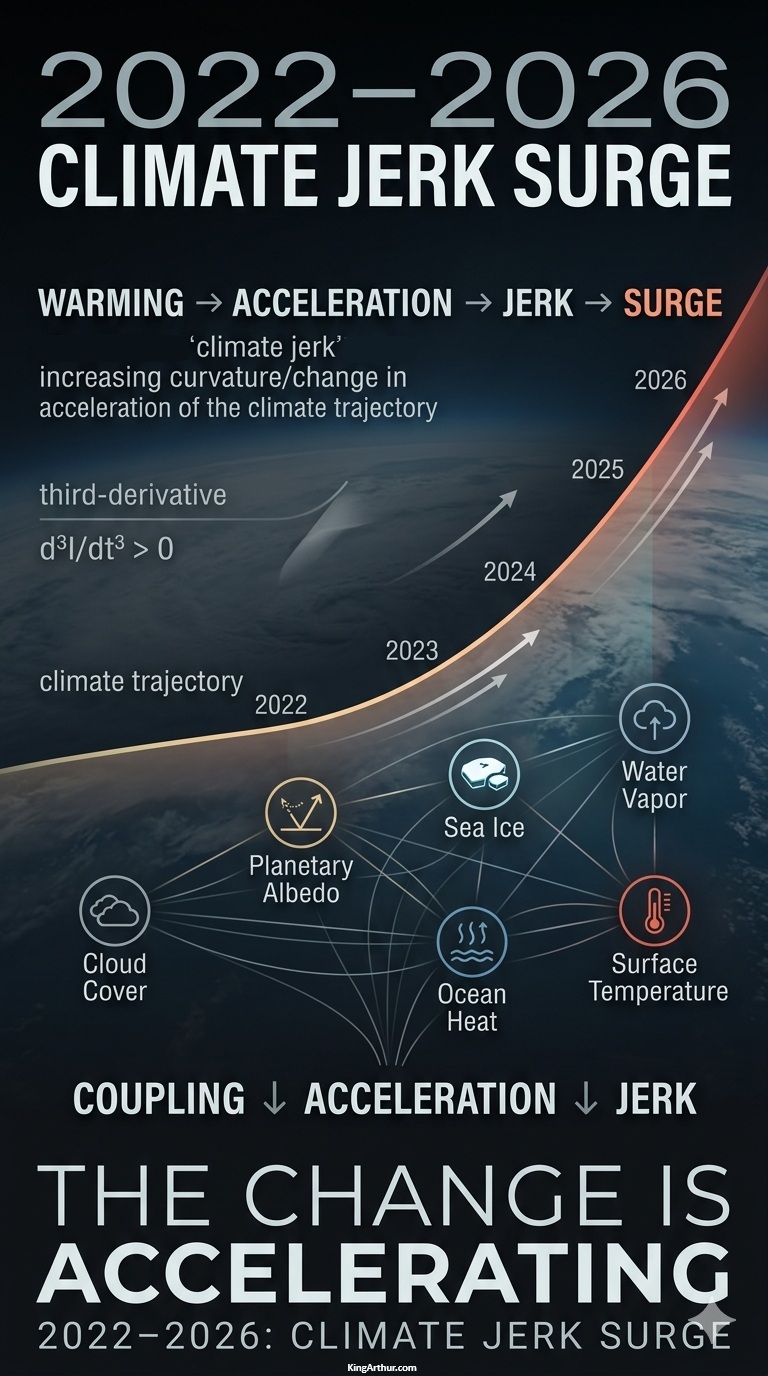
The recent change in climate-system dynamics is being expressed not simply as continued warming, but as increasing synchronization among multiple radiative and thermal feedback pathways.
Beginning most notably around 2022, the climate system exhibits an increasingly interconnected pattern among six major variables: cloud cover, planetary albedo, sea ice extent, atmospheric water vapor, ocean heat content, and surface temperature.
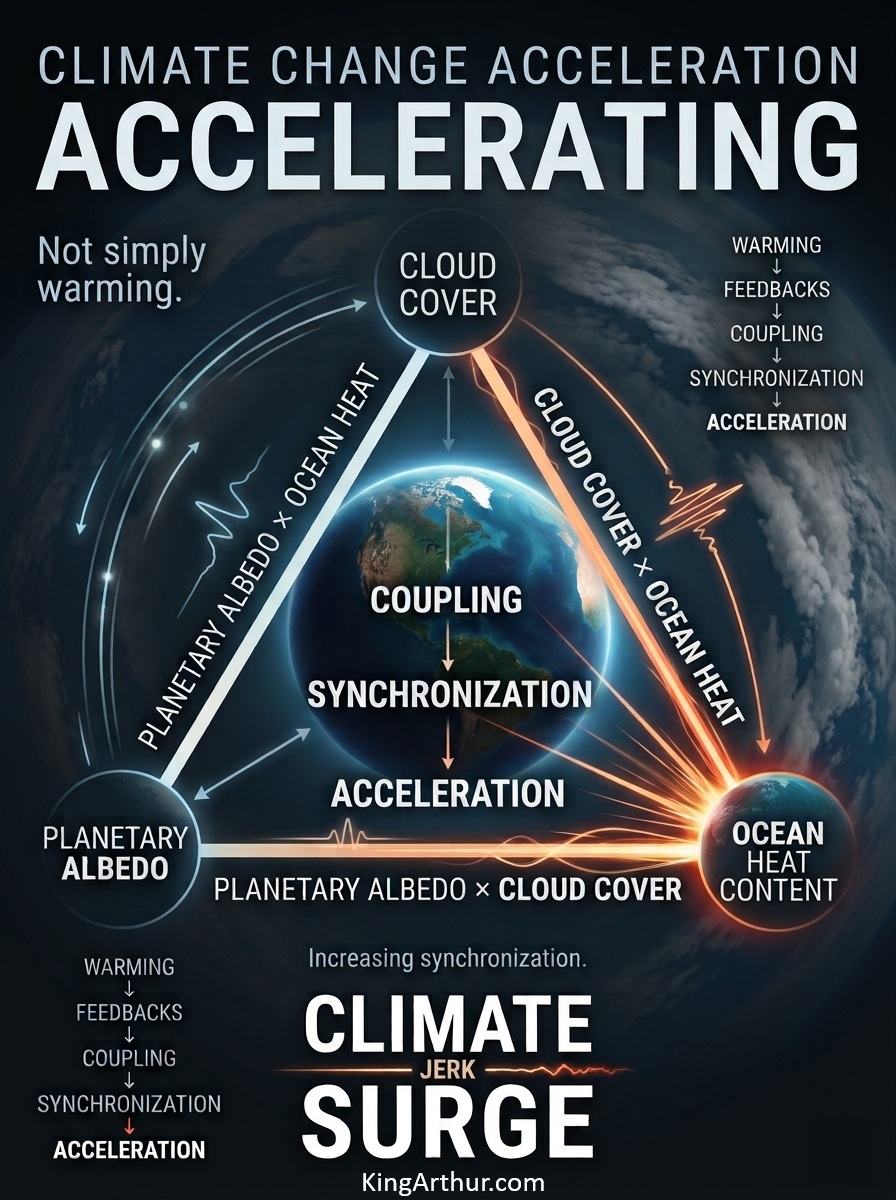
The three largest interaction paths form a closely connected Albedo–Cloud–Ocean Heat Content triad:
- Planetary Albedo × Ocean Heat Content — 14.3%
- Cloud Cover × Ocean Heat Content — 13.2%
- Planetary Albedo × Cloud Cover — 12.1%
Together, these three paths account for 39.6% of the displayed surge weight.
A physically coherent pathway emerges:
Reduced aerosols + cloud variability + ocean warming + internal climate variability
→ low-cloud changes
→ planetary albedo decline
→ increased absorbed solar radiation
→ increased planetary heat uptake
The evidence does not require the shipping intervention to be the sole cause. Instead, it provides a physically testable external perturbation capable of contributing to the observed synchronization among albedo, clouds, and ocean heat content.
The central finding is therefore not that a single feedback has suddenly appeared, but that multiple existing feedback pathways are becoming increasingly coupled—and that the rate of this coupling is itself accelerating.
INTRODUCTION
Multiple Feedback Coupling Becomes Observable
Beginning most notably around 2022, multiple climate-system feedbacks appear to be increasingly coupled, with changes in several major climate variables occurring simultaneously and in physically connected directions.
The analysis tracks six climate-system variables:
- Cloud cover
- Planetary albedo
- Sea ice extent
- Atmospheric water vapor
- Ocean heat content
- Surface temperature
These six variables generate 15 unique pairwise coupling paths, which are combined into a single aggregate Coupling Index:
6 climate-system variables → 15 pairwise coupling paths → 1 aggregate Coupling Index → derivatives → coupling jerk
The 15 paths represent interaction relationships, not 15 independent feedback mechanisms. A single physical feedback can influence multiple pathways simultaneously.
For example, the ice-albedo feedback appears directly in Sea Ice × Planetary Albedo, while changes in sea ice can simultaneously interact with ocean heat content, surface temperature, cloud cover, and atmospheric water vapor.
The purpose of the coupling analysis is therefore to identify whether the relationships among climate-system variables are changing, not simply whether the individual variables are warming, cooling, increasing, or declining.
The 2022–2026 Energy-Feedback Environment
The 2022–2026 period coincides with unusually strong changes in several components of the climate system, including ocean heat content, atmospheric temperature, water vapor, sea ice, cloud properties, and planetary reflectivity.
The resulting conceptual progression is:
Warming Signal
↓
Feedback Responses
↓
Increasing Interdependence
↓
Increasing Coupling
↓
Coupling Acceleration
↓
Positive Coupling Jerk
The important empirical question is therefore whether these variables are merely changing simultaneously—or whether their relationships are becoming increasingly synchronized and dynamically coupled.
That distinction is fundamental.
A climate system can experience large changes in individual variables without necessarily experiencing a comparable increase in system-wide coupling. A rise in coupling jerk indicates something different: the rate at which these relationships are strengthening is itself increasing.
Comparative Sensitivity Matrix: Feedback Pair Contributions, 2022–2026
| Rank | Interacting Feedback Pair | Mean Pair Jerk, 2022–2026 | Baseline Jerk, 1970–2019 | Surge Weight | Primary Physical Driver / Mechanism |
|---|---|---|---|---|---|
| 1 | Planetary Albedo × Ocean Heat Content | 0.00315 | 0.00015 | 14.3% | Aerosol Termination Shock: reduced marine shipping aerosol emissions can increase absorbed solar radiation by reducing the masking/reflection effect of aerosols, with consequences for the ocean-atmosphere energy balance. |
| 2 | Cloud Cover × Ocean Heat Content | 0.00286 | 0.00008 | 13.2% | Low-Cloud Response: changes in reflective marine low-cloud cover can alter incoming solar radiation and interact with ocean heating. |
| 3 | Planetary Albedo × Cloud Cover | 0.00264 | 0.00011 | 12.1% | Co-dependent Reflectivity Change: changes in clouds, snow, ice, and surface properties can jointly alter planetary reflectivity. |
| 4 | Water Vapor × Surface Temperature | 0.00220 | 0.00032 | 9.0% | Clausius–Clapeyron Response: warmer air can hold substantially more water vapor, strengthening the atmospheric greenhouse effect. |
| 5 | Cloud Cover × Water Vapor | 0.00198 | 0.00005 | 9.2% | Thermodynamic Cloud Response: atmospheric moisture and cloud formation are physically coupled, with implications for both shortwave reflection and longwave trapping. |
| 6 | Ocean Heat Content × Water Vapor | 0.00176 | 0.00018 | 7.5% | Evaporative Flux Response: warmer ocean surfaces can increase evaporation and atmospheric moisture loading. |
| 7 | Planetary Albedo × Water Vapor | 0.00154 | 0.00014 | 6.7% | Radiative Interaction: changes in atmospheric moisture and surface/cloud reflectivity can jointly affect the planetary energy balance. |
| 8 | Sea Ice Extent × Ocean Heat Content | 0.00143 | 0.00009 | 6.4% | Ocean–Ice Interaction: ocean heat can contribute to sea-ice loss, while reduced ice cover changes the surface energy balance. |
| 9 | Sea Ice Extent × Planetary Albedo | 0.00132 | 0.00025 | 5.1% | Classic Ice-Albedo Feedback: declining reflective sea ice exposes darker ocean water, reducing surface reflectivity. |
| 10 | Surface Temperature × Ocean Heat Content | 0.00110 | 0.00022 | 4.2% | Air–Sea Thermal Coupling: changes in ocean heat content and surface temperature are linked through exchange of energy between ocean and atmosphere. |
| 11 | Sea Ice Extent × Surface Temperature | 0.00088 | 0.00012 | 3.6% | Polar Amplification: warming and sea-ice loss interact strongly in high-latitude regions. |
| 12 | Sea Ice Extent × Cloud Cover | 0.00066 | −0.00004 | 3.3% | Arctic Cloud Interaction: changes in open water and sea ice can modify regional cloud formation and radiative effects. |
| 13 | Sea Ice Extent × Water Vapor | 0.00055 | 0.00002 | 2.5% | Polar Moisture Interaction: expanding open water can increase regional evaporation and atmospheric moisture. |
| 14 | Cloud Cover × Surface Temperature | 0.00044 | 0.00008 | 1.7% | Temperature–Cloud Interaction: warming influences cloud distributions and cloud radiative effects, with substantial regional variability. |
| 15 | Planetary Albedo × Surface Temperature | 0.00022 | 0.00010 | 0.6% | Residual Radiative Interaction: temperature changes can affect surface properties and therefore planetary reflectivity. |
| — | Total System Interconnection | 0.00151 | 0.00012 | 100%* | Aggregate coupling jerk across all 15 interaction paths. |
*Percentages shown in the table are rounded independently; the displayed component percentages total 99.4%. The underlying unrounded calculation should be normalized to 100%.
Core Attribution
The three largest interaction paths form a closely connected Albedo–Cloud–Ocean Heat Content triad:
- Planetary Albedo × Ocean Heat Content — 14.3%
- Cloud Cover × Ocean Heat Content — 13.2%
- Planetary Albedo × Cloud Cover — 12.1%
Together, these three paths account for 39.6% of the displayed surge weight.
The physical sequence represented by this triad is:
                    Reduced Marine Aerosols
                             │
                             ▼
                 ┌─────────────────────┐
                 │ Planetary Albedo ↓   │
                 └──────────┬──────────┘
                            │
                            ▼
                 ┌─────────────────────┐
                 │ Solar Absorption ↑  │
                 └──────────┬──────────┘
                            │
                            ▼
                    Ocean Heat Content ↑
                            ▲
                            │
                 Cloud Radiative Change
                            ▲
                            │
                    Cloud Cover ↓
What the Decomposition Indicates
The pairwise decomposition indicates that the recent increase in coupling jerk is not concentrated exclusively in the conventional Water Vapor × Surface Temperature pathway.
Instead, a substantial portion of the calculated surge is associated with interactions among planetary reflectivity, cloud cover, and ocean heat content.
This is significant because these variables are not independent components of the climate system. They form a tightly connected radiative-energy pathway:
Cloud changes → planetary reflectivity changes → solar absorption changes → ocean heat uptake → atmospheric and cloud responses.
The resulting interactions can then feed back into one another, creating the possibility of compound amplification rather than isolated feedback responses.
The Aerosol–Cloud–Albedo Connection
One physically testable contributor to this changing environment is the reduction in marine shipping aerosols.
Reduced aerosol emissions can remove part of the atmospheric masking effect associated with reflective particles and their influence on clouds. This can alter the amount of solar radiation reaching and being absorbed by the Earth system.
The proposed pathway is:
Reduced marine aerosols
→ cloud/radiative response
→ lower planetary albedo
→ greater solar absorption
→ greater planetary heat uptake
→ additional ocean-atmosphere response
This mechanism should not be interpreted as requiring a single-cause explanation.
The climate system simultaneously contains internal variability, greenhouse-gas forcing, ocean-atmosphere interactions, sea-ice changes, water-vapor feedback, cloud responses, and other radiative processes.
The significance of the aerosol perturbation is therefore that it represents a physically identifiable external disturbance that can be tested against the observed timing and magnitude of changes in the albedo–cloud–ocean system.
From Feedback to Coupling Jerk
The central concept of this analysis is the distinction between a feedback and the changing interaction among feedbacks.
A feedback can strengthen the response of the climate system to a forcing.
Coupling describes the degree to which different climate-system variables respond in interconnected ways.
Coupling acceleration describes an increasing rate of that interconnection.
Coupling jerk represents the third derivative of the aggregate coupling signal and therefore tracks whether the rate of coupling acceleration is itself changing.
Conceptually:
Climate forcing
→ warming
→ feedback activation
→ increasing coupling
→ coupling acceleration
→ positive coupling jerk
The 2022–2026 signal is therefore examined not simply as another period of warming, but as a potential period in which the architecture of climate-system interaction is changing at an accelerating rate.
Conclusion
The 2022–2026 analysis identifies a pronounced increase in the calculated coupling jerk across the six-variable climate system.
The strongest contributions are concentrated in a closely connected Albedo–Cloud–Ocean Heat Content triad, which collectively represents 39.6% of the displayed surge weight.
The result shifts the analytical question from:
“How fast is the climate warming?”
to:
“How rapidly are the climate system’s feedbacks becoming more tightly coupled—and how rapidly is that coupling itself accelerating?”
The decomposition indicates that the answer cannot be understood through temperature alone.
Cloud cover, planetary albedo, sea ice, atmospheric water vapor, ocean heat content, and surface temperature are interacting components of a single nonlinear energy-distribution system.
The observed 2022–2026 pattern is therefore consistent with a climate system in which multiple feedback pathways are becoming increasingly synchronized, increasingly interconnected, and increasingly capable of influencing one another.
That is the Climate Jerk Surge.