Introduction
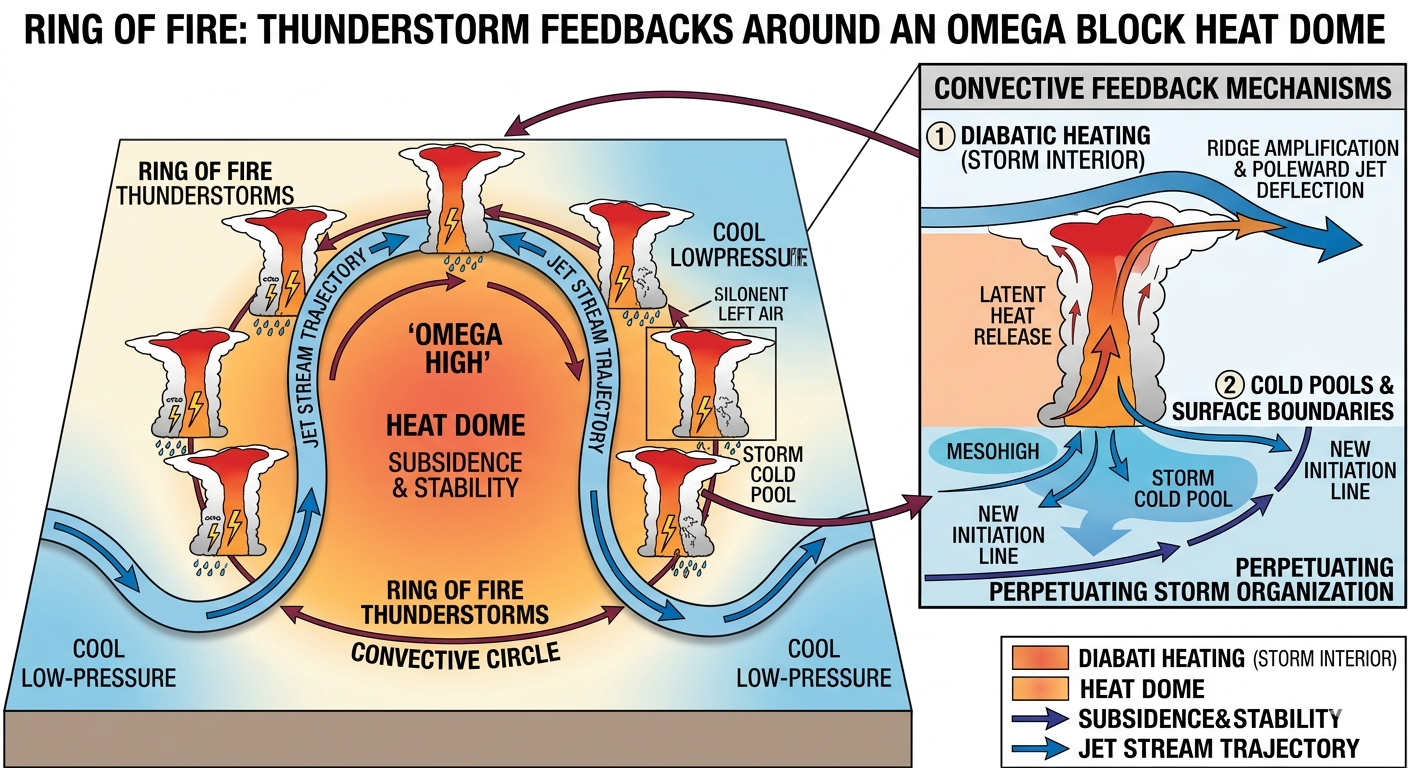
In meteorology, a Ring of Fire describes a recurring pattern in which clusters of powerful thunderstorms repeatedly develop and travel around the outer edge of a large, stationary high-pressure system. These storms form where extremely hot, dry air beneath the heat dome collides with cooler, moisture-rich air circulating around its perimeter.
The pattern becomes especially dangerous when the high-pressure system takes the form of an Omega block, named because the jet stream bends into a shape resembling the Greek letter Ω. In this configuration, the jet stream stalls, leaving a massive dome of sinking air trapped beneath the center of the ridge. The descending air continuously compresses and warms, suppressing cloud formation and preventing thunderstorms from developing over the core of the heat dome.
Unable to penetrate this atmospheric “cap,” storms are instead forced to travel around the edge of the dome, following the path of the jet stream. The result is a nearly continuous corridor of severe thunderstorms that circles the stagnant high-pressure system like a racetrack.
How the “Ring of Fire” Works
             JET STREAM / TRACK OF REPEATED THUNDERSTORMS

          ⚡      ⚡      ⚡      ⚡      ⚡      ⚡      ⚡
       ▲                                                ▼

  LOW PRESSURE      ←  RING OF FIRE  →        LOW PRESSURE
  Cool, Unstable Air                     Cool, Unstable Air

                ┌──────────────────────────────┐
                │      OMEGA HEAT DOME         │
                │                              │
                │   Sinking, Warming Air       │
                │   Clear Skies • Extreme Heat │
                │   Atmospheric "Cap"          │
                └──────────────────────────────┘
The Core: The Atmospheric Cap
At the center of the Omega block, air continuously sinks toward the surface. As it descends, it is compressed and warms adiabatically, evaporating clouds and stabilizing the atmosphere. This suppresses thunderstorm development, producing prolonged periods of cloud-free skies, intense solar heating, record-breaking temperatures, and worsening drought conditions.
The Ring: A Corridor of Explosive Storms
Along the outer edge of the heat dome, the hot, dry air meets cooler, more humid, and unstable air associated with surrounding low-pressure troughs. The sharp temperature and moisture contrasts create an ideal environment for rapid thunderstorm development. Abundant atmospheric moisture—enhanced by warmer oceans and increased evaporation—provides enormous latent heat that fuels severe convection. The result is repeated outbreaks of supercell thunderstorms, mesoscale convective systems (MCSs), derechos, torrential rainfall, large hail, and frequent lightning.
The “Train Track” Effect
Because Omega blocks often remain stationary for days or even weeks, the jet stream changes very little. New thunderstorms repeatedly form along the same atmospheric boundary and follow nearly identical paths. Meteorologists refer to this as training, because successive storms move over the same locations like railroad cars on a track. This dramatically increases the risk of catastrophic flash flooding, even when individual storms are moving rapidly.
Feedback Example
The Ring-of-Fire provides a simple, observable example of a positive feedback loop in the atmosphere. At its core is a convective circulation—a self-reinforcing loop driven by thermal energy that is increasingly amplified by a warming climate. As warmer air rises, it fuels stronger convection, transporting heat and moisture higher into the atmosphere. That energy is ultimately released in the form of lightning, thunder, intense rainfall, and powerful updrafts. In this way, the convective loop serves as a visible reminder of how additional heat in the climate system can translate into more energetic and destructive weather.
Environmental Impacts
| Region | Typical Weather | Primary Hazards |
|---|---|---|
| Under the Heat Dome | Persistent sunshine, sinking air, stagnant heat | Record-breaking temperatures, dangerous heat indices, drought, crop stress, wildfire risk |
| Along the Ring of Fire | Repeated severe thunderstorms and mesoscale convective systems | Derechos, destructive straight-line winds, large hail, prolific lightning, tornadoes, and catastrophic flash flooding |
As climate change intensifies heat waves and increases atmospheric moisture through the Clausius–Clapeyron relationship, Ring of Fire events are becoming increasingly energetic. The hotter the heat dome becomes, the greater the temperature contrast along its edge and the more water vapor is available to fuel deep convection. This creates a powerful positive feedback: stronger heat domes produce more intense thunderstorms, while the latent heat released by those storms can further reinforce the large-scale atmospheric circulation, increasing the persistence of both the heat dome and the surrounding Ring of Fire.
Lightning Feedbacks and Climate Change
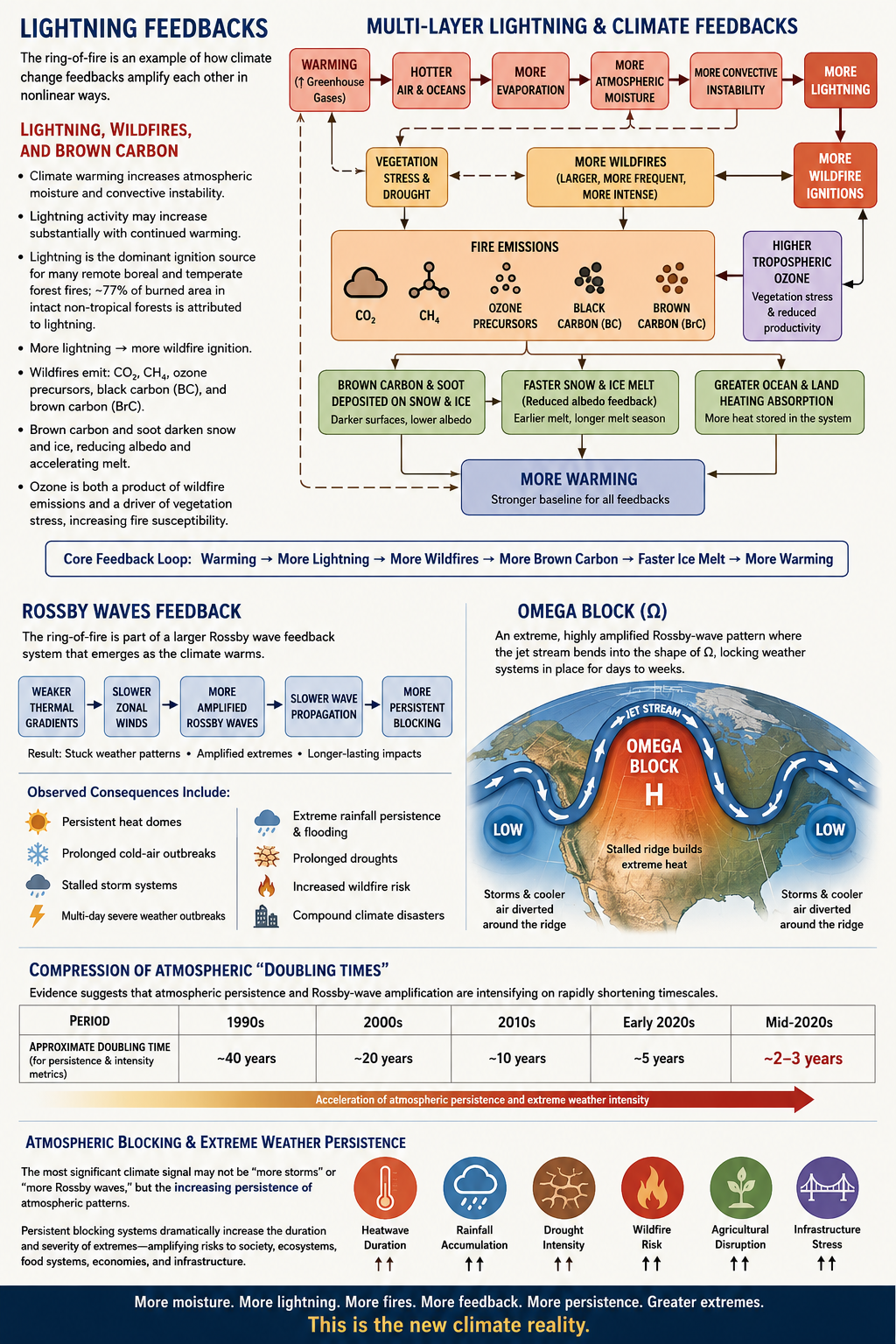
The Ring of Fire is an example of how Earth’s climate system is increasingly governed by interacting positive feedback loops rather than isolated events. Rising temperatures increase atmospheric moisture and instability, producing more lightning, larger wildfires, and greater emissions of greenhouse gases and light-absorbing aerosols. These processes reinforce one another, accelerating climate change.
Lightning, Wildfires, and Brown Carbon
As the atmosphere warms, evaporation increases according to the Clausius–Clapeyron relationship, allowing the atmosphere to hold approximately 7% more water vapor for every 1°C of warming. The additional moisture provides more latent heat to developing thunderstorms, increasing convective instability and the likelihood of lightning.
Multiple studies project that lightning activity will increase substantially as global temperatures continue to rise. This has consequences that extend far beyond severe weather.
Lightning is already the primary natural ignition source for many remote boreal and temperate forests. In intact non-tropical forests, approximately 77% of the burned area has been attributed to lightning-caused fires. As lightning becomes more frequent, wildfire ignitions are expected to increase, particularly in regions already stressed by prolonged heat and drought.
Wildfires release enormous quantities of:
- Carbon dioxide (CO₂)
- Methane (CH₄)
- Ozone precursors (NOₓ and VOCs)
- Black carbon (soot)
- Brown carbon (organic aerosols)
These emissions strengthen several reinforcing climate feedbacks.
Carbon dioxide and methane increase greenhouse warming. Nitrogen oxides and volatile organic compounds promote the formation of tropospheric ozone, which damages vegetation, reduces carbon uptake, and increases drought stress. Black carbon and brown carbon settle onto snow and ice, darkening their surfaces, lowering albedo, and accelerating melting. Earlier snowmelt exposes darker land and ocean surfaces that absorb even more solar energy, producing additional warming.
The result is a cascade of reinforcing feedback loops.
Major Lightning Feedback Loops
Global Warming
      │
      ▼
Warmer Air & Oceans
      │
      ▼
More Evaporation
      │
      ▼
More Atmospheric Moisture
      │
      ▼
Greater Convective Instability
      │
      ▼
More Thunderstorms
      │
      ▼
More Lightning
      │
      ├────────────────────────────────────────────────────────────┐
      ▼                                                            │
More Wildfire Ignitions                                             │
      │                                                            │
      ▼                                                            │
Larger & More Frequent Wildfires                                    │
      │                                                            │
      ├──────────────┬──────────────┬──────────────┬───────────────┐
      ▼              ▼              ▼              ▼               │
More CO₂        More CH₄      More Ozone      More Black & Brown Carbon
      │              │         Precursors             │
      ▼              ▼              │                 ▼
More Greenhouse  More Greenhouse    ▼         Lower Snow & Ice Albedo
   Warming          Warming    More Tropospheric      │
                                  Ozone              ▼
                                     │        Faster Ice Melt
                                     ▼              │
                            Vegetation Stress        ▼
                           Reduced Carbon Uptake  More Solar Absorption
                                     │              │
                                     ▼              ▼
                               Drier Forests ───────────────┐
                                     │                      │
                                     ▼                      │
                             Greater Fire Risk ◄────────────┘
                                     │
                                     ▼
                              More Wildfires
These pathways operate simultaneously, producing multiple reinforcing feedbacks:
- Warming → More Lightning → More Wildfires → More CO₂ → More Warming
- Warming → More Lightning → More Wildfires → More Methane → More Warming
- Warming → More Lightning → More Wildfires → More Brown Carbon → Lower Albedo → Faster Ice Melt → More Warming
- Warming → More Lightning → More Wildfires → More Black Carbon → Lower Albedo → More Warming
- Warming → More Lightning → More Wildfires → More Ozone → Vegetation Stress → More Wildfires
- Warming → More Drought → More Lightning Ignitions → More Wildfires → More Drought
Rather than acting independently, these feedbacks reinforce one another, creating an increasingly nonlinear climate system.
Rossby Wave Feedbacks
The Ring of Fire is itself a product of larger changes occurring within the Rossby wave circulation of the Northern Hemisphere.
Historically, the jet stream flowed progressively from west to east across North America. However, as Arctic amplification reduces the temperature difference between the Arctic and the mid-latitudes, the jet stream weakens and becomes increasingly sinuous.
The resulting changes include:
- weaker zonal winds,
- larger Rossby-wave amplitudes,
- slower wave propagation,
- greater atmospheric blocking,
- more persistent weather patterns.
These changes allow heat domes, droughts, and storm tracks to remain nearly stationary for days or weeks instead of moving steadily across the continent.
Rossby Wave Feedback
Global Warming
      │
      ▼
Arctic Amplification
      │
      ▼
Reduced Pole-to-Equator Temperature Gradient
      │
      ▼
Slower Jet Stream
      │
      ▼
Larger Rossby Waves
      │
      ▼
More Atmospheric Blocking
      │
      ▼
Persistent Heat Domes
      │
      ├──────────────┐
      ▼              ▼
Longer Droughts   Ring-of-Fire Thunderstorms
      │              │
      ▼              ▼
Greater Fire Risk  More Lightning
      │              │
      └───────► More Wildfires ◄──────────┘
                     │
                     ▼
                More Warming
Atmospheric Persistence and the Compression of Climate Timescales
Perhaps the most important emerging signal is not simply an increase in storms or heat waves, but the increasing persistence of atmospheric circulation patterns.
As blocking events become more common, weather systems remain locked over the same regions for longer periods. Heat waves last longer, rainfall accumulates over the same watersheds, droughts deepen, wildfire seasons lengthen, and infrastructure is exposed to prolonged stress.
Evidence also suggests that the effective timescale over which atmospheric persistence intensifies is shortening.
| Period | Approximate Effective Doubling Time |
|---|---|
| 1990s | ~40 years |
| 2000s | ~20 years |
| 2010s | ~10 years |
| Early 2020s | ~5 years |
| Mid-2020s | ~2–3 years |
If this trend continues, atmospheric circulation may increasingly favor long-lived, self-reinforcing extremes rather than isolated weather events. In this emerging regime, lightning, wildfire, Rossby-wave amplification, atmospheric blocking, drought, ozone production, and cryosphere loss no longer operate as separate phenomena—they become interconnected components of a rapidly accelerating climate feedback network.
Conclusion
Climate change is often described as a gradual increase in global average temperature. While this description is technically correct, it fails to capture the fundamental transformation now occurring within the Earth’s climate system.
The evidence suggests that climate change is increasingly becoming a problem of interacting feedback loops rather than isolated environmental changes. Rising greenhouse gas concentrations initiate warming, but the warming itself activates numerous secondary processes—including increased atmospheric moisture, stronger convection, more lightning, larger wildfires, greater tropospheric ozone formation, accelerated snow and ice loss, enhanced water vapor, and increasingly persistent atmospheric blocking. Each of these processes amplifies others, producing a climate system whose behavior is increasingly nonlinear.
The Ring of Fire thunderstorm pattern illustrates this transition. What was once considered simply a recurring weather phenomenon now demonstrates how stalled Rossby waves, persistent heat domes, enhanced atmospheric moisture, and explosive convection combine to produce repeated outbreaks of destructive weather. These storms are not isolated anomalies; they are manifestations of a climate system operating under stronger feedbacks than those that characterized the twentieth century.
The same interconnected processes extend across the Earth system. Increased lightning ignites more wildfires. Wildfires emit greenhouse gases, ozone precursors, and light-absorbing aerosols that accelerate warming and cryosphere loss. Tropospheric ozone weakens vegetation, reducing the land’s capacity to absorb carbon while increasing susceptibility to drought and fire. Declining snow and ice reduce planetary albedo, allowing more solar energy to be absorbed by the Earth’s surface. Meanwhile, Arctic amplification weakens the pole-to-equator temperature gradient, slowing the jet stream and increasing the persistence of atmospheric blocking patterns that intensify heat waves, droughts, floods, and wildfire conditions.
Perhaps the most significant finding is not that individual extreme events are becoming more severe, but that the duration and persistence of atmospheric patterns are increasing. Weather systems that historically moved across continents in a matter of days are increasingly becoming locked in place. The resulting accumulation of heat, rainfall, drought, and ecological stress transforms ordinary weather hazards into compound disasters whose impacts greatly exceed the sum of their individual components.
Viewed together, these observations suggest that the Earth’s climate is undergoing a transition from a system dominated primarily by external forcing to one increasingly shaped by internally generated positive feedbacks. The atmosphere, oceans, cryosphere, and biosphere are no longer responding independently; they are becoming more tightly coupled, allowing disturbances in one component to propagate rapidly throughout the entire climate system.
Understanding these interactions is essential for improving climate projections. Traditional approaches that evaluate individual feedbacks in isolation may underestimate future risks if they fail to capture the compounding effects that emerge when multiple feedbacks operate simultaneously. Future research should therefore place greater emphasis on coupled Earth-system dynamics, atmospheric persistence, feedback interactions, and potential tipping behavior.
The challenge facing society is not merely adapting to a warmer climate, but adapting to a climate that is becoming increasingly dynamic, interconnected, and persistent. As feedback loops strengthen, the distinction between weather and climate becomes increasingly blurred, with prolonged heat waves, wildfire outbreaks, extreme rainfall, and atmospheric blocking evolving from episodic events into defining characteristics of a new climatic regime.
Recognizing climate change as a network of interacting feedbacks rather than a collection of isolated trends provides a more complete framework for understanding the accelerating pace of observed change. It is this systems-level perspective that will be essential for improving prediction, informing policy, strengthening resilience, and reducing the long-term risks posed by a rapidly evolving Earth system.