Tipped Tipping Points, Feedback Loops, and the Domino Effect
Feedback Loops → Tipping Points → Acceleration → Domino Effect
Feedback loops amplify climate change and can push interconnected Earth systems past critical tipping points. As tipping points are crossed, they can trigger additional feedback loops and destabilize other climate systems. This cascading “Domino Effect” compresses timescales, accelerates change, and increases the risk of rapid, nonlinear climate transformations.
By Daniel Brouse and Sidd Mukherjee
September 29, 2023, and November 12, 2023
Tipping points are Critical Milestones that directly impact the rate of acceleration in climate change by multiplying the number and intensity of feedback loops.
An Accessible Introduction to Advanced Anthropogenic Global Warming and the Domino Effect
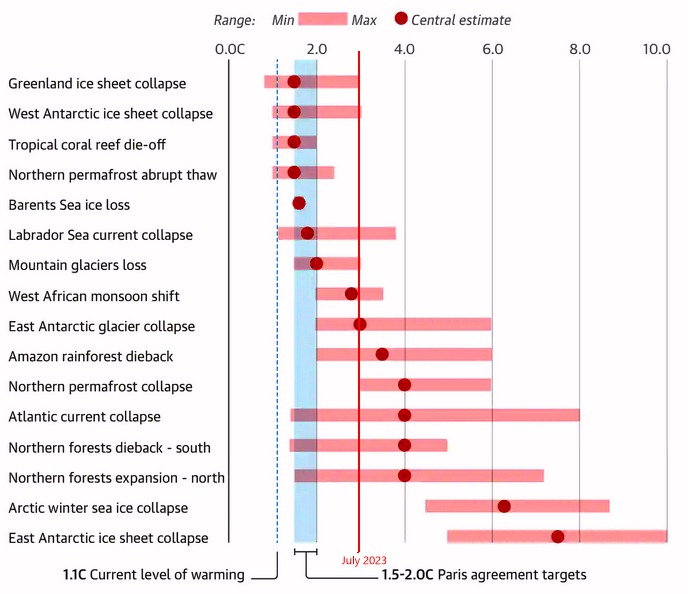
Identifying and understanding these tipping points is crucial for climate science and policymaking. Crossing multiple tipping points could lead to a domino effect, resulting in a much more rapid and severe climate change than currently projected.
Push a glass toward the edge of a table and eventually it will fall off on its own. No matter how slowly or meticulously you push… no matter how you weight or fill the glass, it will reach a tipping point and fall off before being pushed completely off the table. No matter whether you believe the glass is half-empty or half-full, when the tipping point is reached it will plummet out-of-control to its end. This is science not fate, faith, nor belief. Human induced climate change has resulted in environmental tipping points being breached.
Tipping points, when crossed, trigger self-sustaining feedback loops that are no longer dependent on human activity. Similar to when a domino topples over hitting two more dominoes that in turn fall hitting more dominoes. Thus, the name The Domino Effect. In literature, this is usually called:
- cascading tipping points
- tipping cascades
- coupled nonlinear thresholds
It can also be visualized as The Snowball Effect. A tipping point is like a snowball rolling down a hill growing in mass and velocity (momentum). When a tipping point is crossed, it results in cumulative and reinforced global warming.
A look at seven of the nine tipping points crossed that show the proverbial snowball is already rolling. The first dominoes have fallen and will continue to knock down more tiles with each escalating step.
- Mountain Glacier Loss
- Greenland Ice Sheet Collapse
- Antarctic Ice Sheet Collapse
- Collapse of AMOC (Atlantic Meridional Overturning Circulation)
- Amazon Rainforest Dieback
- Coral Reef Die-Off
- Northern Permafrost Collapse
Crossing even a single tipping point is alarming. For instance, crossing the tipping point for ‘mountain glacier loss‘ has immediate consequences: millions of people in Europe will be impacted by the lack of fresh water. Billions of people that live along coasts will be impacted by the saline infiltration and eventually by the submerging of their property. In September of 2022, UNESCO reported accelerated melting of glaciers in World Heritage sites, with glaciers in a third of sites set to disappear by 2050. In September of 2023, the GLAMOS glacier monitoring center found 10% of Swiss glaciers had disappeared in the last 2 years. They do not expect any Swiss glaciers will be left by 2050 no matter what actions are taken. If extreme measures are taken, they anticipate we may be able to save some polar glaciers.
This in and of itself should be alarming; however, it gets worse. Tipping points are parts of feedback loop systems. The ice-albedo feedback loop is an expression of the ability of surfaces to reflect sunlight (heat from the sun). Any loss of ice over a darker surface means the surface will absorb more heat and reflect less heat. This process makes the Earth warmer causing more loss of ice, which in turn causes more warming of the Earth. So, yes, the mountain ice tipping point is quite alarming for both its immediate impact as well as its self-sustaining growth to global warming; but wait, it gets more alarming. The increasing temperatures due to crossing a tipping point cause other tipping points to be toppled (The Domino Effect).
Update on Interactions and Feedbacks: An example of this is the converging collapse of the AMOC and the jet streams. This acceleration is driven by non-linear system failures across the AMOC, jet streams, and hydrological cycles — dynamics that traditional climate models have consistently underestimated. These shifts are not theoretical predictions for the distant future; they are being measured in real time right now.
By the Autumn of 2023, it had become evident the West Antarctic and Greenland ice sheets will completely melt. The process is irreversible and inevitable. The rain intensity is increasing faster today than ever known. The cool water from the melting ice at the poles is being drawn toward the center of the Earth and getting warmed to record high temperatures. The warm, moist air is circulating and moving over land. These changes in climate systems will cause other areas to experience unprecedented drought. We expect sea level rise will total about 270 feet over the next several millennia. It is episodic, and in the fast bits it can go up 3 feet every twenty years for five hundred years. The melting Arctic and Antarctic have multiple feedback loops including: enhanced oceanic heating and ice-albedo, Planck feedback, lapse-rate feedback, and cloud feedback.
The tipping point for the collapse of AMOC (Atlantic Meridional Overturning Circulation) was thought to be centuries away, at the earliest. In July of 2023, the study Warning of a forthcoming collapse of the Atlantic meridional overturning circulation was published in the journal Nature Communications. “Here we provide statistical significance and data-driven estimators for the time of tipping. We estimate a collapse of the AMOC to occur around mid-century (2025-2095) under the current scenario of future emissions.” The collapse is likely to cause faster sea level rise on the east coast of the US, more severe storms in Europe, and increasing drought in the Sahel in Africa. “From the study of past climate, we know changes in the AMOC have been some of the most abrupt and impactful events in the history of climate,” said Prof. Stefan Rahmstorf, at the Potsdam Institute for Climate Impact Research in Germany and world leading oceanographer. During the last Ice Age, winter temperatures changed by up to 10C within three years in some places. “We are dealing with a system that in some aspects is highly non-linear, so fiddling with it is very dangerous, because you may well trigger some surprises,” he said. “I wish I knew where this critical tipping point is, but that is unfortunately just what we don’t know. We should avoid disrupting the AMOC at all costs. It is one more reason why we should stop global warming as soon as possible.” A feedback loop created by the AMOC tipping point would cause a disruption of weather systems and circulation. The result would be the loss of naturally occurring carbon sinks. One scenario is desertification of the Amazon rainforest. In 2023, the Amazon River and the Rio Negro set record low levels.
The tipping point / feedback loop problem is very complex (chaos theory) and exponentially alarming. Yet another tipping point appears to have been triggered before 2024 — Amazon Rainforest Dieback. The Amazon is often referred to as ‘the lungs of our planet.’ Not only does the Amazon suck in huge quantities of CO2 and breath out O2, but the Amazon soils also store huge amounts of CO2. The desertification of the Amazon would result in a release of the carbon as the soils disappeared.
1) part of July was spent at record temperatures +3C
2) the collapse of the Amazon rainforest is likely to happen between +2 – 4C. The collapse of the Amazon is expected to occur because of changing weather patterns and circulation that result in drought.
3) Brazil set up a task force for “unprecedented drought in the Amazon”
Low river levels and hotter waters have killed masses of fish seen floating on river surfaces, contaminating the drinking water, Environment Minister Marina Silva said. “We have a very worrying situation. This record drought has disrupted river transport routes (dropping 30 cm / day) threatening food and water shortages, and a large fish mortality is already beginning.” This was the effect of a periodic El Nino mixing with changes in weather patterns brought by global warming. “We are seeing a collision of two phenomena, one natural which is El Nino and the other a phenomenon produced by humans, which is the change in the Earth’s temperature.” Worsened by climate change, this combination has caused drought not seen before in the Amazon and “is incomparably stronger and could happen more frequently.”
The average temperature for Brazil had been above the historical average from July through October of 2023. Rio de Janeiro recorded 42.5C on November 12, 2023 (a record for November) and high humidity on the 14th meant that it felt like 58.5C, municipal authorities said. Deadly humid heat is the greatest short term climate change risk to human health. On November 17, “a young Brazilian fan of US singer Taylor Swift died in Rio de Janeiro after falling ill inside the sweltering stadium where the superstar’s concert was held, amid a record-breaking heatwave across large swathes of Brazil,” as reported by ABC. “The show took place on the same day that Rio recorded its highest-ever heat index reading, which combines temperature and humidity, at 59.3 degrees Celsius (139 degrees Fahrenheit).”
Brazil’s Pantanal wetlands are famous for their paradise of biodiversity. There were 2,387 fires in the Pantanal in the first 13 days of November 2023, an increase of more than 1,000 percent from the entire month of November last year, according to satellite monitoring by Brazilian space research agency INPE. “The situation is completely out of control. And between the heatwave and the wind, it’s only going to get worse,” says biologist Gustavo Figueiroa, head of the environmental group SOS Pantanal.
Rio Negro Case Study: Amazon Dieback under Climate Change
What do you know about the Rio Negro as it relates to climate change and carbon sinks? The Rio Negro gets its name from its color. The black water is caused by highly acidic and carbon rich water. One scientist that lives on the river called it similar to Coca-cola. In 2023, the Rio Negro recorded record low levels.
Most of the carbon discharged into the water helps the carbon to eventually sink in the ocean as a literal carbon sink. The lack of rain and drought conditions result in more vegetation dying and contribute to a feedback loop — more plants die from less rain… and there is less rain to wash the excess carbon to the bottom of the ocean… resulting in more global warming… resulting in more dead vegetation.
A study of Dissolved Organic Carbon (DOC) in South American rivers found, “Small and steep catchments hosting organic rich forest soils and peatlands were the most sensitive and showed the highest and fastest DOC release if evaluated on a per unit area basis. Here, rain events caused a rapid exponential increase in DOC release….”
The study Effects of natural light and depth on rates of photo-oxidation of dissolved organic carbon in a major black-water river, the Rio Negro, Brazil found under natural sunlight during the dry seasons rates of complete photo-oxidation and changes in absorbance indices decayed exponentially. The deeper the water the less CO2 emissions created and the more carbon is sequestered at the bottom of the ocean.
The Amazon river was also at record lows during 2023. The drought conditions in the Amazon rain forest are unusual. We are watching the Rio Negro and Amazon Rivers as a case study for the slowing and/or collapse of the AMOC, the die-back of the Amazon, and the carbon cycle.
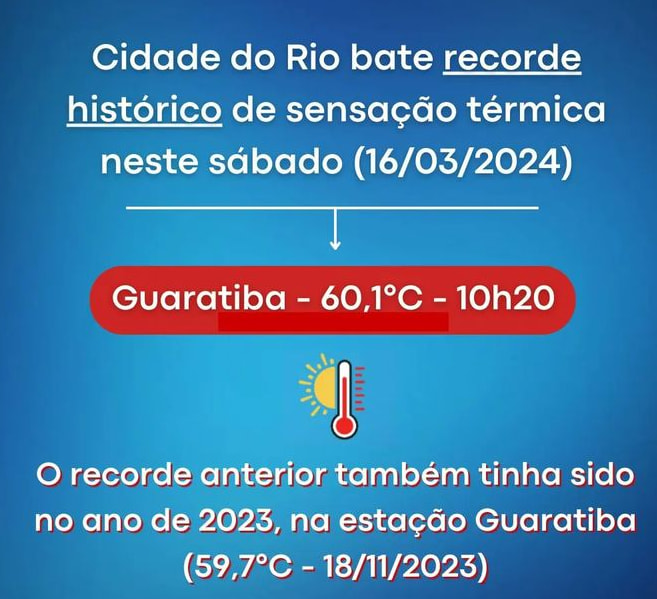
From March 16 through 18, 2024, Brazil experienced a severe heatwave, setting new records in Rio de Janeiro with a wet-bulb temperature reaching 62.3 degrees Celsius (144.1 degrees Fahrenheit). The wet-bulb temperature reflects the body’s cooling mechanism through sweat evaporation. Higher heat and humidity levels, indicated by the heat index, impede sweat evaporation. A wet-bulb temperature of 35℃ (95℉) at 100% humidity, or 115℉ at 50% humidity, represents the upper limit of safety, beyond which the human body cannot effectively regulate its core temperature through sweat evaporation.
On March 23, an atmospheric river event brought heavy rains to Brazil’s Rio de Janeiro state, resulting in at least nine fatalities, primarily in Petropolis, which bore the brunt of the impact. An astonishing 270 mm (11 inches) of rain fell within a 24-hour period, significantly affecting the region and leading to numerous incidents, including landslides and house collapses.
Example: Amazon Rainforest Dieback (2026)
Coral Reefs’ Tipping Point
Coral reefs confront unprecedented challenges arising from various stressors, many of which are directly tied to human activities. Some of these stressors possess critical tipping points, surpassing which can lead to the collapse of coral ecosystems. According to the European Geosciences Union’s statement on January 2, 2024, specific tipping points include a temperature increase of 1.2℃ above pre-industrial levels and atmospheric CO2 concentrations exceeding 350 parts per million. Disturbingly, as of February 2024, the Earth’s yearly average temperature has already risen to +1.5℃ and CO2 to 425 ppm, underscoring the urgency of addressing climate-related threats to coral reefs.
The cumulative impact of these climate-related stressors poses a severe threat to coral reefs worldwide. It’s crucial to address the root causes of climate change and implement conservation measures to enhance the resilience of coral ecosystems. Protection of coral reefs involves both local and global efforts, including sustainable fishing practices, marine protected areas, reducing greenhouse gas emissions, and promoting coral reef restoration initiatives.
Coral reef ecosystems can be influenced by several feedback loops that contribute to reaching tipping points. These feedback loops often involve interactions between various environmental stressors and the responses of coral reefs.
Conclusion
The Domino Effect is also known as “tipping cascades” in climate science. Tipping cascades have emerged between biogeophysical and social-ecological systems. This Domino Effect is causing climate change to accelerate at an exponential rate.
The carbon sequestration from dissolved organic carbon is only one of the many carbon sinks in the Amazon. It is likely Amazon droughts will become more frequent and intense resulting in decarbonization at an exponential rate. The collapse of the AMOC will hasten the collapse of the Amazon. The collapse of the Amazon will hasten the collapse of the AMOC.
Feedback loops and tipping points are parts of an equation that determine the rate of acceleration in climate change. Triggering these tipping points results in the CO2 stored in nature to be released without the assistance of humans. Though we do not know how much carbon is stored in nature, it would be reasonable to assume that the temperature could be pushed from 3 degrees to 6 degrees above pre-industrial levels. Humans cannot thrive above a rise of 1.5 degrees. Much of the Earth will be uninhabitable if the temperature rises an additional 6 degrees Celsius. If humans also add 3 degrees Celsius, the temperature and humidity will approach a wet-bulb temperature that will not sustain human life.
For the first time in human history, global warming is going to continue no matter what humans do. Even if humans stopped their greenhouse gas emissions today, humans have invoked nature’s greenhouse gas emissions. Nevertheless, the sooner humans stop their emissions, the better. In addition, humans must adapt their habitat to remove, reduce, and hinder nature’s greenhouse gas emissions.
Addendum: Climate Change Review 2023
Sidd said, “Do you remember back in the early 2000’s when we thought we wouldn’t live to see the extreme changes due to global warming?”
Daniel replied, “I think 2023 is the most significant year so far. We saw confirmation of tipping points being crossed for Mountain Glacier Loss, Greenland Ice Sheet Collapse, Antarctic Ice Sheet Collapse, and potentially the Collapse of AMOC.”
Sidd continued, “We already knew that. It was Canada catching on fire that I could not believe. I never thought I’d live to see the day.”
Daniel asked, “Do you think the permafrost and peatlands will have zombie fires and cause the permafrost tipping point?”
Sidd responded, “Yes. They are gone, too. We already know from the permafrost peatland fires in Siberia.”
Daniel ponders, “Hmmmm… I guess that means my plan went up in smoke? My worst case scenario / last resort emergency plan was to escape to Canada.”
NASA reported: Wildland fire experts have described Canada’s 2023 fire season as record-breaking and shocking. Over the course of a fire season that started early and ended late, blazes have burned an estimated 18.4 million hectares. Hundreds of fires exceeded 10,000 hectares (39 square miles), large enough to be considered “megafires.” These megafires were also unusually widespread this season, charring forests from British Columbia and Alberta in the west to Quebec and the Atlantic provinces in the east to the Northwest Territories and the Yukon in the north.
Forest fires cause a carbon feedback loop. The carbon emissions of Canada’s fires outweighed the combined emissions from its oil and gas, transport and agriculture sectors. The fires also cause the melting of the permafrost and zombie fires to burn in the permafrost. The permafrost collapse is a self-sustaining feedback loop/tipping point. As the permafrost melts, the peatlands emit CO2 and methane. The increase in CO2 and methane results in more warming that results in more peatland emissions. A third feedback loop is created with lightning strikes. The study Forests at Risk Due to Lightning Fires found a sensitivity of extratropical intact forests to potential increases in lightning fires, which would have far-reaching consequences for terrestrial carbon storage and biodiversity. The results show that, on a global scale, lightning is the primary ignition source of fires in temperate and boreal forests. Global warming causes more extreme weather events and conditions for lightning creating more forest fires that create more warming and more lightning strikes.
The study Wildfire as a major driver of recent permafrost thaw in boreal peatlands published in the Journal Nature Communications found wildfires have caused a quarter of permafrost thaw (2,000 square kilometres) in Western Canada’s boreal peatlands over the past 30 years. “Historically, permafrost in this area underwent a natural cycle of thawing and reforming, but given current climate conditions and projections for the future, this fire-induced thaw appears to be irreversible,” said Carolyn Gibson, who conducted the research.
On January 1, 2024, the article, Why Are Alaska’s Rivers Turning Orange?, was published in Scientific America. “Streams in Alaska are turning orange with iron and sulfuric acid. Scientists who have studied these rusting rivers agree that the ultimate cause is climate change. Kobuk Valley National Park has warmed by 2.4 degrees Celsius (4.32 degrees Fahrenheit) since 2006 and could get another 10.2 degrees C hotter by 2100, a greater increase than projected for any other national park. The heat may already have begun to thaw 40 percent of the park’s permafrost, the layer of earth just under the topsoil that normally remains frozen year-round. McPhee wanted to protect the Salmon River because humans had ‘not yet begun to change it.’ Now, less than 50 years later, we have done just that. The last great wilderness in America, which by law is supposed to be ‘untrammeled by man,’ is being trammeled from afar by our global emissions.”
Conclusion
Feedback Loops → Tipping Points → Acceleration → Domino Effect
Feedback loops amplify climate change and can push interconnected Earth systems past critical tipping points. As tipping points are crossed, they can trigger additional feedback loops and destabilize other climate systems. This cascading “Domino Effect” compresses timescales, accelerates change, and increases the risk of rapid, nonlinear climate transformations.
The current status of the most critical global and regional climate tipping points is structured below by their level of immediacy.
🚨 Breached or Actively Tipping
These systems have crossed or are currently crossing their critical thresholds, locked into self-sustaining degradation even if global temperatures stabilize. [1]
- Low-Latitude Coral Reefs
- Threshold: 1.2°C to 1.5°C of warming.
- Current Status: Passed / Tipping. Over 80% of global reefs have suffered unprecedented thermal bleaching events. Scientists officially classify warm-water coral reefs as the first major global tipping point to be actively breached, putting them on a path toward near-total ecological collapse. [1, 2, 3]
- Greenland Ice Sheet
- Threshold: ~1.5°C of warming.
- Current Status: Accelerating Collapse. Massive, self-reinforcing ice loss is underway due to the “elevation-feedback” effect (as the ice melts, its surface sinks into warmer, lower-altitude air). Complete melting is likely locked in, though the final sea-level rise of ~7 meters will take centuries to fully play out. [1, 2, 3]
- West Antarctic Ice Sheet
⚠️ Imminent Danger (1.5°C – 2.0°C)
These systems are facing severe destabilization and could tip if global warming peaks or stabilizes closer to 2°C. [1, 2]
- Boreal Permafrost (Abrupt Thaw)
- Atlantic Meridional Overturning Circulation (AMOC)
📉 Heightened Risk (Deforestation & Climate Pressures)
These systems are approaching their physical climate limits, but are heavily accelerated by direct human destruction.
- Amazon Rainforest
- Threshold: ~2.0°C to 3.5°C of global warming, or 20–25% total deforestation.
- Current Status: Fragmenting. The combined stress of global warming, severe regional droughts, and active deforestation has degraded nearly half the forest. Parts of the Southern Amazon have already transitioned from a carbon sink to a carbon source, risking a large-scale shift into a dry savanna. [1, 2]
Climate tipping points do not operate in isolation; they are deeply interconnected. Leading research from the Potsdam Institute for Climate Impact Research (PIK) and the Global Tipping Points Report confirms that destabilizing one system actively lowers the threshold required to trigger another. [1, 2, 3]
This interconnectedness creates a dangerous “domino effect” (or tipping cascade), where localized collapses merge into a self-sustaining global feedback loop. The primary avenues of these climate cascades operate through specific environmental channels. [1, 2, 3]
[ Greenland Ice Sheet Melt ] ──(Massive Freshwater Influx)──> [ AMOC Weakens / Collapses ]
                                                                       │
             ┌─────────────────────────────────────────────────────────┴────────────────────────────────────────────────────────┐
             ▼                                                                                                                  ▼
[ Southern Ocean Warming ]                                                                                             [ South American Monsoon Disruption ]
             │                                                                                                                  │
             ▼                                                                                                                  ▼
[ West Antarctic Ice Sheet Melt ]                                                                                      [ Amazon Rainforest Savannization ]
Climate tipping points are critical thresholds within the Earth system where a small additional increase in temperature can spark rapid, self-reinforcing, and often irreversible changes. [1]
The landmark Global Tipping Points Report, compiled by an international coalition of over 160 scientists, confirms that global warming has officially pushed major Earth systems to the brink. Because global temperatures have consistently breached the 1.5°C threshold over recent multi-year periods, several systems are transitioning from “at risk” to actively collapsing. [1, 2, 3, 4]
The current status of the most critical global and regional climate tipping points is structured below by their level of immediacy.
🚨 Breached or Actively Tipping
These systems have crossed or are currently crossing their critical thresholds, locked into self-sustaining degradation even if global temperatures stabilize. [1]
- Low-Latitude Coral Reefs
- Threshold: 1.2°C to 1.5°C of warming.
- Current Status: Passed / Tipping. Over 80% of global reefs have suffered unprecedented thermal bleaching events. Scientists officially classify warm-water coral reefs as the first major global tipping point to be actively breached, putting them on a path toward near-total ecological collapse. [1, 2, 3]
- Greenland Ice Sheet
- Threshold: ~1.5°C of warming.
- Current Status: Accelerating Collapse. Massive, self-reinforcing ice loss is underway due to the “elevation-feedback” effect (as the ice melts, its surface sinks into warmer, lower-altitude air). Complete melting is likely locked in, though the final sea-level rise of ~7 meters will take centuries to fully play out. [1, 2, 3]
- West Antarctic Ice Sheet
⚠️ Imminent Danger (1.5°C – 2.0°C)
These systems are facing severe destabilization and could tip if global warming peaks or stabilizes closer to 2°C. [1, 2]
- Boreal Permafrost (Abrupt Thaw)
- Atlantic Meridional Overturning Circulation (AMOC)
📉 Heightened Risk (Deforestation & Climate Pressures)
These systems are approaching their physical climate limits, but are heavily accelerated by direct human destruction.
- Amazon Rainforest
- Threshold: ~2.0°C to 3.5°C of global warming, or 20–25% total deforestation.
- Current Status: Fragmenting. The combined stress of global warming, severe regional droughts, and active deforestation has degraded nearly half the forest. Parts of the Southern Amazon have already transitioned from a carbon sink to a carbon source, risking a large-scale shift into a dry savanna. [1, 2]
🛡️ Stable but Tracking Downward (>2.0°C)
These tipping points require much higher levels of sustained global heating to trigger total collapse, but they are beginning to show regional warning signs.
- Boreal Forests (Dieback & Shift)
- Threshold: ~3.5°C to 4.0°C.
- Current Status: Distressed. While the core biome remains intact, its southern boundaries are experiencing severe dieback due to unprecedented wildfire frequency and insect infestations. Simultaneously, the forest is migrating further north into the warming Arctic tundra. [1, 2, 3, 4]
- East Antarctic Ice Sheet
- Threshold: >3.0°C of warming.
- Current Status: Mostly Stable. As the largest ice mass on Earth, it remains highly resilient. However, subglacial marine basins in the eastern region are beginning to show localized vulnerabilities to warming ocean waters. [1]
Climate tipping points do not operate in isolation; they are deeply interconnected. Leading research from the Potsdam Institute for Climate Impact Research (PIK) and the Global Tipping Points Report confirms that destabilizing one system actively lowers the threshold required to trigger another. [1, 2, 3]
This interconnectedness creates a dangerous “domino effect” (or tipping cascade), where localized collapses merge into a self-sustaining global feedback loop. The primary avenues of these climate cascades operate through specific environmental channels. [1, 2, 3]
[ Greenland Ice Sheet Melt ] ──(Massive Freshwater Influx)──> [ AMOC Weakens / Collapses ]
                                                                       │
             ┌─────────────────────────────────────────────────────────┴────────────────────────────────────────────────────────┐
             ▼                                                                                                                  ▼
[ Southern Ocean Warming ]                                                                                             [ South American Monsoon Disruption ]
             │                                                                                                                  │
             ▼                                                                                                                  ▼
[ West Antarctic Ice Sheet Melt ]                                                                                      [ Amazon Rainforest Savannization ]
🌊 The Ocean Conveyor Cascade (Cryosphere ➔ Oceans)
The Greenland Ice Sheet acts as the primary global “initiator” for domino effects. [1, 2]
- The First Domino: As global warming accelerates the melting of the Greenland Ice Sheet, gigatons of cold, fresh water pour into the North Atlantic. [1, 2]
- The Cascade: This freshwater influx dilutes the salinity of the ocean, making the water less dense. Because it cannot sink as easily, it slows down the Atlantic Meridional Overturning Circulation (AMOC). [1, 2]
- The Next Domino: A weakened AMOC retains excess heat in the Southern Hemisphere ocean currents. This trapped, subsurface heat directly attacks the grounding lines of the West Antarctic Ice Sheet, accelerating its collapse from underneath. [1, 2]
🌪️ The Global Weather Seesaw (Oceans ➔ Biosphere)
A disruption to the Atlantic ocean currents immediately translates into a global atmospheric crisis.
- The First Domino: The slowing or eventual collapse of the AMOC shifts global wind patterns and thermal bands southward. [1, 2]
- The Cascade: This shift alters the trajectory of the South American monsoon system. It deprives northern and western South America of vital seasonal rainfall. [1, 2]
- The Next Domino: Deprived of moisture and battered by rising temperatures, the Amazon Rainforest experiences severe drought. This accelerates its transition from a dense, carbon-absorbing jungle into a dry, fire-prone savanna (savannization). [1]
🌡️ The Arctic “Doom Loop” (Albedo ➔ Greenhouse Gases)
The northern high latitudes are experiencing the fastest self-reinforcing temperature acceleration on Earth. [1]
- The First Domino: As Arctic sea ice melts, dark ocean water replaces highly reflective white ice. This drop in “albedo” means the Arctic absorbs significantly more solar radiation, warming the region up to four times faster than the global average. [1]
- The Cascade: This amplified regional heat triggers the rapid, abrupt thawing of the Boreal Permafrost. [1]
- The Next Domino: Deep permafrost thaws expose organic matter that has been frozen for millennia, releasing immense amounts of methane and carbon dioxide into the atmosphere. These greenhouse gases trap more global heat, driving the global temperature up and feeding back into the Greenland and Arctic ice melt loops. [1, 2]
The Ultimate Risk: “Hothouse Earth”
The overarching fear among climate scientists is that these individual cascades will eventually link up. If the collective feedback loops generate more warming than baseline human emissions, the planet could drift into a self-sustaining “Hothouse Earth” trajectory. In this scenario, the global climate system stabilizes at a much higher temperature baseline, regardless of human carbon reduction efforts. [1]
Would you like to examine how scientists map the mathematical probability of these cascades, or explore the “positive tipping points” (like clean energy market adoption) that could spark a counter-cascade to prevent this? [1, 2]
Analyzing these nine specific tipping points reveals a system heavily weighted toward the North Atlantic and global cryosphere (ice systems). Rather than independent disasters, these nine elements function as a highly sensitive planetary gear system where the acceleration of one system mechanically forces the movement of the next.
Analyzing their structural classifications, estimated temperature thresholds, and specific cascading pathways reveals how they interact. [1]
📊 Structural Matrix of the 9 Tipping Points
| Tipping Element [1, 2, 3, 4, 5, 6, 8, 9, 10, 11] | Structural System | Estimated Threshold | Current Scientific Risk Assessment |
|---|---|---|---|
| Greenland Ice Sheet | Cryosphere (Ice) | ~1.5°C (Range: 0.8–3.0°C) | Actively Tipping; locked into irreversible elevation-feedback loops. |
| West Antarctic Ice Sheet | Cryosphere (Ice) | ~1.5°C (Range: 1.0–3.0°C) | Actively Tipping; marine glacier grounding lines are in retreat. |
| Boreal Permafrost Collapse | Carbon Cycle / Biosphere | ~1.5°C (Range: 1.0–2.3°C) | High Risk; abrupt localized thermal thaws are accelerating. |
| Labrador-Irminger Seas (SPG) | Ocean Circulation | ~1.8°C (Range: 1.1–3.8°C) | Imminent Threat; deep convection currents are rapidly freshening. |
| Arctic Winter Sea Ice Collapse | Cryosphere (Ice) | ~2.0°C to 2.5°C | Accelerating; winter structural thinning reduces system resilience. |
| Amazon Rainforest Dieback | Biosphere / Ecosystem | ~2.0°C (Combined with 20% deforestation) | Fragmenting; southern sectors have transitioned into carbon sources. |
| East Antarctic Subglacial Basins | Cryosphere (Ice) | ~3.0°C (Range: 2.0–6.0°C) | Tracking Downward; marine-grounded basins show localized vulnerability. |
| AMOC Collapse | Ocean Circulation | ~4.0°C (Range: 1.4–8.0°C) | Weakening; tracked at its weakest state in over 1,000 years. |
| East Antarctic Ice Sheet | Cryosphere (Ice) | ~7.5°C (Core Biome resilience) | Spatially Resilient; stable core, but tracking multi-millennial loss. |
🔄 The Three Primary Domino Vectors
The nine elements you listed feed directly into three devastating cascading loops.
1. The North Atlantic Freshening Cascade
This loop shows how the partial collapse of regional ice directly kills global ocean circulation.
- The Trigger: Accelerated meltwater from the Greenland Ice Sheet introduces immense volumes of buoyant fresh water into the subpolar North Atlantic. [1]
- The Secondary Collapse: This localized dilution forces the immediate Labrador-Irminger Seas/SPG Convection Collapse by blocking the heavy surface water from sinking. [1, 2]
- The Global Terminal Point: The failure of this local subpolar pump starves the overarching Atlantic Meridional Overturning Circulation (AMOC), driving it toward complete collapse. [1, 2]
2. The Trans-Planetary Thermal Teleconnection
When ocean currents stop, the physical relocation of heat destabilizes the opposite side of the earth.
- The Trigger: The slowing of the AMOC creates a thermal backlog, trapping massive amounts of solar heat in the South Atlantic and Southern Oceans.
- The Antarctic Response: This trapped southern heat destabilizes the marine grounding lines of the West Antarctic Ice Sheet, triggering rapid collapse.
- The Multi-Century Threat: Unchecked Southern Ocean heating propagates deep inland, eventually threatening the East Antarctic Subglacial Basins and reducing the thousands-of-years stability of the core East Antarctic Ice Sheet. [1, 2]
3. The Atmospheric Carbon Squeeze
This vector accelerates global atmospheric heating entirely outside of human industrial emission controls.
- The Trigger: The combination of Arctic Winter Sea Ice Collapse and global warming drives extreme heat into high-latitude lands.
- The Feedback Loop: This heat drives Boreal Permafrost Collapse, releasing colossal volumes of ancient methane and \(CO_{2}\).
- The Biosphere Failure: The resulting spike in global temperature shifts rainfall patterns entirely away from South America, pushing the vulnerable, drought-ridden Amazon Rainforest into an unrecoverable savanna dieback. [, 2, 3]
The 23 climate acceleration indicators you listed do not just represent isolated symptoms of global warming; they function as the real-time physical gears, pathways, and feedbacks that drive the planetary domino effect.
To understand how they correspond to tipping points and cascades, they must be structurally mapped by their specific physical roles: the Igniters (regional warming drivers), the Transmitters (atmospheric and oceanic channels that pass the disruption along), and the Receivers (the major tipping points being pushed over the edge).
1. The Regional Igniters (Feedback Loops & Local Drivers)
These indicators serve as the primary ignition points. They absorb initial global warming and use internal feedback loops to amplify it locally, providing the raw energy needed to trip the first dominos.
[ Arctic Sea Ice Decline ] ──> [ Polar Amplification ] ──> [ Permafrost Thaw & Thermokarst ]
                                                                       │
                         ┌─────────────────────────────────────────────┴─────────────────────────────────────────────┐
                         ▼                                                                                           ▼
            [ Methane / Carbon Outgassing ]                                                            [ Zombie Fires / Overwintering Fires ]
- Arctic Sea Ice Decline ➔ Polar Amplification: As white sea ice disappears, dark ocean water absorbs more solar radiation. This local loop drives Polar Amplification, warming the Arctic up to four times faster than the global average.
- Permafrost Thaw and Thermokarst Collapse ➔ Methane Emissions: Amplified polar heat causes rapid sub-surface thawing. The structural collapse of the land (thermokarst) creates oxygen-depleted meltwater pools, accelerating anaerobic decomposition. This triggers a massive spike in methane emissions from wetlands and thawing permafrost, trapping more atmospheric heat.
- Wildfire Frequency, Burned Area ➔ Wildfire Feedback Amplification Cycles: Rising temperatures dry out vegetation, increasing fire risk. The resulting fires release vast stores of carbon into the atmosphere while covering nearby glaciers in dark soot, which lowers their reflectivity (albedo) and accelerates melting.
- Zombie Fires / Overwintering Fires: These smolder underground in carbon-rich peat layers throughout the freezing Arctic winter. They reignite spontaneously in the spring, entirely bypassing normal seasonal fire cycles and accelerating the destruction of northern carbon sinks.
2. The Transmitters (Atmospheric & Oceanic Delivery Channels)
Once a regional igniter fires, these indicators act as the “wires” and “pipes” of the domino effect. They physically transport extreme thermal and hydrological energy across thousands of miles, disturbing stable systems elsewhere.
[ Temperature-Gradient Destabilization ] ➔ [ Rossby Wave Amplification ] ➔ [ Weather Whiplash & Blocked Heatwaves ]
[ Atmospheric Water-Vapor Amplification ] ➔ [ Atmospheric River Intensity ] ➔ [ Ice Sheet Instability ]
The Atmospheric Transmitters
- Temperature-Gradient Destabilization ➔ Rossby Wave Amplification: Because the Arctic is warming faster than the equator, the thermal gradient between them shrinks. This weakens the atmospheric pressure systems, causing the jet stream (Rossby waves) to become slow, wavy, and highly amplified.
- Lengthening Heat Waves & Accelerating Nighttime Minimums: Amplified Rossby waves stall in place, causing high-pressure systems to “lock” over specific regions for weeks. This drives prolonged heatwaves where accelerating nighttime minimum temperatures prevent ecosystems and human populations from cooling down, breaching wet-bulb temperature exceedances where human biology can no longer self-regulate.
- Moisture-Gradient Amplification ➔ Hydrological Extremes & Climate Whiplash: Warmer air holds exponentially more water (atmospheric water-vapor amplification). This widens the gap between dry and wet regions. Areas experience prolonged, baking droughts, followed immediately by torrential downpours—a destructive cycle known as drought–flood climate whiplash.
- Atmospheric River Intensity: These massive corridors of concentrated moisture slam into landmasses with unprecedented force, dropping months of rainfall in days and driving rapid melting when they hit icy regions.
The Oceanic Transmitters
- Ocean Heat Content and Marine Heatwaves: The oceans absorb over 90% of excess planetary heat. This thermal energy builds up as a massive subsurface reservoir. It fuels devastating marine heatwaves that wipe out marine ecosystems and travel via deep currents directly to polar ice margins.
3. The Receivers (The Major Tipping Points)
These are the massive planetary systems that absorb the combined compounding shocks from the Transmitters. When these systems collapse, they alter the global climate system permanently.
[ Atmospheric Rivers & Marine Heatwaves ] ──> [ Greenland & Antarctic Dynamic Instability ] ──> [ Sea-Level Rise Doubling Times ]
                                                                                                           │
                                                                                                           ▼
                                                                                                [ AMOC Weakening Collapse ]
- Greenland and Antarctic Ice-Sheet Dynamic Instability: Battered from above by intensifying atmospheric rivers and from below by rising ocean heat content, marine-grounded glaciers experience structural fracturing. This dynamic instability causes ice shelves to shatter and calving fronts to retreat rapidly.
- Sea-Level Rise Doubling Times: As the physical mechanics of ice sheet collapse shift from slow melting to rapid structural calving, the time it takes for global sea levels to double shrinks significantly, threatening trillions of dollars in coastal infrastructure.
- AMOC Weakening: The deluge of fresh meltwater from Greenland pours directly into the subpolar Atlantic. This alters the local pressure-gradient amplification, diluting ocean salinity and weakening the Atlantic Meridional Overturning Circulation (AMOC) toward a complete structural shutdown.
- Amazon Rainforest Dieback & Boreal Forest Stress: Stressed by climate whiplash, altered pressure gradients, and prolonged heatwaves, the world’s major forest biomes begin to fail. The Boreal forest undergoes rapid biome migration, dying at its southern boundary and crawling north into the tundra. Simultaneously, the Amazon rainforest fragments, losing its ability to generate its own internal rainfall and shifting toward an irreversible savanna dieback.
Summary of the Domino Effect
When these indicators are viewed together, a clear chain reaction emerges: Regional Igniters (like Arctic sea ice decline) drive local heating, which is picked up and weaponized by Transmitters (like stagnant Rossby waves and intense atmospheric rivers). These transmitters deliver extreme heat and moisture shocks across the globe, overcharging the feedback loops of the Receivers (Ice Sheets, the AMOC, and Earth’s Great Forests) and accelerating their path toward complete collapse.
Ocean heat content, global surface temperatures, and sea-level rise are officially showing the most distinct, statistically validated acceleration.
The 2026 Indicators of Global Climate Change (IGCC) report and a landmark study published in Geophysical Research Letters confirm that global warming has nearly doubled its baseline pace. When natural fluctuations like El Niño or solar cycles are filtered out, the planet is warming at an unprecedented 0.35°C to 0.48°C per decade. [1, 2, 3, 4]
The four specific climate indicators accelerating the fastest—and the tipping points they are aggressively triggering—are analyzed below.
1. Ocean Heat Content (OHC) & Marine Heatwaves
- The Acceleration Rate: Ocean heat uptake is breaking records at a vertical, exponential pace. In 2025, the global upper 2000 meters of the ocean absorbed an additional \(23 \pm 8\) Zettajoules (ZJ) of energy relative to 2024. Despite 2025 entering a cooler La Niña cycle, OHC surged to its highest levels in human history, with ocean heat now rising 1.7 to 1.8 times faster than previous multi-decadal averages. This massive energy accumulation has tripled the background frequency of marine heatwaves. [1, 2, 3, 4, 5]
- Corresponding Tipping Points: This subterranean heat reservoir acts as a direct underwater torch against polar ice sheets. It bypasses surface air entirely, flowing via deep marine currents to melt the grounding lines of the West Antarctic Ice Sheet and destabilize the East Antarctic Subglacial Basins from below. [1]
2. Sea-Level Rise Doubling Times
- The Acceleration Rate: Global Mean Sea Level (GMSL) is accelerating aggressively due to the dual impacts of thermal expansion and ice-sheet calving. Historically, sea levels rose by roughly 1.3 mm per year. Over the last decade, that rate has expanded to 3.5 to 3.8 mm per year. [1, 2, 3]
- Corresponding Tipping Points: The shrinkage of sea-level rise doubling times is a mathematical reflection of Greenland and Antarctic Ice-Sheet Dynamic Instability. As ice sheets transition from slow surface melting to mechanical fracturing and structural collapse, they discharge larger chunks of ice into the sea, threatening to permanently lock in a multi-meter sea-level rise cascade. [1]
3. Atmospheric Water-Vapor Amplification & Moisture Whiplash
- The Acceleration Rate: For every 1°C of warming, the atmosphere’s capacity to hold moisture expands by roughly 7% (governed by the Clausius-Clapeyron relation). Because global human-induced warming reached 1.37°C to 1.39°C above pre-industrial levels, water-vapor amplification has accelerated dramatically. This is fueling supercharged, highly destructive atmospheric river intensities. [1, 2]
- Corresponding Tipping Points: This massive influx of atmospheric moisture is driving severe drought–flood climate whiplash. This moisture-gradient amplification directly starves the Amazon Rainforest of steady seasonal rains, provoking massive fragmentation and accelerating the jungle’s transition into a dry, flammable savanna. [1]
4. Permafrost Thaw & Wildfire Carbon Outgassing
- The Acceleration Rate: Driven by unrelenting Polar Amplification, temperatures in the high Arctic are climbing up to four times faster than the rest of the globe. This has forced an unprecedented rise in zombie fires (overwintering fires) and high-latitude wildfire burned area.
- Corresponding Tipping Points: The intense heat from these fire feedback cycles is inducing rapid thermokarst collapse (abrupt permafrost cave-ins). This structural collapse creates anaerobic, water-logged conditions that are causing a massive, un-modeled surge in methane emissions from wetlands and thawing permafrost, threatening to bypass human carbon reduction goals entirely.
                       [ Earth's Energy Imbalance Doubles ]
                                       │
            ┌──────────────────────────┴──────────────────────────┐
            ▼                                                     ▼
[ Upper Ocean Heat Surges: +23 ZJ ]          [ Core Decadal Warming Doubles to ~0.35°C ]
            │                                                     │
            ▼                                                     ▼
[ Deep Polar Ice Calving Accelerates ]               [ Polar Amplification & Wildfire Feedback Loops ]
            │                                                     │
            ▼                                                     ▼
[ Sea Level Rise: ~3.8mm/year ]               [ Permafrost Methane / Carbon Outgassing ]