by Daniel Brouse
SIMPLIFIED INTRODUCTION
⚡ How Is Climate Change Hitting You? Rapid-Fire Lightning
Rapid-fire, near-continuous cloud-to-cloud lightning can sound less like an ordinary thunderstorm and more like a prolonged fireworks finale lasting an hour or more.
But the lightning is doing more than making noise.
⚡ Lightning creates NOx
🌎 NOx contributes to ozone formation
🌿 Ground-level ozone damages vegetation and reduces its ability to take up CO₂
🔥 Ozone is also a greenhouse gas
That creates a powerful climate feedback:
More heat → more intense atmospheric processes → more lightning → more NOx → more low-level ozone → less vegetation carbon uptake → more CO₂ remaining in the atmosphere → more warming.
The vegetation that normally helps remove carbon from the atmosphere can itself become a casualty of increasing atmospheric ozone.
This is why climate change is not simply about a rising temperature.
It is about interconnected feedbacks that can amplify one another.
Sometimes you don’t just see climate change.
You hear it.
You feel it.
And sometimes, like during a night of nearly continuous lightning, it can sound like a war zone outside your window.
🌩️🌿🔥
How Is Climate Change Hitting You? Read the full paper:
Rapid-Fire, Near-Continuous Cloud-to-Cloud Lightning
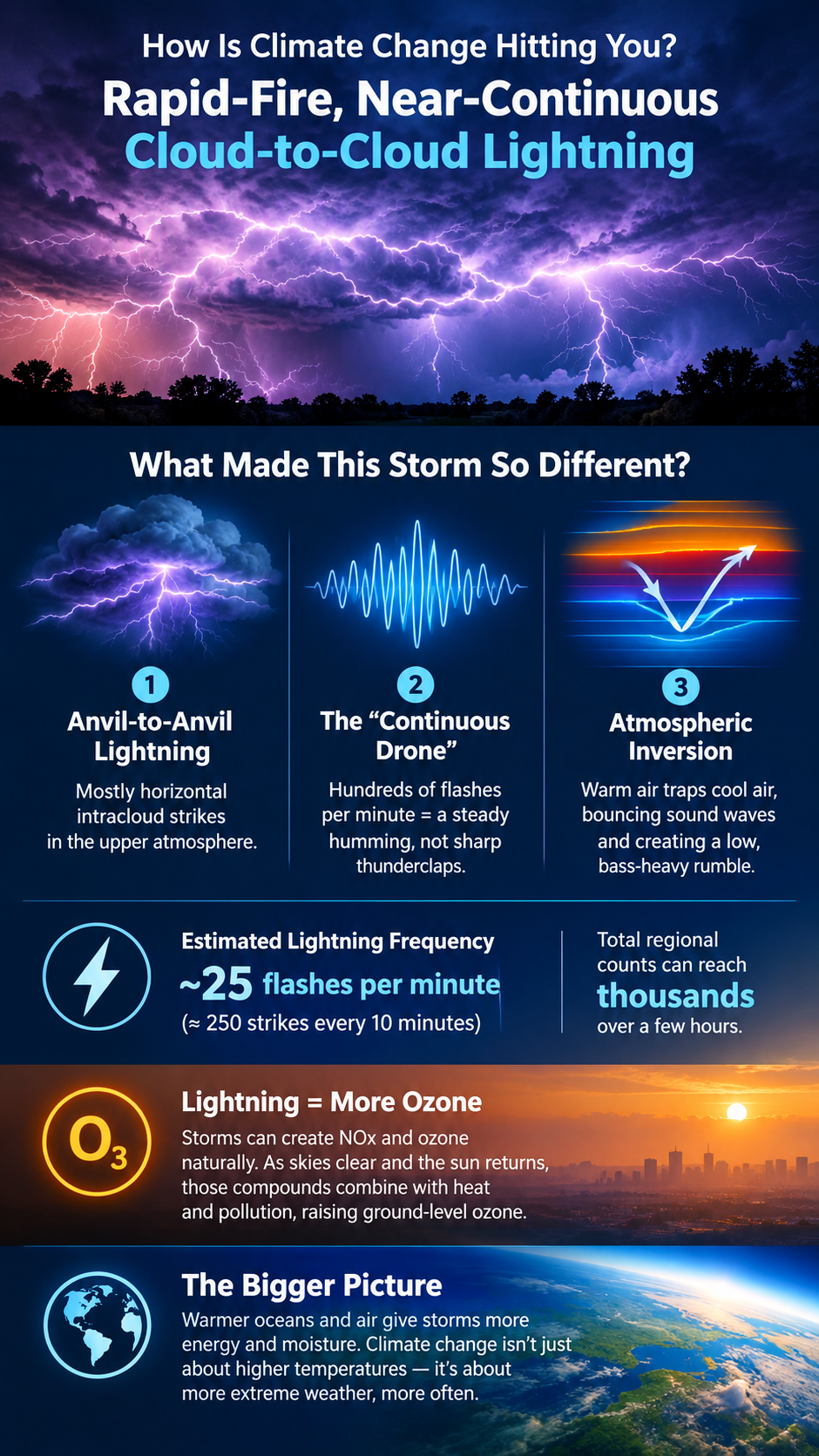
The unusual-sounding lightning storm that moved through Chester County, Pennsylvania, overnight was a severe weather system characterized by rapid-fire, near-continuous cloud-to-cloud lightning, accompanied by low, constant rolling rumbles rather than distinct thunderclaps.
The storm’s acoustic and visual profile was dictated by several notable meteorological factors.
Anvil-to-Anvil (Intracloud) Lightning
Rather than producing primarily traditional vertical cloud-to-ground strikes, this system generated a massive amount of horizontal, intracloud lightning that appeared to crawl across the upper atmosphere.
The “Continuous Drone” Sound
Because hundreds of high-altitude flashes occurred every minute, their sound waves overlapped continuously. Instead of hearing a sharp, localized crack followed by booming thunder, residents experienced a strange, uninterrupted humming or buzzing vibration that persisted for extended periods, sounding more like a prolonged fireworks finale lasting an hour or more.
Atmospheric Inversion
The storm arrived during a highly humid evening ahead of a cooler morning. When a layer of warmer air traps cooler air near the surface, it creates an atmospheric inversion that can act as an acoustic ceiling. This can cause sound waves to be reflected back toward the ground, muffling the sharpness of individual cracks and stretching the thunder into a low-frequency, bass-heavy rumble that can seem to vibrate through the walls of homes.
Estimated Lightning Frequency
At the peak of the system moving through the region, regional radar and lightning networks estimated close to 25 lightning flashes per minute—roughly 250 strikes every 10 minutes—across the storm cells in southeastern Pennsylvania.
For a fast-moving but highly charged system like this one, total regional flash counts over a multi-hour period can scale into the thousands of individual flashes.
Lightning, NOx, and Ground-Level Ozone
Severe lightning storms contribute to low-level, or ground-level, ozone through chemical production triggered by the intense heat and vertical atmospheric churning associated with lightning.
Most ground-level ozone is a man-made pollutant formed when emissions from vehicles and industry interact with sunlight. But intense lightning can also produce ozone naturally and generate nitrogen oxides (NOx) high in the atmosphere.
Because last night’s storm was highly electrical and featured continuous intracloud flashing, it likely generated a high volume of regional NOx within the storm clouds. As clear skies and sunlight return to southeastern Pennsylvania today, those lingering compounds can interact with existing heat and other atmospheric pollutants, contributing to elevated regional ground-level ozone.
Climate Energy Hitting You
The important point is not simply that southeastern Pennsylvania experienced another unusual thunderstorm.
It is that climate change is altering the energy available to Earth’s weather systems.
As the atmosphere and oceans warm, more energy and moisture become available to storms. That additional energy can manifest locally as changes in precipitation intensity, heat, humidity, lightning, severe thunderstorms, and other forms of extreme weather.
Sometimes climate change doesn’t announce itself with a gradual change in a temperature reading.
Sometimes you hear it.
You feel it.
And on a night filled with nearly continuous lightning, you may even hear it as a low, persistent rumble vibrating through your home—more like a war zone than an ordinary thunderstorm.