by Daniel Brouse
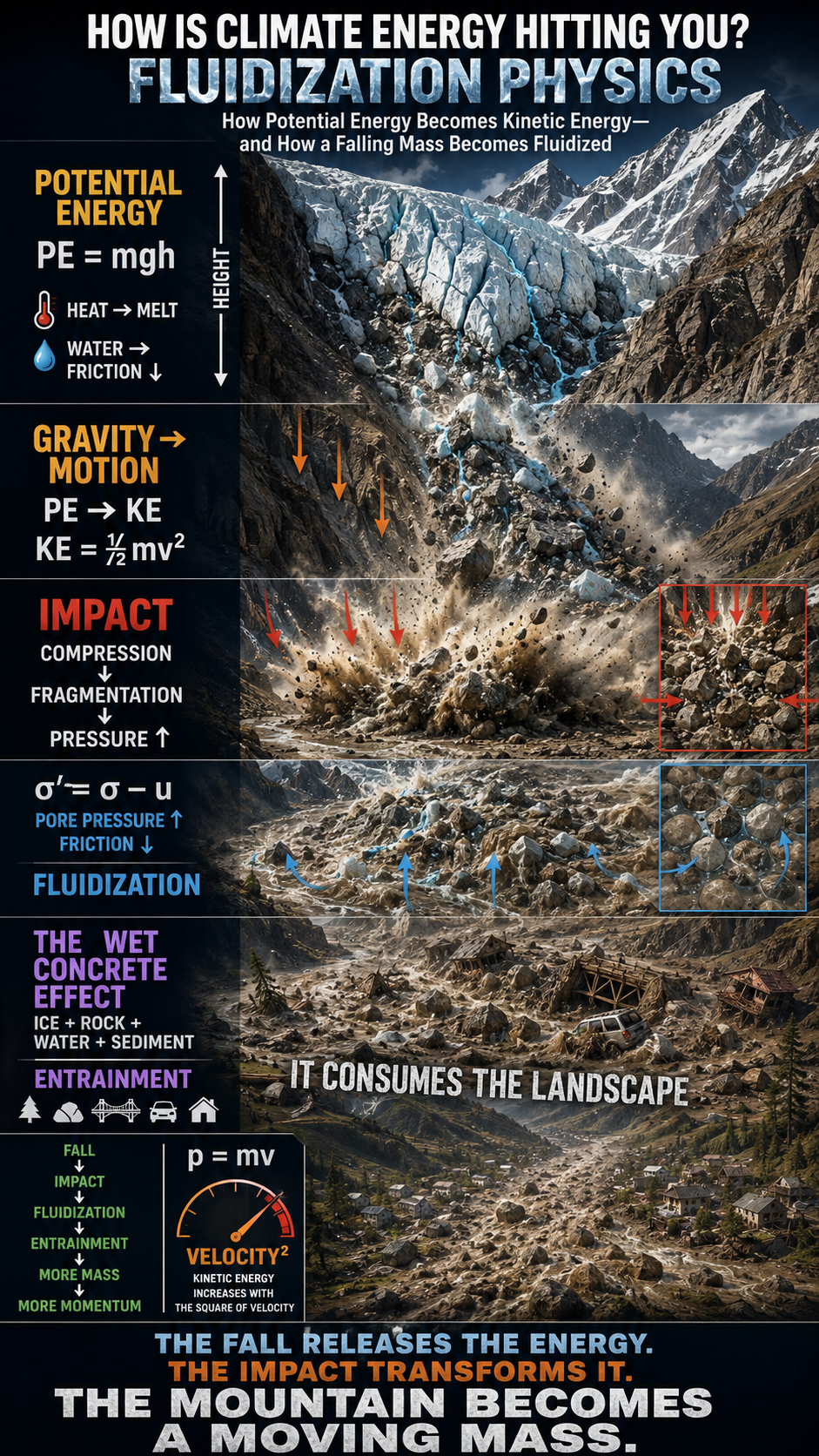
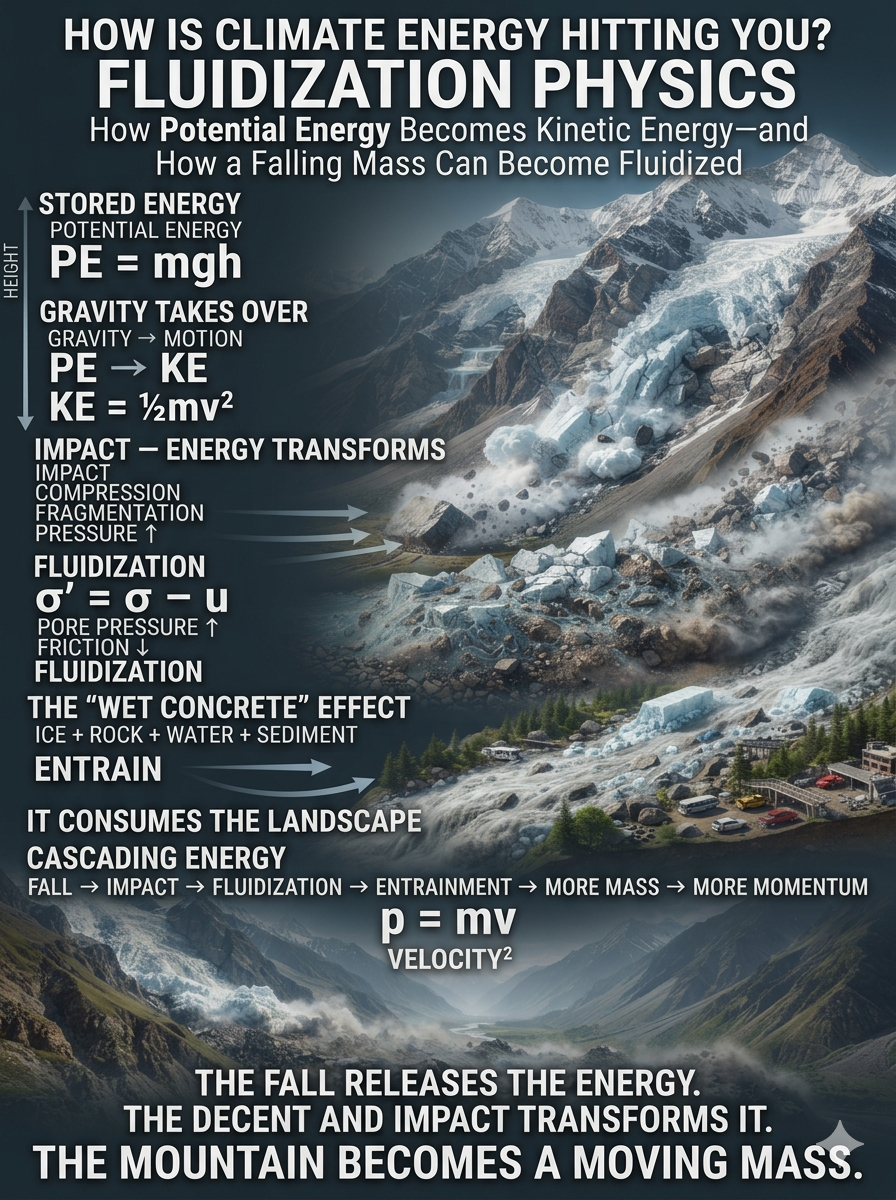
How Potential Energy Becomes Kinetic Energy—and How a Falling Mass Can Become Fluidized
Rocky Rex said, “The ice mass (or composite) came out of a hanging valley that contained a cirque, possibly starting to move as a rotational slump. So there’s a lot of potential energy right at the start of the process.”
That observation gets to the heart of the physics. The collapse itself is a gravitational event. Gravity supplies the immediate energy that drives the mass downward. The climate connection lies in how human-caused warming can alter the physical conditions under which that gravitational energy is released.
Heat can accelerate glacier melt. Meltwater can penetrate fractures and accumulate beneath ice. Rain and meltwater can increase pore-water pressure. Permafrost thaw can weaken previously frozen ground. Warming can therefore change the mechanical stability of ice, rock, soil, and sediment. Climate change does not need to physically push a mountain downhill. It can alter the conditions that determine when that mountain becomes capable of moving.
Then gravity does the rest.
Once the mass begins moving, another fascinating piece of physics takes over: water can actually make a moving granular system more mobile.
We generally think of water as something that slows things down. But water under pressure between particles can reduce the friction holding those particles together. In simplified form:
σ′ = σ − u
where σ′ is effective stress, σ is total stress, and u is pore-water pressure.
As pore-water pressure rises, effective stress falls. As effective stress falls, frictional resistance can decrease. That can make a slope or debris mass substantially more mobile.
This is one reason a wet, saturated mass can behave so differently from the dry rock, soil, and ice from which it originated. The material does not literally turn into water. Instead, water becomes part of a coupled solid-fluid system in which fluid pressure can support and mobilize solid particles.
Under sufficiently energetic and saturated conditions, a granular mass can become partially fluidized, allowing it to flow and transport enormous quantities of additional material.
That is the “wet concrete” effect.
The distinction is important. We are not talking about a solid block of ice simply sliding down a mountain. We are talking about a material system whose physical properties can change dramatically as it accelerates, fragments, mixes with water, and incorporates sediment and other debris.
And once that transformation begins, the physics becomes even more interesting.
The Fall Is Only the Beginning
The fluidization of the mass on the way down is remarkable physics. But the energy transfer at the bottom may be even more consequential.
The material did not strike the valley floor all at once.
The leading edge arrived first.
It collided with the valley floor and surrounding terrain, fractured, compressed, deformed, and began spreading. Behind it, enormous quantities of ice, rock, water, and sediment were still moving downhill.
That means the impact was not a single collision.
It was a cascading sequence of collisions.
The first material to arrive effectively became an impact surface for the material immediately behind it. The incoming mass continued transferring momentum into material that had already slowed, while the valley floor resisted the movement from below.
The basic relationship is:
p = mv
where p is momentum, m is mass, and v is velocity.
Changing the momentum of an enormous mass requires an enormous force. The rate at which that momentum is transferred matters as well:
F = Δp / Δt
The shorter the time over which momentum is transferred, the greater the instantaneous force.
This is why the impact of a massive debris flow is fundamentally different from simply placing the same amount of material on the ground. A stationary mountain weighs an enormous amount, but its weight is distributed through relatively stable structures. A mountain in motion has momentum. When that momentum is suddenly redirected, compressed, fragmented, or stopped, enormous forces are generated.
Four Hundred Million Tons in Motion
Early scientific estimates put the mass of the initial detachment at approximately 400 million metric tons, or about:
4 × 10¹¹ kg
That estimate was derived from the seismic forces generated by the collapse. The scale is difficult to visualize: roughly the equivalent mass of 1,000 Empire State Buildings moving as part of the collapse.
The estimated vertical elevation difference between the initial failure and the valley floor is approximately 1,200–1,300 meters.
That gives us a way to estimate the gravitational potential energy available to the system:
PE = mgh
Using 400 million metric tons and a 1,200-meter elevation loss:
PE ≈ 4.7 × 10¹⁵ joules
At 1,300 meters:
PE ≈ 5.1 × 10¹⁵ joules
That is approximately 4.7–5.1 petajoules of gravitational potential energy before accounting for the enormous energy losses and transformations that occur during a real collapse.
This does not mean that all of that energy became forward-moving kinetic energy. It could not. The collapse fractured ice and rock, deformed the terrain, generated heat and sound, produced seismic waves, increased pore pressure, and drove erosion and entrainment.
But it establishes the scale of the energy reservoir.
The Theoretical Velocity Scale
We can also ask what velocity that elevation difference represents in an idealized gravitational system.
If gravitational potential energy were converted entirely into kinetic energy:
mgh = ½mv²
which gives:
v = √(2gh)
For a 1,200-meter vertical drop, the theoretical free-fall-equivalent velocity is approximately:
153 m/s ≈ 343 mph
For 1,300 meters:
160 m/s ≈ 357 mph
Those numbers should not be interpreted as measured velocities of the actual debris flow. A landslide is not a frictionless free-fall object. Energy is continually consumed by fragmentation, friction, collisions, deformation, terrain geometry, fluid interaction, erosion, and entrainment.
The calculation instead tells us something more fundamental: the elevation difference represents an enormous gravitational energy source.
The actual flow velocity would depend on how efficiently that energy was converted into motion.
The Impact Becomes a Cascade
Now imagine the leading portion of that enormous mass reaching the valley floor.
It does not simply stop.
Some of its kinetic energy is converted into deformation of the ground. Some fractures rock. Some pulverizes ice. Some accelerates water. Some generates turbulence. Some increases pore-water pressure. Some becomes heat and sound. Some is transferred into the material immediately behind it.
And then the next mass arrives.
The process becomes:
Impact → compression → fragmentation → pressure → fluidization → continued motion → secondary impact
Then it happens again.
And again.
The mass behind the leading edge continues arriving with momentum. The material in front is compressed and displaced. Water and sediment are forced through the granular matrix. Pore pressure rises. Effective stress can fall. Friction can decrease. The material can spread and flow rather than simply pile into a stationary heap.
This creates a remarkable transition.
The impact itself can help create the conditions that allow the material to continue moving.
When the Pile Doesn’t Behave Like a Pile
Ordinarily, we expect a large quantity of rock to pile up when it reaches the bottom of a slope. But a heavily saturated, highly fragmented granular mass can behave very differently.
As the incoming material compresses the material beneath it, water trapped between particles can become pressurized. That pressure can temporarily reduce the effective contact forces between particles.
Again:
σ′ = σ − u
Increase u, and effective stress σ′ decreases.
That can reduce frictional resistance and allow the mass to rearrange and move.
Instead of:
rock → impact → pile
the process can become:
rock + ice + water → impact → fragmentation → compression → pore pressure → reduced friction → fluidization → flow
This is why “wet concrete” is such a useful visual description.
The material is still carrying enormous amounts of solid mass, but it can move with characteristics of a fluid.
The Flow Begins Consuming the Landscape
And this is where another critical process—entrainment—takes over.
The moving mass does not simply travel over the landscape.
It consumes the landscape.
As the flow moves downstream, it can erode riverbanks and valley walls, incorporate additional sediment and water, pick up boulders and trees, and destroy and incorporate infrastructure.
Every new piece of material adds mass.
More mass means more momentum at the same velocity:
p = mv
And when the added material is dense rock, it can also substantially change the bulk density and mechanical behavior of the flow.
The flow therefore becomes a changing system.
It starts with one composition at the glacier.
It has another composition halfway down the mountain.
And by the time it reaches the valley, it may contain ice, rock, water, mud, sand, gravel, trees, soil, concrete, vehicles, buildings, and fragments of the valley itself.
The original collapse has become something much larger than the original failure.
Density and Velocity Become the Amplifiers
For a moving flow, one useful way of describing the dynamic pressure scale is:
q = ½ρv²
Here, ρ is the bulk density of the moving mixture and v is its velocity.
Water has a density of approximately:
1,000 kg/m³
A heavily sediment-laden debris mixture might have a bulk density around:
1,500 kg/m³
as an illustrative midpoint.
At the same velocity, the denser mixture therefore has approximately 1.5 times the dynamic-pressure scale of water.
But velocity is even more important because it is squared.
Double the velocity and the dynamic-pressure scale increases by a factor of four.
That is why the combination of mass, density, and velocity is so important.
Water can push.
A dense debris flow can push while simultaneously carrying boulders, trees, ice, vehicles, and structural debris.
The difference is not merely that the water is “stronger.”
The moving material contains vastly more solid mass capable of transferring momentum through direct collision.
A boulder becomes a projectile.
A tree becomes a battering ram.
A vehicle becomes additional moving mass.
A bridge becomes debris that can strike whatever lies downstream.
The flow becomes both the delivery system and the source of additional projectiles.
The Cascading Impact
This is the part of the physics that fascinates me most.
The initial fall converts gravitational potential energy into motion.
The impact converts that motion into crushing, fragmentation, deformation, pressure, turbulence, and heat.
The pressure changes the frictional behavior of the material.
The reduced friction allows continued movement.
The continued movement entrains more material.
The additional material increases the mass of the flow.
The increased mass increases its momentum.
And then that larger moving mass impacts the landscape again.
The cascade becomes:
GRAVITY
↓
ACCELERATION
↓
IMPACT
↓
FRAGMENTATION + COMPRESSION
↓
PORE PRESSURE ↑
↓
EFFECTIVE STRESS ↓
↓
FRICTION ↓
↓
FLUIDIZATION
↓
ENTRAINMENT
↓
MASS ↑
↓
MOMENTUM ↑
↓
MORE IMPACT
This is not perpetual-motion physics. Energy is continually being dissipated. The point is that the energy released by the initial gravitational collapse is being redistributed through many interacting physical processes rather than disappearing at the first impact.
The valley floor becomes part of the energy-transfer system.
The Seismic Energy Is Only One Piece of the Story
The reported seismic signal provides another fascinating comparison.
A magnitude-5.2 seismic event was recorded from the collapse, and early estimates associated the seismic energy with roughly 1,000 tons of TNT equivalent. That corresponds to approximately:
4.2 × 10¹² joules
Compared with the estimated 4.7–5.1 × 10¹⁵ joules of gravitational potential energy associated with a 1,200–1,300 meter elevation loss, the seismic energy represents only a small fraction of the available gravitational energy.
That distinction is essential.
The magnitude-5.2 tremor does not mean that only 1,000 tons of TNT worth of energy existed in the collapse. It describes the portion of energy coupled into seismic waves.
The rest went into the physical destruction and transformation of the system: motion, fragmentation, deformation, erosion, fluidization, turbulence, heat, sound, and downstream transport.
In other words, the earthquake was a signal of the collapse—not a complete measurement of the collapse’s mechanical energy.
From Glacier to Wet Concrete
This is why the event is so interesting from a climate-physics perspective.
The climate connection begins before the mountain moves. Warming can alter glacier mass, meltwater production, permafrost stability, precipitation, soil moisture, and the mechanical conditions within and beneath ice and rock.
But once the failure begins, gravity becomes the immediate energy source.
The falling mass accelerates.
Ice and rock fracture.
Water becomes incorporated.
The impact generates enormous stresses.
Pore pressure rises.
Friction can fall.
The granular material becomes increasingly mobile.
Then the flow begins consuming the landscape.
More sediment.
More water.
More rock.
More trees.
More structures.
More mass.
More momentum.
And the result is no longer simply an ice collapse or a rockslide.
It is a coupled ice-rock-water-sediment system undergoing a rapid mechanical transformation.
A mountain begins as a collection of relatively stable materials.
Gravity sets it in motion.
Energy transforms its structure.
Water changes its friction.
Impact changes its state.
And entrainment turns the landscape itself into additional moving mass.
That is the physics behind the phrase:
Like wet concrete.
It isn’t just a metaphor for something thick and muddy.
It describes a system in which enormous quantities of water and solid material can become mechanically coupled into a dense, mobile mass—one capable of transferring momentum, carrying additional material, and continuing the cascade long after the initial glacier failure has occurred.
The initial fall releases the energy.
The impact transforms it.
Fluidization redistributes it.
Entrainment multiplies the moving mass.
And the resulting flow carries the consequences downstream.