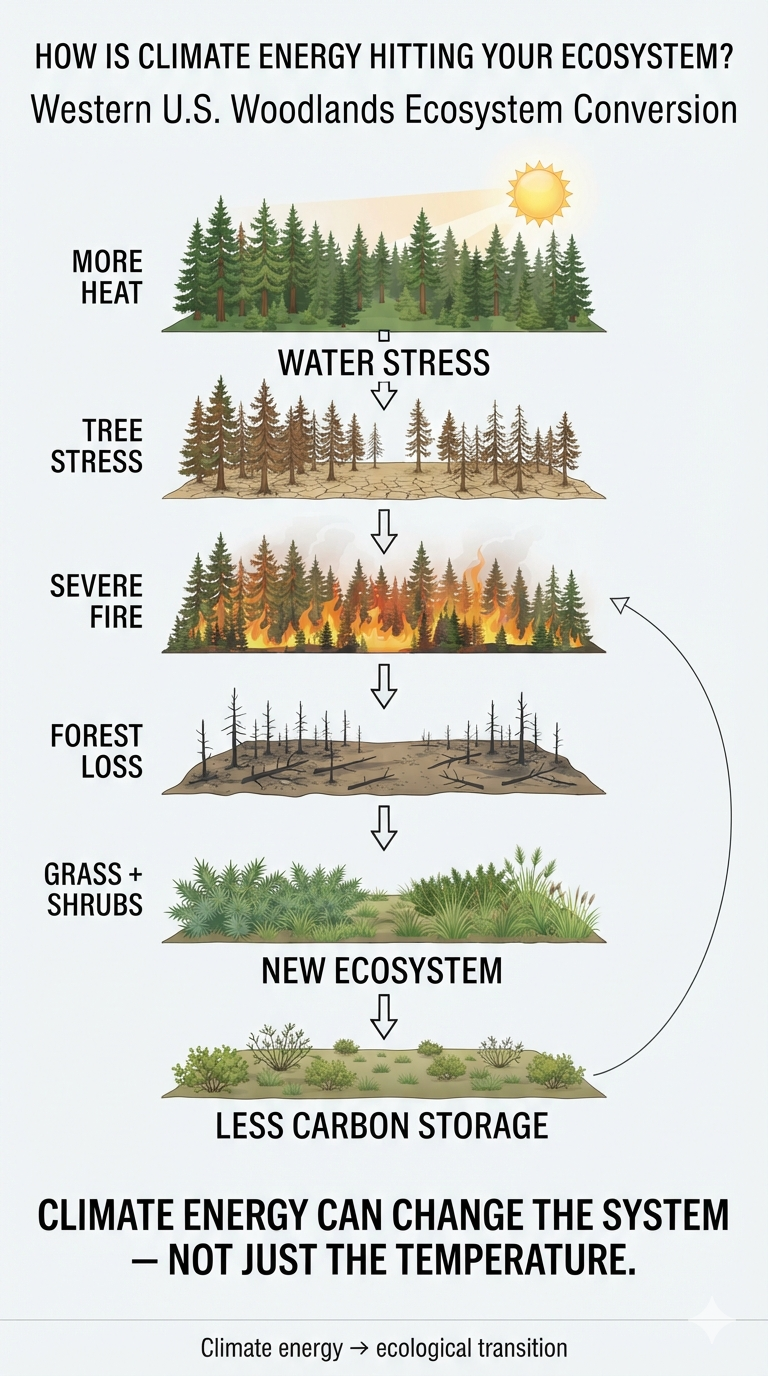
How Is Climate Energy Hitting You?
Western U.S. Woodlands: Ecosystem Conversion or Vegetation Type Conversion
Towering woodlands across the Western U.S. are being permanently replaced by spiky shrubs as bigger and hotter wildfires sweep through forests that have not evolved to survive such high-intensity blazes and a warmer climate. Conditions “just aren’t normal anymore,” said researchers from Lehigh University. “Bigger, Hotter Fires Are Slowly Erasing America’s Great Forests” references a 2024 modeling study published in Communications Earth & Environment titled “Future transition from forests to shrublands and grasslands in the western United States is expected to reduce carbon storage”. Conducted by researchers from Lehigh University, the study projects that up to 40% of Western conifer forests could convert to shrubland or grassland by 2100 under moderate emissions scenarios.
by Daniel Brouse and Sidd Mukherjee
Introduction
Climate change is often described as a gradual increase in temperature. That description is technically correct but scientifically incomplete.
The climate system does not distribute additional energy uniformly or produce consequences that increase smoothly with temperature. Additional energy changes the behavior of the atmosphere, the hydrologic cycle, soils, vegetation, fire regimes, and biological systems. As those systems respond, their responses can feed back into the climate and into one another.
This creates a more consequential question:
What happens when an ecosystem can no longer absorb the changing climate without changing its fundamental structure?
Forests in the western United States provide an important example.
The issue is not simply that trees experience warmer temperatures. The larger problem is that warming changes the entire environmental system in which forests exist. Higher temperatures increase atmospheric moisture demand. Changes in precipitation and snowpack alter the timing and availability of water. Soil moisture is depleted more rapidly. Trees become increasingly stressed. Drought weakens regeneration. Wildfires become more severe. Severe fires remove mature trees and seed sources. Grasses and shrubs then occupy the newly opened landscape.
The result can be more than forest damage.
It can become an ecosystem transition.
The system can move from one relatively stable state—forest—to another state dominated by shrubs and grasses.
That distinction is central to understanding nonlinear climate change.
1. Climate Energy Is More Than Temperature
Temperature is one observable expression of energy within the climate system.
But biological systems do not respond to temperature alone.
They respond to a combination of:
- temperature
- atmospheric moisture demand
- precipitation
- soil moisture
- snowpack
- evapotranspiration
- fire
- growing-season conditions
- carbon availability
- biological competition
- disturbance frequency
- regeneration conditions
Consequently, a modest increase in average temperature can produce a much larger ecological response when several variables move simultaneously.
A warmer atmosphere can demand more water from vegetation and soils. Earlier snowmelt can shift water availability away from the period when forests need it most. Hotter and drier conditions can increase fire risk. Fire removes vegetation that previously stored carbon and provided shade and moisture retention.
The important variable therefore becomes not simply:
How much warmer is it?
but:
How much additional energy is moving through the system, and what does that energy do to the processes that maintain ecosystem stability?
2. The Forest Is a System, Not a Collection of Trees
A forest exists because a particular combination of environmental conditions permits trees to survive, reproduce, compete, and regenerate.
That means the persistence of a forest depends on a chain of conditions.
A simplified representation is:
Climate → water availability → tree health → regeneration → competition → disturbance resistance → forest persistence
Climate change can stress several links simultaneously.
Higher temperatures increase evaporative demand.
Reduced soil moisture increases physiological stress.
Drought reduces growth and seedling survival.
Heat and drought increase vulnerability to fire.
High-severity fire removes mature trees and seed sources.
After the fire, hotter and drier conditions can prevent the forest from regenerating.
At that point, the question is no longer whether the original trees can survive.
The question becomes whether the forest state itself remains viable.
3. Hydroclimatic Stress Can Become a Threshold
One of the most important characteristics of complex systems is that their response to forcing does not have to be linear.
A forest may tolerate increasing stress for years.
Then a threshold is crossed.
Before the threshold:
More heat → more stress
After the threshold:
More heat → mortality → reduced regeneration → vegetation change
The distinction is crucial.
A forest can therefore appear relatively resilient while conditions deteriorate beneath the surface.
Trees may survive while seedlings increasingly fail.
Older trees may remain while regeneration collapses.
The landscape can therefore retain the appearance of a functioning forest even as its ability to reproduce itself is being lost.
This creates what can be described as a climate–vegetation mismatch.
The climate has changed faster than the ecosystem can reorganize.
4. Fire Can Transform a Stress Response Into a Feedback Loop
Fire is particularly important because it can convert gradual environmental stress into rapid structural change.
Consider the sequence:
Warming
↓
Greater atmospheric moisture demand
↓
Declining soil moisture
↓
Vegetation stress
↓
Greater fire susceptibility
↓
High-severity fire
↓
Loss of mature forest
↓
Reduced seed sources
↓
Poor forest regeneration
↓
Expansion of grasses and shrubs
The process does not necessarily stop there.
Grasses and shrubs can create different fuel structures from forests. In some environments, this can support more frequent burning.
The system can therefore become:
forest → fire → grass/shrub → fire → grass/shrub
The disturbance has become part of the mechanism maintaining the new ecosystem.
This is a classic positive feedback.
5. Disturbance Can Become an Ecological Accelerator
Climate change does not have to directly eliminate an ecosystem.
It can instead increase the frequency and severity of disturbances that eliminate the ecosystem’s ability to recover.
This distinction is extremely important.
Imagine a forest that normally experiences periodic fire.
If a fire occurs and the climate remains favorable, trees regenerate.
But if the same fire occurs under hotter and drier conditions, regeneration may fail.
The fire itself may therefore not be fundamentally different.
The recovery environment is different.
This means that climate change can transform a disturbance from a temporary event into a state transition.
The same principle can apply to:
- drought
- flooding
- heatwaves
- hurricanes
- insect outbreaks
- disease
- agricultural failure
- coral bleaching
- wetland loss
The disturbance becomes more consequential because the background state of the system has changed.
6. The Carbon Cycle Contains a Critical Asymmetry
Forests illustrate another important feature of nonlinear climate dynamics.
A landscape can continue absorbing carbon while simultaneously losing its long-term carbon-storage capacity.
These are not the same thing.
Grasslands and shrublands can remain productive. They can photosynthesize, grow, and absorb atmospheric CO₂.
But a mature forest stores carbon in:
- trunks
- branches
- roots
- dead wood
- forest soils
- long-lived biomass
When a forest is replaced by lower-biomass vegetation, the ecosystem can continue to exchange carbon with the atmosphere while carrying a substantially smaller carbon reservoir.
Therefore:
carbon uptake ≠ carbon storage capacity
and:
positive carbon flux ≠ preservation of the previous carbon stock
This distinction is essential when evaluating ecosystems as natural climate buffers.
7. A Carbon Sink Can Become a Smaller Carbon Reservoir
This creates a potentially misleading observation.
Suppose a forest is replaced by grassland.
The grassland grows rapidly.
Its net ecosystem productivity may increase.
One might therefore conclude:
The ecosystem is still absorbing carbon, so the transition is not particularly important.
That conclusion would be wrong.
The relevant question is not simply how much carbon the ecosystem absorbs during a particular period.
The larger question is:
How much carbon can the ecosystem retain over the long term?
A forest can represent a large accumulated carbon reservoir.
A grassland may cycle carbon more rapidly while maintaining a much smaller standing stock.
The transition therefore represents a change in the architecture of the carbon cycle.
That is precisely the type of distinction required by a climate-energy framework.
8. The Feedback Extends Beyond the Forest
The consequences do not stop at vegetation.
Forest loss can alter:
- surface energy balance
- evapotranspiration
- local humidity
- soil temperatures
- runoff
- erosion
- snow retention
- water availability
- biodiversity
- carbon storage
- fire behavior
The ecosystem is therefore not merely responding to climate.
It can begin changing the conditions under which the climate interacts with the landscape.
This creates another feedback structure:
Climate forcing
↓
Hydroclimatic stress
↓
Vegetation change
↓
Surface and hydrologic changes
↓
Disturbance changes
↓
Carbon-storage changes
↓
Further alteration of the climate–ecosystem relationship
The system becomes increasingly coupled.
9. Elevation Becomes a Moving Boundary
One observable consequence of warming is the movement of climate zones.
As temperatures rise, species may attempt to occupy higher elevations or move toward cooler environments.
This creates an ecological migration problem.
The climate envelope moves.
The ecosystem must follow.
But ecosystems do not move like atmospheric air masses.
Trees require:
- seeds
- suitable soil
- time
- reproduction
- dispersal
- successful establishment
- adequate moisture
- protection from subsequent disturbances
If climate conditions move faster than species can migrate, the suitable habitat effectively moves away from the organism.
This produces another form of mismatch:
The climate is moving faster than the ecosystem.
That is potentially much more important than the simple statement that temperatures are increasing.
10. The Nonlinear Acceleration Problem
This provides a useful example of why climate impacts can appear to accelerate.
Suppose warming produces only modest ecological stress during the first phase.
The system may appear stable.
But as stress accumulates:
Phase 1:
Temperature increases.
↓
Phase 2:
Moisture stress increases.
↓
Phase 3:
Tree growth and regeneration decline.
↓
Phase 4:
Fire vulnerability increases.
↓
Phase 5:
High-severity disturbances remove mature forest.
↓
Phase 6:
Regeneration fails.
↓
Phase 7:
Grass and shrub systems expand.
↓
Phase 8:
The new vegetation regime modifies future fire behavior.
The forcing has not necessarily increased eightfold.
The response pathway has changed.
That is the critical distinction.
Nonlinear acceleration can occur because each stage changes the conditions governing the next stage.
11. From Climate Change to State Change
This suggests a more useful hierarchy for understanding climate impacts.
Level 1 — Climate forcing
Greenhouse gases increase radiative forcing.
Level 2 — Physical response
Temperature, atmospheric moisture demand, precipitation patterns and snowpack change.
Level 3 — Hydroclimatic response
Soils dry more rapidly, drought stress increases and water availability becomes less synchronized with biological demand.
Level 4 — Biological stress
Growth, survival and regeneration are affected.
Level 5 — Disturbance amplification
Fire and other disturbances become more consequential.
Level 6 — Ecosystem restructuring
Forest becomes shrubland or grassland.
Level 7 — Feedback
The new ecosystem modifies carbon storage, fuels, hydrology and future disturbance behavior.
This is not simply:
warming → impact
It is:
forcing → response → stress → disturbance → restructuring → feedback
That is the architecture of a climate cascade.
12. The Threshold Is Not Necessarily a Single Temperature
This is another important implication.
There may be no universal temperature at which a forest suddenly disappears.
Instead, the threshold may emerge from the interaction of several variables.
For example:
Temperature + soil moisture + fire severity + regeneration failure
may collectively determine whether a forest can persist.
This means ecological thresholds are often multidimensional.
A system may tolerate:
- high temperature with adequate moisture,
- drought with moderate temperatures,
- fire when regeneration remains possible,
but fail when all three occur together.
The threshold is therefore a property of the system, not necessarily of a single variable.
13. Resilience Can Be Consumed
This leads to another useful concept for the climate framework:
resilience is not unlimited.
An ecosystem can absorb disturbance and recover.
But repeated disturbances can progressively reduce its ability to recover.
Consider:
Drought → partial recovery → drought → fire → partial recovery → extreme fire → failed regeneration
The landscape may look resilient after each individual event.
But the cumulative effect can progressively reduce resilience.
Eventually:
disturbance > recovery capacity
At that point, the ecosystem crosses into a different state.
This provides a mechanism by which cumulative climate energy can produce delayed but increasingly abrupt consequences.
14. The System May Not Return to Its Previous State
This is perhaps the most important implication.
Traditional environmental thinking often assumes:
damage → restoration → recovery
But climate-driven state transitions can produce:
damage → altered conditions → failed recovery → new ecosystem
Once the climate no longer supports the original ecosystem, restoration becomes fundamentally different.
The problem is no longer simply repairing damage.
It becomes determining what ecosystem can exist under the new boundary conditions.
That is a much more profound transformation.
15. Climate Change as a Competition Between States
The forest example can therefore be represented as competition between ecological states.
State A
Forest
High biomass
High carbon storage
Established trees
Established seed sources
Specific moisture requirements
Specific fire regime
↓
Increasing climate stress
Higher temperature
Greater moisture demand
Drought
Fire
↓
Transition zone
Reduced regeneration
Tree mortality
High-severity disturbance
Shrub expansion
Grass expansion
↓
State B
Shrubland/Grassland
Lower tree biomass
Different carbon storage
Different fuel structure
Different fire regime
Different hydrology
Different ecological relationships
The crucial point is that State B does not necessarily represent a damaged version of State A.
It may represent a new equilibrium or quasi-stable state produced by the altered climate.
16. This Is Why Climate Impacts Can Be Misread
Looking at individual variables can conceal the transition.
Temperature records may show a gradual trend.
Precipitation may fluctuate.
Forest cover may decline slowly.
Fire activity may vary enormously from year to year.
Carbon uptake may remain positive.
Individually, none of these observations necessarily demonstrates a system transition.
But together they can reveal something much larger:
the relationships between the variables are changing.
That is the signal we should be watching.
Climate change is therefore not simply a problem of increasing averages.
It is a problem of changing relationships among variables.
17. The Climate-Energy Framework
The forest example suggests a generalized framework:
Climate Energy
Accumulating energy
↓
Physical Amplification
Heat + atmospheric moisture demand + altered precipitation + altered snowpack
↓
Hydroclimatic Stress
Soil moisture loss + drought + water-timing disruption
↓
Biological Stress
Reduced growth + mortality + regeneration failure
↓
Disturbance Amplification
Fire + insects + disease + extreme events
↓
Structural Transition
Forest → shrubland/grassland
↓
Functional Transition
Changed carbon storage + hydrology + biodiversity + fire regime
↓
Feedback
New ecosystem conditions influence subsequent climate and disturbance responses
This is a cascade, not a single climate impact.
18. The Broader Principle
The forest example is therefore not fundamentally about forests.
It is about what happens when a complex system is subjected to persistent forcing while its recovery mechanisms are simultaneously weakened.
The same framework can be applied to many systems.
Agriculture
Heat + drought + soil moisture loss → crop failure → soil degradation → reduced productivity.
Coral reefs
Warming + marine heatwaves → bleaching → mortality → ecosystem restructuring.
Wetlands
Sea-level rise + storm surge + erosion → vegetation loss → reduced sediment trapping → further vulnerability.
Arctic systems
Warming → permafrost thaw → vegetation and hydrologic change → carbon release → additional warming.
Urban systems
Heat + intense rainfall → infrastructure stress → flooding → system damage → reduced resilience to subsequent events.
In each case, the critical question is:
Does the system recover, or does the disturbance alter the system itself?
Conclusion
The most consequential climate impacts may not occur when a physical variable reaches an unprecedented value.
They may occur when the relationships that hold a system together begin to fail.
A forest does not need to experience a single catastrophic temperature to disappear.
It can be progressively destabilized by warming, increasing atmospheric moisture demand, declining soil moisture, altered snowpack, drought, severe fire and failed regeneration.
At some point, the system can cross a threshold.
The forest is replaced by another vegetation state.
Carbon storage declines.
Fire behavior changes.
Hydrology changes.
Biological communities change.
The ecosystem becomes different.
This is the central lesson for a climate-energy framework:
Climate change does not merely add energy to an existing system. It can change the rules governing how the system behaves.
That distinction separates ordinary climate variability from nonlinear climate-system transformation.
The important question is therefore not simply:
How much has the climate warmed?
It is:
How much additional energy has entered the system, how has that energy altered the interactions among its components, and have those interactions begun pushing the system toward a different state?
When the answer is yes, climate change is no longer merely producing stress.
It is producing transition.