by Daniel Brouse
Backyard Experiment
How Is the Climate Energy Hitting You? is a collection of backyard experiments conducted in conjunction with you—the reader. The goal is simple: to look at how the increased energy in the climate system is showing up in our everyday lives.
Is it becoming more extreme, more frequent, and more persistent? Are the changes becoming stranger—or even disturbing?
The Worms Squirm experiment checks all the boxes.
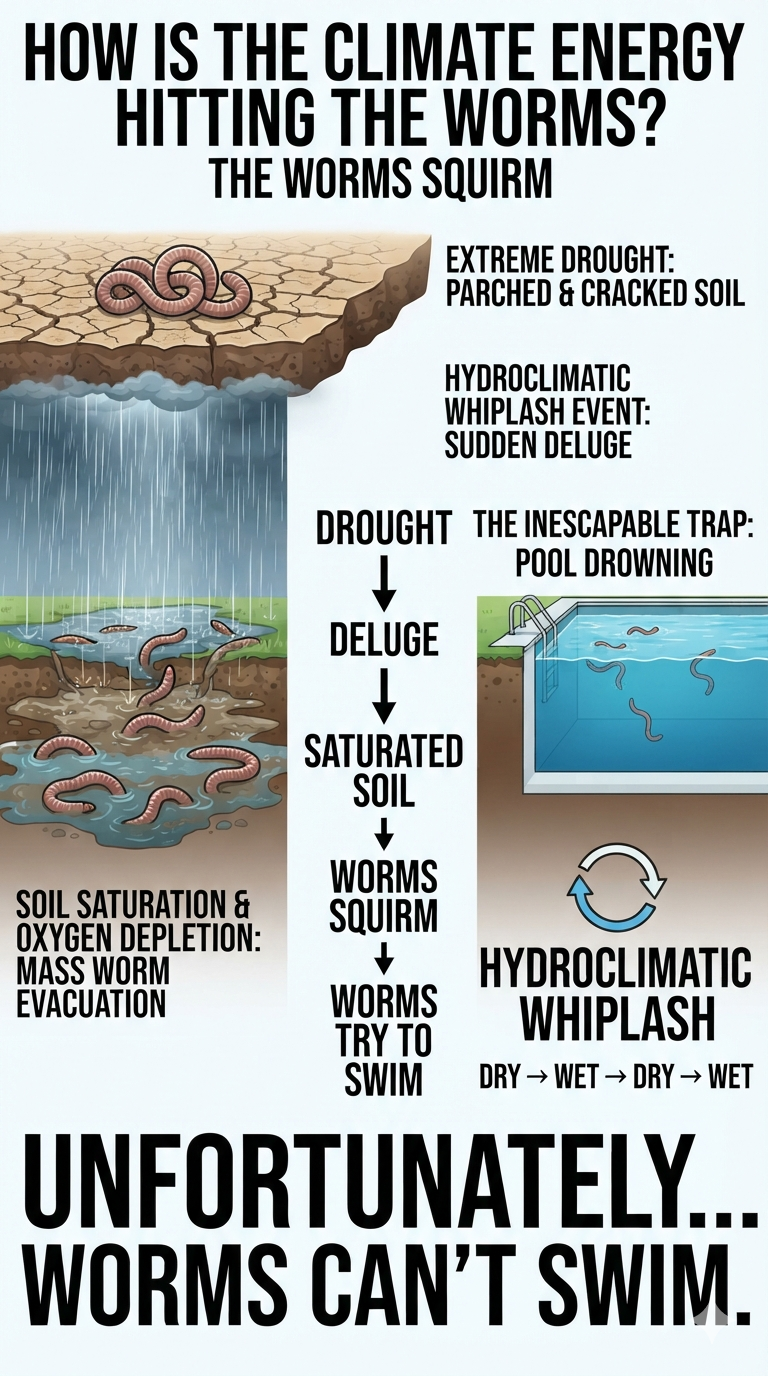
It started with a simple backyard observation: an increasing number of earthworms turning up in the swimming pool. What seems like a strange and seemingly insignificant nuisance may actually be a small, visible signal of a much larger change in the way water is moving through the environment.
Sometimes, you don’t need a laboratory to see climate energy at work.
Sometimes, you just need to look in the pool.
The Worms Squirm
Climate change is altering the conditions that earthworms depend on—soil temperature, moisture, oxygen availability, and precipitation patterns. These changes can affect earthworm survival, reproduction, abundance, and geographic distribution. At the same time, earthworm activity influences soil carbon cycling and greenhouse-gas emissions, creating another connection between life in the soil and the climate system.
Temperature and Moisture Effects
Warming temperatures: Rising soil temperatures can shift the ranges of some earthworm species toward higher latitudes and elevations. However, excessive heat can reduce activity, growth, reproduction, and survival, particularly when warming is accompanied by drying.
Drought: Prolonged dry conditions can sharply reduce earthworm activity and abundance. Because earthworms breathe through their moist skin, severe soil drying can force them deeper into the soil or into a dormant, low-activity state. Extended drought can produce substantial local population losses.
Flooding: Intense rainfall can saturate soils and dramatically reduce the amount of oxygen available in pore spaces. Earthworms may respond by moving toward the surface, where oxygen is more readily available. Prolonged waterlogging, however, can become lethal.
The Climate Feedback Beneath Our Feet
Earthworms are ecosystem engineers. As they consume organic material and move through the soil, they alter soil structure, redistribute nutrients, and stimulate microbial activity. These processes can affect carbon dioxide and nitrous oxide production, although the magnitude and direction of the greenhouse-gas effect depend heavily on soil type, moisture, temperature, vegetation, and earthworm species.
Climate change can also alter where different earthworm species can survive. In some regions, warming and changing precipitation patterns may allow non-native earthworms to expand into new forests and other ecosystems. Their arrival can dramatically alter soil structure, nutrient cycling, and forest-floor communities.
And Then There Are the Worms in My Pool
Over the past five years, I’ve noticed a significant increase in drowned earthworms showing up in my swimming pool. This year has been the most dramatic.
One explanation is that increasingly intense rainfall is changing the conditions that cause earthworms to come to the surface. Earthworms commonly move toward the surface when soils become saturated, and heavy rain can produce much larger and more rapid changes in soil moisture and oxygen than a gentle, prolonged rainfall.
The swimming pool then becomes an accidental trap.
The basic sequence is remarkably simple:
[Extreme Rainfall] → [Soil Saturation & Oxygen Stress] → [Surface Migration] → [Accidental Pool Entry]
Once an earthworm reaches the pool deck, there is little it can do to escape the water. What begins as a survival response to changing soil conditions can therefore end with a dead worm in the pool.
Hydroclimate Whiplash: From Drought to Deluge
The bigger story may be hydroclimate whiplash—rapid swings between unusually dry conditions and unusually wet conditions.
A soil ecosystem experiencing prolonged drought is fundamentally different from one receiving regular, moderate rainfall. When an intense rain event arrives after an extended dry period, several processes can occur simultaneously.
1. Parched Soil Can Change How Rainwater Moves
Extended drying can cause some soils to become water-repellent, while clay-rich soils can shrink and develop large cracks. When intense rainfall arrives, water may initially run across the surface or rapidly enter cracks rather than infiltrating uniformly through the soil profile.
The result can be a sudden change in the physical environment surrounding earthworm burrows.
Rather than gradually replenishing soil moisture, an extreme rain burst can produce rapid saturation in some areas and intense surface runoff in others. The sudden loss of available oxygen in saturated soil can encourage earthworms to move toward the surface.
2. Drought Can Damage Soil Structure
Severe drying can cause soils to shrink, crack, and harden. Burrows and other soil structures can become unstable.
When intense rainfall follows, those structures may partially collapse or become flooded. Earthworms that have retreated deeper into the soil during drought can suddenly find their normal pathways altered or inundated.
That can increase surface movement at exactly the time when rainfall is producing large amounts of surface water.
3. Earthworms Depend on Moisture—but Not Too Much
Earthworms need moisture because they exchange gases through their skin. Dry conditions can therefore be dangerous, but complete saturation creates a different problem: oxygen becomes much less available in the soil.
This produces an important paradox.
Too dry → physiological stress.
Too wet → oxygen stress.
Rapidly switching between the two → repeated physiological and behavioral stress.
It is therefore more accurate to think of hydroclimate whiplash as repeatedly pushing soil organisms between environmental extremes rather than simply “more rain” or “more drought.”
4. Wet Conditions Can Trigger Reproduction and Activity
Earthworm populations also respond to favorable moisture conditions. After periods of drought, renewed moisture can allow surviving worms and newly hatched individuals to become active again.
The exact population response varies considerably by species and local conditions, so it would be too strong to assume that every drought is followed by a synchronized population explosion. But when favorable moisture arrives after a dry period, increased earthworm activity near the surface can coincide with subsequent heavy rainfall.
That creates another possible pathway to the pool:
[Drought] → [Reduced Activity & Deeper Retreat] → [Rain Returns] → [Increased Activity] → [Extreme Rainfall] → [Surface Migration] → [Pool]
So Why Are There More Worms in the Pool?
I can’t prove that climate change is responsible for the worms in my pool.
But the observation is consistent with a changing hydroclimate.
If rainfall is becoming more intense, if dry periods are becoming more pronounced, and if the transition between those conditions is becoming more abrupt, then the soil environment is experiencing larger and faster swings in moisture and oxygen availability.
Earthworms respond to those conditions.
And sometimes, their response puts them on the surface.
Unfortunately for the worms, my swimming pool is right there.
What looks like a bizarre little nuisance at the edge of the pool may therefore be a small-scale example of a much larger climate phenomenon: extreme changes in the movement of water through the environment can produce biological responses that we encounter in surprisingly personal ways.
The climate system doesn’t just change temperature.
It changes where the water goes, how fast it moves, and how abruptly conditions change.
Sometimes, you notice that change when the worms start squirming.
Conclusion
How is the climate energy hitting the worms?
Hydroclimatic whiplash makes the worms squirm—and try to swim.
Unfortunately, worms can’t swim.
Even more unfortunately, the lesson applies to humans, too.
Climate-driven increases in extreme rainfall can amplify urban flooding, overwhelming drainage systems and turning streets, basements, and low-lying buildings into dangerous traps. People living in basement apartments can be especially vulnerable when floodwaters rise faster than they can escape.
From South Korea to New York City, deadly urban floods have demonstrated the danger of extreme rainfall in densely populated areas.
The worms may be small, but the lesson is not:
When the water comes faster and harder, there may be nowhere to go.
How is the climate energy hitting you?
Sometimes, it makes the worms squirm.
Sometimes, it makes people run for higher ground.