by Daniel Brouse
Introduction: The Climate Regime Is Changing
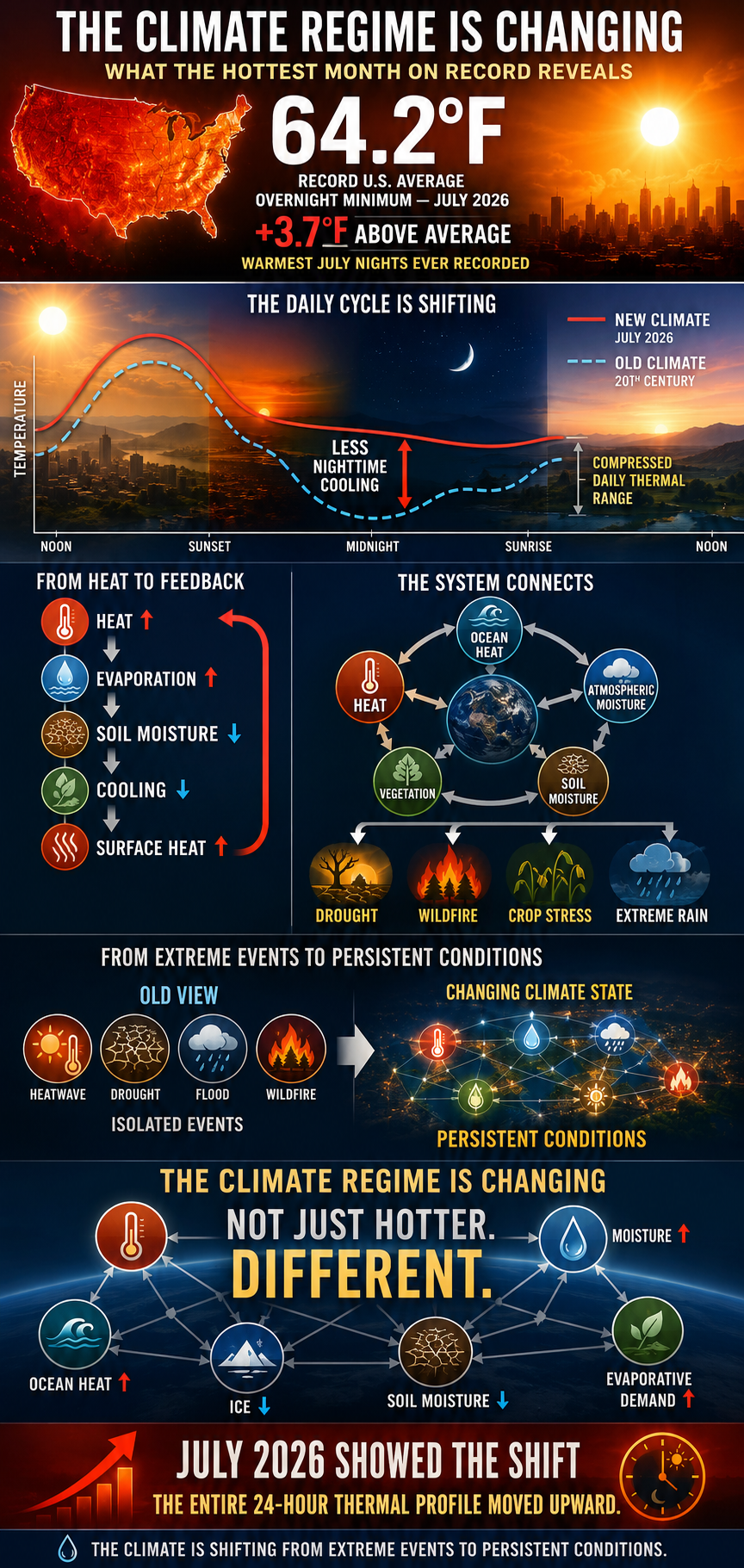
July 2026 was the hottest month ever recorded for the contiguous United States—but the most revealing record wasn’t the daytime heat.
It was the heat that didn’t go away at night.
The average overnight minimum reached 64.2°F—3.7°F above average, setting a new U.S. record for the warmest average July minimum temperature.
That matters because nighttime cooling is part of the climate system’s ability to shed accumulated heat.
When nights stay warmer:
🌡️ The daily temperature range compresses.
💧 Evaporative demand increases.
🌱 Soil moisture declines faster.
🔥 Surface heating intensifies.
🌾 Vegetation and crops face greater stress.
🌧️ Atmospheric moisture interacts with a warmer atmosphere to alter precipitation extremes.
These aren’t isolated changes. They interact.
Heat + drought + soil moisture loss + wildfire + extreme precipitation are components of the same changing climate system.
July 2026 provides a striking example: the entire 24-hour temperature profile shifted upward.
The climate isn’t simply becoming hotter.
It’s becoming different.
#ClimateChange #ClimateScience #ExtremeHeat #GlobalWarming #July2026 #ClimateRegime #HeatWaves #ClimateRisk
The Climate Regime Is Changing: July 2026 and the Transformation of the 24-Hour Earth System
July 2026 was the hottest month ever recorded for the contiguous United States since national records began in 1895. The daytime heat was extraordinary, but the defining feature of the record was the heat that remained after sunset. The average overnight minimum temperature reached 64.2°F—3.7°F above average. That established the warmest average minimum temperature ever recorded for the contiguous United States, surpassing the previous record, set in July 2022, by 0.7°F.
This is more than another temperature record. It is a measurable change in how the climate system operates. A record daytime temperature shows that the surface became exceptionally hot. A record nighttime temperature demonstrates that the system retained an exceptional amount of that heat through the entire overnight period. The distinction is fundamental. Climate change is not simply producing more extreme temperatures within an otherwise familiar climate. It is changing the background conditions that govern the atmosphere, oceans, land surface, hydrological cycle, ecosystems, agriculture, infrastructure, and human health.
July 2026 therefore provides direct observational evidence of a changing thermal regime. The important signal is not simply how high temperatures reached during the afternoon. It is how little the system cooled before the next day began.
Nighttime temperatures reveal accumulated heat
Nighttime minimum temperatures provide a direct window into the thermal behavior of the surface-atmosphere system. After sunset, the land surface normally loses energy through infrared radiation, and the air near the surface cools. This daily cycle of heating and cooling is fundamental to Earth’s climate and to the biological and physical systems operating within it.
Daytime temperatures respond strongly to solar radiation, wind, soil moisture, cloud cover, and atmospheric circulation. Nighttime temperatures respond to these factors as well, but they also reveal how effectively the surface-atmosphere system releases accumulated heat. Greenhouse gases and water vapor absorb and re-emit infrared radiation, reducing the efficiency of radiative cooling. Atmospheric moisture, clouds, wind, soil conditions, and circulation further influence the amount of heat that remains near the surface overnight.
July 2026 demonstrates this change clearly. The United States did not simply experience exceptionally hot afternoons. It experienced exceptionally warm mornings. The average minimum temperature was 3.7°F above normal, producing a larger anomaly than the daytime temperature anomaly and establishing a national record.
The most important number in understanding the character of this event is therefore 64.2°F, not simply the daytime maximum.
That minimum temperature records the condition of the system after an entire day of heating and an entire night of attempted cooling. The system remained unusually warm at the point when it historically would have reached its daily minimum. That is a direct indication that the thermal baseline has shifted.
The daily thermal cycle is being compressed
Rising nighttime temperatures are changing the daily temperature cycle itself. A hot afternoon historically transitioned into a cooler night, allowing people, plants, animals, soils, buildings, and infrastructure to release accumulated heat. As nighttime temperatures rise, that recovery period becomes shorter and less effective.
The system increasingly moves from daytime heating into incomplete nighttime cooling and then immediately into another daytime heating cycle. The following morning begins with more residual heat. The next afternoon adds additional energy. The following night begins from an even warmer condition.
This creates persistence.
Weather variability can interrupt this process through clouds, precipitation, wind, or the arrival of cooler air. But a warmer climate baseline increases the probability of warm nights and reduces the frequency and duration of substantial overnight cooling.
The result is a compression of the daily thermal range. The upper temperature limit rises, but the lower temperature limit rises as well. The entire temperature distribution shifts upward.
Climate change therefore does not simply increase the height of the temperature peaks.
It raises the floor beneath them.
The climate system stores and transfers energy
The Earth system has enormous thermal memory. The atmosphere, oceans, land, soils, vegetation, ice, and built environment absorb, store, transport, and release energy continuously. The oceans dominate this energy storage because their heat capacity allows them to absorb and redistribute enormous quantities of energy.
The atmosphere is changing at the same time. A warmer atmosphere can contain more water vapor, and water vapor is a greenhouse gas that absorbs and re-emits infrared radiation. Increased atmospheric moisture also changes cloud formation, precipitation, atmospheric instability, and the movement of latent heat.
The land surface stores heat as well. Urban areas, pavement, buildings, and other infrastructure remain warm after sunset. Soil moisture determines how much incoming energy is converted into evaporation versus sensible heat. When soils dry, evaporative cooling declines and a larger share of available energy remains as heat near the surface.
Temperature therefore reflects more than the conditions at a single moment. It reflects the accumulated state of a system that is continually absorbing, transporting, storing, and releasing energy.
Rising nighttime temperatures demonstrate that more of that energy remains within the coupled surface-atmosphere system through the overnight period.
The system begins the next day carrying more heat.
A warmer baseline changes the meaning of extreme
Climate extremes are defined relative to a baseline. When the baseline moves, the statistical meaning of an extreme changes with it.
A temperature that once occurred only during an exceptional event becomes more common when the entire distribution shifts upward. A nighttime temperature that once provided relief can become a source of physiological stress. A daytime temperature that once represented a rare heatwave can become increasingly probable.
This changes the character of heat itself.
A hot day followed by a cool night is fundamentally different from a hot day followed by another hot night. In the first case, the system experiences heating followed by recovery. In the second, heating is followed by incomplete recovery.
The difference accumulates over time.
For humans, elevated nighttime temperatures interfere with physiological recovery and sleep. For agriculture, warm nights increase plant respiration and reduce recovery from daytime heat. For buildings and infrastructure, warm nights reduce the opportunity to dissipate stored heat. For electrical systems, elevated nighttime temperatures prolong air-conditioning demand.
The impact of heat therefore depends not only on the maximum temperature reached but also on the amount of time the system remains thermally stressed.
The hydrological cycle is part of the transformation
Temperature is inseparable from the movement of water through the climate system. Warmer air can hold more water vapor. Increased atmospheric moisture changes evaporation, cloud formation, precipitation, and the transfer of latent heat.
Evaporation moves energy from the surface into the atmosphere. Condensation releases that energy back into the atmosphere. This continuous transfer of energy connects surface temperature with atmospheric moisture and precipitation.
Changes in soil moisture add another layer. When soils contain water, evaporation provides cooling. When soils dry, evaporative cooling declines. More incoming solar energy then remains available to heat the surface.
This produces a reinforcing interaction:
warming increases evaporative demand; evaporative demand dries soils; dry soils reduce evaporative cooling; reduced cooling increases surface heating.
The resulting heat can intensify drought, increase wildfire conditions, stress crops, reduce ecosystem resilience, and increase water demand.
The nighttime temperature record is therefore not an isolated atmospheric statistic. It is one visible component of a larger reorganization of energy and water within the Earth system.
Heat and soil moisture create interacting feedbacks
The relationship between heat and soil moisture demonstrates why climate change cannot be evaluated through individual variables in isolation.
A warm atmosphere increases the demand for water from soils and vegetation. Persistent heat accelerates evaporation and plant water use. As available moisture declines, evaporative cooling weakens. Surface temperatures then rise more efficiently.
The consequences propagate through the system.
Agriculture experiences increased water stress. Vegetation becomes more vulnerable to heat and drought. Dry landscapes become more susceptible to wildfire. Reduced vegetation and soil moisture alter the surface energy balance. Water supplies face greater demand at the same time that replenishment becomes less reliable in some regions.
These interactions create conditions in which the effects of warming reinforce one another.
The temperature record is therefore not the entire story. It is a measurement of one component within a network of coupled physical processes.
The transformation extends into infrastructure
The same thermal changes affect the built environment.
Buildings, roads, pavement, bridges, electrical equipment, and other infrastructure absorb heat during the day and normally release some of that energy overnight. When nighttime temperatures remain elevated, the cooling period becomes less effective.
Buildings begin the next day warmer. Air-conditioning systems operate longer. Electricity demand remains elevated for more hours. Equipment experiences prolonged thermal loading. Infrastructure designed around historical temperature ranges increasingly encounters conditions outside those assumptions.
The energy system is particularly sensitive to this change. A conventional heat event produces high afternoon demand followed by overnight relief. Persistent nighttime heat converts that pattern into sustained demand.
The difference is important because infrastructure responds not only to peak intensity but also to duration.
A system can withstand a short peak that becomes difficult to manage when the same stress persists for days.
From extreme events to persistent conditions
This is the central distinction between a changing climate and a collection of isolated weather records.
A heatwave occurs within a climate state. A drought occurs within a climate state. A flood occurs within a climate state. A wildfire occurs within a climate state.
When the climate state changes, the conditions surrounding every one of those events change.
Heat occurs over warmer oceans and a warmer atmosphere. Drought occurs under greater evaporative demand. Heavy precipitation occurs in an atmosphere capable of carrying more moisture. Wildfire occurs on landscapes increasingly exposed to heat and dryness. Extreme heat increasingly follows nights that provide less cooling.
The background condition becomes part of the event.
This transforms the risk profile.
A heatwave is no longer simply a period of unusually high daytime temperatures. It becomes a period of sustained thermal loading involving daytime heat, nighttime heat, humidity, soil moisture, water availability, electricity demand, human physiology, and ecological stress.
The system becomes more interconnected because the stresses occur simultaneously.
This is a change in climate regime
The term “climate regime” describes the statistical and physical conditions in which weather occurs. A regime changes when the underlying distribution and relationships among climate variables change sufficiently to alter system behavior.
That process is occurring now.
The baseline temperature is rising. Atmospheric moisture is increasing. Ocean heat is increasing. Ice is declining. Soil moisture is changing. Evaporative demand is increasing. Extreme precipitation is intensifying in many regions. Heat extremes are becoming more frequent and persistent.
These changes interact.
The result is not simply a warmer version of the old climate.
It is a climate system operating under different boundary conditions.
July 2026 provides a clear example because the change appears simultaneously at the top and bottom of the daily temperature cycle. The United States experienced record daytime heat and record nighttime warmth. The entire 24-hour thermal profile shifted upward.
That is the signature of a changing regime.
The rate of change is historically significant
Human civilization developed within a comparatively stable climate. Agriculture, cities, infrastructure, water systems, economies, and food networks evolved around climatic conditions that remained within relatively narrow ranges over the period in which civilization expanded.
Human activities are now changing the atmospheric composition and energy balance of the planet on a timescale measured in decades and centuries. Multiple Earth-system components are responding simultaneously.
The result is a rapid departure from the climatic conditions within which modern civilization developed.
The danger comes not only from the absolute temperature reached but from the rate at which the baseline is moving and the speed with which interconnected systems must adapt.
The climate is shifting from events to conditions
The most important conceptual change is the transition from thinking about climate change as a series of extreme events to understanding it as a transformation of persistent background conditions.
A heatwave does not occur independently of ocean temperature, atmospheric moisture, soil moisture, vegetation, and nighttime cooling. A drought does not occur independently of temperature and evaporative demand. A wildfire does not occur independently of heat, dryness, vegetation stress, and wind. A flood does not occur independently of atmospheric moisture and precipitation intensity.
The climate system connects them.
As the baseline changes, the relationships among these variables change as well.
This produces compound risks in which several stressors occur simultaneously. High temperatures combine with warm nights. Heat combines with drought. Drought combines with wildfire. Atmospheric moisture combines with extreme precipitation. Ocean heat combines with atmospheric instability.
The risk emerges from the interaction.
July 2026 demonstrates the transformation
July 2026 should therefore not be remembered simply as the month when the United States broke another temperature record.
It should be remembered as a month that demonstrated a change in the structure of the climate system itself.
The record was present in the daytime heat, but it was equally present in the nighttime minimum. The system heated more intensely and cooled less effectively. The thermal range compressed. The next day began from a warmer baseline.
That change affects everything connected to the temperature cycle: human health, sleep, agriculture, ecosystems, soil moisture, wildfire conditions, water demand, buildings, infrastructure, and electricity consumption.
The significance extends beyond July.
A climate system that retains more heat overnight operates differently from one that releases that heat efficiently. A climate system with warmer oceans, more atmospheric moisture, altered soil moisture, declining ice, and elevated temperatures operates differently from the system that existed when modern civilization developed.
The evidence is accumulating across multiple variables and multiple physical systems.
The fundamental change is therefore not simply that temperature records are being broken.
The baseline itself is moving.
The climate is becoming warmer throughout the 24-hour cycle. The atmosphere is carrying more energy and moisture. The land is experiencing changing water availability and evaporative demand. The oceans are storing more heat. Ecosystems and human systems are operating under increasingly different thermal conditions.
July 2026 makes that transformation visible in one of the simplest measurements possible: the temperature before sunrise. The record minimum temperature demonstrates that the climate system no longer resets to the same thermal state each night.
The heat carries forward. That is the deeper significance of the July 2026 record. We are not simply experiencing more extreme weather within the old climate regime.
We are changing the regime itself.
And the most important evidence of that transformation is not only found in how high the temperature rises.
It is found in how little it falls.