he ranking criterion is observed evidence of positive jerk (the acceleration of acceleration) from roughly the 1990s to the present, rather than projected future importance, I would rank them according to how clearly the observational record shows an increasingly nonlinear trajectory over the last 30–35 years.
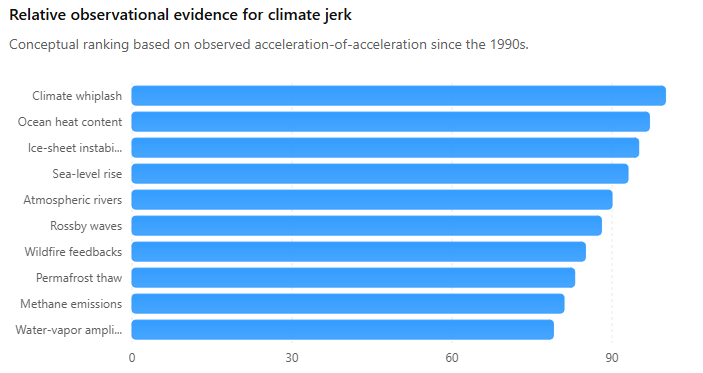
Tier 1: Strongest Observational Evidence of Climate Jerk
These indicators show some of the clearest evidence that acceleration itself is increasing.
- Hydrological extremes and drought–flood climate whiplash
- Ocean heat content and marine heatwaves
- Greenland and Antarctic ice-sheet dynamic instability
- Sea-level rise doubling times
- Atmospheric river intensity
- Rossby wave amplification and persistence
- Wildfire feedback amplification cycles
- Permafrost thaw and thermokarst collapse
- Methane emissions from wetlands and thawing permafrost
- Atmospheric water-vapor amplification
Tier 2: Strong Evidence of Accelerating Nonlinear Behavior
These exhibit strong acceleration and emerging jerk characteristics.
- Arctic sea ice decline
- Polar amplification
- Wet-bulb temperature exceedances
- Lengthening and increasingly persistent heat waves
- Accelerating increases in nighttime minimum temperatures
- Wildfire frequency and burned area
- Temperature-gradient destabilization
- Moisture-gradient amplification
- Pressure-gradient amplification
- AMOC weakening
- Boreal forest stress and biome migration
- Amazon rainforest dieback
- Zombie fires / overwintering fires
Tier 3: Moderate Evidence of Jerk
Acceleration is evident, but the observational record is shorter, noisier, or attribution is more complex.
- Growing urban heat persistence and diminished nighttime recovery
- Seasonal expansion
- Glacial retreat rates
- Coral reef bleaching and dieoff
- Species range shifts and ecosystem reorganization
- Crop yield instability
- Surface and tropospheric temperature trends
Tier 4: Emerging or Indirect Indicators
These are important but currently provide weaker direct observational evidence of climate jerk.
- Ocean acidification
- Climate-driven changes in Earth’s rotation and mass distribution
Why the Top Five Rank Highest
1. Hydrological extremes and climate whiplash
The transition from “500-year” floods toward repeated extreme events in many regions is one of the most societally visible examples of increasing acceleration.
2. Ocean heat content
The ocean stores over 90% of Earth’s excess energy, and OHC records show a remarkably persistent upward curvature that has become more pronounced since the 1990s.
3. Ice-sheet dynamic instability
Both Greenland and parts of Antarctica have shifted from relatively gradual mass loss toward increasingly dynamic and nonlinear ice discharge.
4. Sea-level rise
The shortening of sea-level-rise doubling times is one of the clearest mathematically measurable examples of acceleration itself increasing.
5. Atmospheric rivers and Rossby-wave behavior
These indicators connect directly to the growing prevalence of extreme floods, droughts, heat domes, and persistent weather patterns.