By Daniel Brouse November 20, 2025
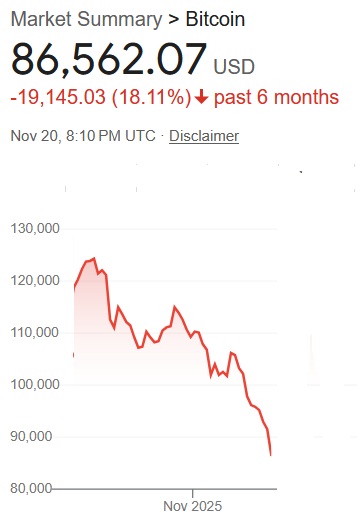
Bitcoin has fallen from $120,000 to under $90,000 in just six weeks. What’s behind the move?
Two forces are doing most of the work:
- Leverage
- A fundamental shift in how markets classify Bitcoin—from risk-on to risk-off
1. Leverage: The Amplifier Behind the Drop
While we can’t pin down an exact percentage of leveraged Bitcoin exposure, it is unquestionably large, reflexive, and sensitive to volatility.
- Cumulative open interest in perpetual BTC futures recently climbed to about $43.6 billion, indicating enormous leveraged positioning.
- Leveraged ETFs now represent nearly 25% of open interest on the CME, and some estimates put total market leverage even higher.
When BTC softens, margin calls begin. Loans are called, collateral thresholds are breached, and automated liquidations kick in. Those liquidations create forced selling, which drives prices lower—triggering still more liquidations. It’s a classic cascade: leverage doesn’t just add fuel; it adds momentum to both rallies and crashes.
2. Bitcoin’s Identity Crisis: From Risk-On Hedge to Risk-Off Liability
For years, Bitcoin was lumped in with gold as a “risk-on” inflation hedge. When deficits ballooned, inflation expectations rose, or geopolitical stress intensified, BTC often rallied.
But that perception has flipped. Entire macro trading systems are now treating Bitcoin as a risk-off asset—something to dump, not buy, when stress rises.
Why the reversal?
- Bitcoin has become tightly intertwined with leveraged speculative flows.
- Institutional quant desks increasingly treat BTC as a proxy for market liquidity, not inflation.
- Rising real yields and tighter financial conditions have made Bitcoin behave less like digital gold and more like a high-beta liquidity sponge.
When markets rotate into fear, Bitcoin isn’t the refuge—it’s the first asset sold in bulk.
3. The Stock Market Parallel: A Leverage Environment Ripe for Contagion
To understand the broader implications, it helps to look backward. The 1929 crash was fueled by roughly 10% leverage in equities. Today, by many measures, equity leverage is above that threshold, once you include:
- Margin debt
- Options exposure
- Leveraged volatility products
- Structured derivatives
- High-frequency strategies embedding synthetic leverage
Since “Liberation Day’s” correction, traders have again viewed equities as a risk-on bet. But here’s the critical shift:
Many algorithmic trading models now treat Bitcoin’s behavior as a signal for equity risk.
Meaning:
- When Bitcoin sells off in a risk-off pattern
- Models assume broader liquidity stress is rising
- So the algorithms reduce equity exposure right alongside Bitcoin
This creates a cross-asset feedback loop that didn’t exist a few years ago.
4. The New Market Regime: Bitcoin as a Sentiment Barometer
Bitcoin’s transformation from a risk-on hedge to a risk-off trigger is reshaping market structure:
- Bitcoin weakness → signals liquidity stress
- Liquidity stress → triggers systematic de-risking
- Systematic de-risking → amplifies equity volatility
- Heightened equity volatility → creates more Bitcoin selling
In other words, Bitcoin—once touted as a portfolio diversifier—is increasingly becoming a sentiment accelerant. It now behaves not like gold, but like a voltage meter for market fragility.
5. Is Bitcoin Speculative?
A: Yes, very speculative. And there’s a deeper issue that rarely gets discussed: it’s unlikely Bitcoin will ever fully regain its old “digital gold” status because its long-term vulnerabilities are fundamentally different from those of a physical asset like gold.
Gold exists in the real world. You can hold it, store it, bury it, vault it — and none of that depends on software, electricity, networks, miners, or cryptographic standards remaining unbroken for decades.
Bitcoin, by contrast, relies on a long chain of non-tangible systems: a functioning global internet, distributed mining infrastructure, long-term cryptographic stability, wallet software, recovery mechanisms, and digital interfaces that all must operate flawlessly. If any link in that chain fails, the ability to access or verify ownership can collapse. And with quantum computing likely to break the underlying cryptographic algorithms, Bitcoin’s current security model—and therefore its value—could be rendered effectively worthless.
That dependency stack makes it far more fragile than physical gold — and that fragility is exactly why many investors now treat Bitcoin as pure speculation rather than a durable store of value.