by Daniel Brouse
September 30, 2025
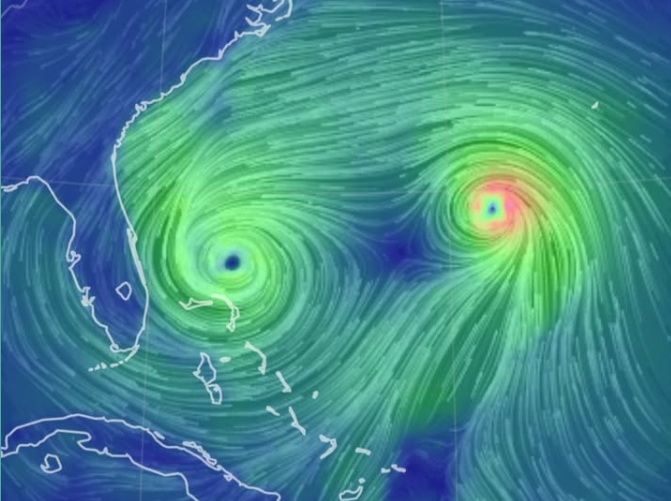
It is rare enough to see two hurricanes simultaneously spinning in the Mid-Atlantic. Even rarer still when those storms interact with a sagging jet stream and the disruption of the polar vortex. Yet this is precisely the kind of increasingly bizarre atmospheric alignment we are witnessing in the age of climate change. As human-driven warming accelerates, the complexity of interactions between climate systems grows—and so does the risk of compounding disasters.
Both Hurricane Imelda and Hurricane Humberto drew strength from the same underlying driver: climate change. Rising ocean temperatures provide hurricanes with more latent heat, acting as high-octane fuel that allows storms to intensify rapidly. Meanwhile, higher sea levels amplify the destructive power of storm surge. But the story does not end with simple cause and effect. Instead, these storms highlight a web of feedback loops that are making Earth’s climate system more volatile.
The Web of Feedback Loops
-
Ocean Warming → Stronger Storms → More Heat Released
Hurricanes act as massive heat engines, pulling energy from the ocean and releasing it into the atmosphere. Stronger storms churn up deeper warm water and transfer even more heat into the air, which in turn influences atmospheric circulation patterns, creating a self-reinforcing cycle. -
Jet Stream Disruption and Polar Vortex Instability
The warming of the Arctic is reducing the temperature gradient between the poles and the tropics. This weakens and destabilizes the jet stream, causing it to meander and sometimes stall. A sluggish jet stream allows storms to linger, dumping catastrophic amounts of rain in one place, or, in this case, to align with other anomalies like a displaced polar vortex. The interactions multiply, making storm tracks less predictable and more destructive. -
Storm Interactions – The Fujiwhara Effect
The Fujiwhara effect occurs when two cyclones rotate around a common center, sometimes merging, sometimes slingshotting one another into unexpected paths. While this phenomenon has long been known, climate change is increasing the probability of such interactions by raising the baseline frequency and intensity of storms. What was once an outlier may become a recurring feature of a warmer planet. -
Moisture Feedbacks
Warmer air holds more water vapor, itself a potent greenhouse gas. As hurricanes intensify, they release enormous amounts of moisture into the atmosphere, which not only fuels heavier rainfall but also reinforces global warming by amplifying the greenhouse effect.
The Complexity Problem
Each of these processes alone would be troubling. Together, they weave a feedback network where one climate anomaly feeds into another, raising the odds of compound events. Instead of single, isolated extremes, we are entering an era defined by overlapping crises: two hurricanes colliding while the jet stream buckles and the polar vortex slumps southward. The result is not linear change but exponential escalation in intensity, frequency, and absurdity.
Strange Times, Stranger Storms
The case of Imelda and Humberto illustrates how climate change is no longer about gradual warming alone—it’s about destabilization. As feedback loops interact, they amplify chaos in ways our models struggle to fully capture. The Fujiwhara effect may be the headline here, but the deeper story is the tangled web of reinforcing climate feedbacks now shaping the 21st century.
We have entered a strange new climate era, where storms no longer follow familiar rules and extremes overlap in ways that strain our infrastructure, economies, and imagination. If Imelda and Humberto are any indication, the future will not only bring more powerful storms but increasingly bizarre interactions that defy precedent.