by Daniel Brouse and Sidd Mukherjee
UPDATE TO: https://www.kingarthur.com/global_warming/Climate-Energy-Nor-Easter.html
Three Successive Nor’easters: Cumulative Damage, Declining Resilience, and Tipping Points
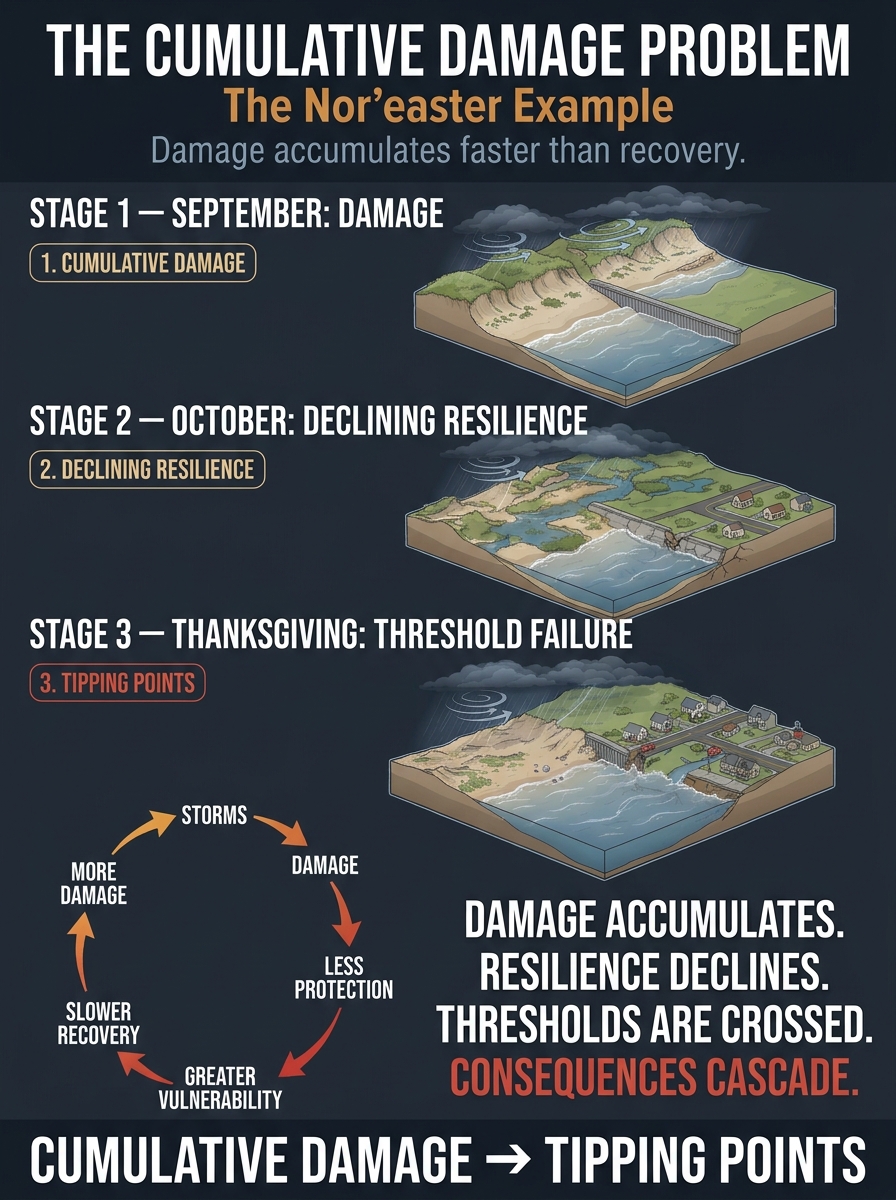
The September 2026 nor’easter was a major coastal disaster, but its consequences did not end when the storm moved offshore. Two subsequent coastal storm events, one in October and the powerful Thanksgiving Day storm on November 26, demonstrated why the economic and environmental consequences of extreme weather must be evaluated cumulatively.
The critical issue is not simply how much damage an individual storm produces. It is how much damage remains when the next storm arrives.
This introduces three interconnected concepts: cumulative damage, declining resilience, and tipping points.
1. Cumulative Damage: Each Storm Inherits the Damage of the Previous One
Coastal storms are often evaluated as separate events. A storm arrives, produces flooding and erosion, emergency repairs begin, and the event is eventually declared over.
But the physical environment does not reset when a storm ends.
Consider what happens when a powerful nor’easter removes beach sand, cuts into protective dunes, damages boardwalks, undermines roads, and floods buildings.
Those losses remain until they are repaired or naturally restored.
If another storm arrives before recovery is complete, it encounters a coastline that is physically different from the one encountered by the previous storm.
The October coastal storm added another disturbance to the region’s already stressed coastal environment. Then, on November 26, Thanksgiving Day, another powerful nor’easter brought damaging winds, heavy rainfall, and major to record coastal flooding to portions of the East Coast.
The Thanksgiving storm demonstrated the consequences of this continuing exposure:
- Cape May, New Jersey, exceeded its previous all-time high-water record from January 2016.
- Atlantic City and Ocean City, New Jersey, experienced their highest storm tides since Superstorm Sandy in 2012.
- Lewes, Delaware, recorded its third-highest storm tide.
- Norfolk, Virginia, experienced its highest storm tide since Hurricane Isabel in 2003.
- Seawater again breached protective dunes along North Carolina’s Outer Banks, flooding Highway 12.
- Hundreds of thousands of utility customers lost electricity, with the national outage total approaching one million.
These impacts demonstrate that coastal vulnerability is not determined by the latest storm alone.
It also depends on the physical condition of the coastline, the accumulated damage from previous events, and the ability of communities and natural systems to recover.
Sources: National Weather Service, FEMA, Associated Press, and reporting on the November 26 storm.
2. Declining Resilience: The System Loses Its Ability to Recover
Resilience is the capacity of a natural or human system to absorb a disturbance, maintain essential functions, and recover.
For a coastal environment, resilience depends on several interconnected protective systems.
Beaches provide a buffer that absorbs wave energy and redistributes sand.
Dunes provide elevated natural barriers against storm-driven water and waves.
Barrier islands help dissipate wave energy and protect mainland communities and estuaries.
Wetlands store floodwater, reduce wave energy, and help stabilize shorelines.
Infrastructure provides additional protection through engineered barriers, drainage systems, roads, utilities, and coastal defenses.
These systems do not recover at the same rate.
A storm can remove beach sand in hours. Natural beach recovery may require months or years, depending on wave conditions, sediment supply, and subsequent storms.
Dune restoration may require additional time and intervention. Infrastructure repairs can take months or years, while damaged ecosystems may require even longer.
This creates a fundamental mismatch:
STORM DAMAGE CAN OCCUR IN HOURS OR DAYS.
RECOVERY CAN REQUIRE MONTHS OR YEARS.
When the interval between damaging events is shorter than the time required for recovery, the system begins each new storm with diminished resilience.
This is the cumulative damage problem.
It also means that the same storm can produce substantially different consequences depending on the condition of the coastline when it arrives.
A beach with a wide sand buffer and intact dunes can absorb disturbances that would overwhelm a beach already stripped of its protective features.
A community with functioning drainage, electrical infrastructure, and intact coastal defenses can recover more effectively than one whose protective systems have already been compromised.
The important variable is not just storm intensity. It is the remaining resilience of the system.
3. Tipping Points: When Incremental Damage Produces Disproportionate Consequences
A tipping point occurs when a system reaches a threshold beyond which its behavior changes substantially.
Coastal systems provide understandable examples of how this can happen.
A beach gradually loses sand. Its protective capacity diminishes. Dunes become narrower and lower. Repeated waves penetrate farther inland.
Initially, the consequences may appear incremental.
But eventually, a threshold can be reached.
A dune breach can allow storm-driven water to move into areas previously protected from direct inundation. A barrier island can experience extensive overwash. A road can become impassable. Floodwater can reach electrical equipment, buildings, and critical infrastructure.
The transition from a protected coastline to an inundated community can happen rapidly even though the deterioration that made it possible occurred over many years.
This is an important distinction between gradual deterioration and abrupt system response.
The system may lose resilience incrementally, but the consequences of crossing a physical threshold can be sudden and disproportionate.
The Thanksgiving storm’s renewed dune overwash and flooding of Highway 12 illustrate this type of coastal vulnerability. They are evidence of a physical threshold being exceeded locally, not proof that a global climate tipping point has been crossed.
4. The Feedback Between Damage, Vulnerability, and Economic Loss
The relationship becomes more consequential when physical damage and economic exposure interact.
Consider this progression:
Storm → Beach and dune erosion → Reduced natural protection → Greater exposure to the next storm → More flooding and infrastructure damage → Higher repair costs → Longer recovery → Greater vulnerability.
This is a reinforcing cycle.
The economic consequences also accumulate.
Communities must pay for repeated beach replenishment, dune restoration, road repairs, utility reconstruction, flood mitigation, emergency response, and property restoration.
Insurance losses and repeated flooding can further increase the financial burden on homeowners, businesses, local governments, and taxpayers.
A community can therefore experience increasing economic losses even when individual storms do not become progressively stronger.
Why?
Because the vulnerability of the community has increased.
The same amount of storm energy can produce greater damage when natural protection has diminished and infrastructure has become more exposed.
This is why measuring the cost of each storm independently understates the potential long-term economic burden.
The true cost includes unrepaired damage, diminished protective capacity, repeated restoration expenses, and the increasing cost of maintaining essential services.
5. The Climate-Energy Connection: Background Conditions Matter
Nor’easters are natural weather systems. Their occurrence does not independently establish that climate change caused them.
However, the environmental conditions into which these storms arrive influence their consequences.
Several factors deserve particular attention:
Rising sea levels: Higher background water levels increase the starting point for storm-driven coastal flooding.
Ocean heat content: The ocean stores the overwhelming majority of the excess heat accumulating in the climate system. Ocean conditions influence atmospheric moisture and the energy exchange between the ocean and atmosphere.
Atmospheric moisture: A warmer atmosphere can hold more water vapor, increasing the potential for heavy precipitation when atmospheric conditions support it.
Coastal erosion: Repeated wave action and elevated water levels can reduce the volume of natural protective features.
Infrastructure exposure: Development in vulnerable coastal areas increases the amount of property and infrastructure exposed to flooding.
These factors interact. Their individual contributions must be evaluated rather than automatically attributed to a particular storm.
The larger concern is that changing background conditions can increase the consequences of naturally occurring weather disturbances.
6. Resilience Is a Race Against Time
The September, October, and Thanksgiving storms illustrate a critical problem for coastal planning.
Recovery is not simply a matter of repairing what was damaged.
It is a race against the next disturbance.
If natural systems and infrastructure can recover before another major storm arrives, resilience can be maintained or restored.
If disturbances arrive faster than recovery, accumulated damage progressively reduces the system’s ability to absorb additional impacts.
This creates two fundamentally different trajectories.
Recovery trajectory:
Storm → Damage → Restoration → Recovery of protective capacity → Greater resilience.
Declining-resilience trajectory:
Storm → Damage → Incomplete recovery → Another storm → Additional damage → Reduced protection → Greater vulnerability.
The second trajectory can eventually lead to abrupt failures when physical thresholds are exceeded.
This is particularly important because restoration does not necessarily return a system to its original condition. Repeated rebuilding may become more expensive, natural sediment supplies may be insufficient, and some protective features may become increasingly difficult to restore.
Resilience must therefore be measured not only by how much damage a system can withstand, but also by how quickly and completely it can recover.
7. From Cumulative Damage to the Domino Effect
The implications extend beyond individual beaches and coastal communities.
Natural systems, infrastructure, economies, and human populations are interconnected.
Coastal erosion can undermine roads. Road closures can disrupt transportation and emergency services. Power outages can interrupt water treatment and communications. Flooding can damage businesses, housing, and public infrastructure.
One failure can increase the consequences of another.
This is the same general principle underlying the climate feedback and tipping-point network:
FEEDBACK LOOPS → TIPPING POINTS → COUPLING → ACCELERATION → BIFURCATION → DOMINO EFFECT
The successive nor’easters provide a practical example of how disturbances interact with an increasingly vulnerable system.
The important question is no longer limited to how much energy a storm releases or how much damage it produces.
We must also ask how much resilience remains when the next disturbance arrives.
The Bottom Line: Damage Accumulates, Resilience Declines, and Thresholds Matter
The September 2026 nor’easter demonstrated how atmospheric and oceanic energy becomes physical destruction and economic loss.
The October storm added another disturbance.
The Thanksgiving Day nor’easter demonstrated how another powerful event can produce exceptional coastal flooding, damaging winds, and additional infrastructure disruption.
Together, these events illustrate a fundamental principle of climate and disaster risk:
A system’s vulnerability is determined not only by the disturbance it experiences, but also by the condition in which it enters that disturbance.
When damage accumulates faster than recovery, resilience declines.
When resilience declines, the same disturbance can produce greater consequences.
And when a critical threshold is crossed, gradual deterioration can transition into abrupt and disproportionate failure.
The economic significance is enormous. We cannot accurately evaluate the cost of climate-related disasters by adding up isolated storm damage estimates while ignoring the progressive deterioration of the systems expected to protect us.
The real cost includes what was damaged, what was never restored, what became more vulnerable, and what the next storm may overwhelm.
DAMAGE ACCUMULATES.
RESILIENCE DECLINES.
THRESHOLDS ARE CROSSED.
THE CONSEQUENCES CAN CASCADE.
Research Sources
- October 18–23 coastal storm: Northeast Regional Climate Center — October 2026 and AccuWeather storm report.
- Thanksgiving storm: Weather.com — November 27 storm assessment.
- Pennsylvania impacts: National Weather Service — State College.
- Regional storm summary: National Weather Service Weather Prediction Center.