How Aging Populations, Immigration, Artificial Intelligence, and Workforce Replacement Are Reshaping the Stock Market
By Daniel Brouse
Economist | Financial Analyst
Simplified Overview
Retirement Planning in the Age of Demographic and Technological Disruption
The economic forces shaping retirement are changing—and the implications for the stock market deserve serious attention.
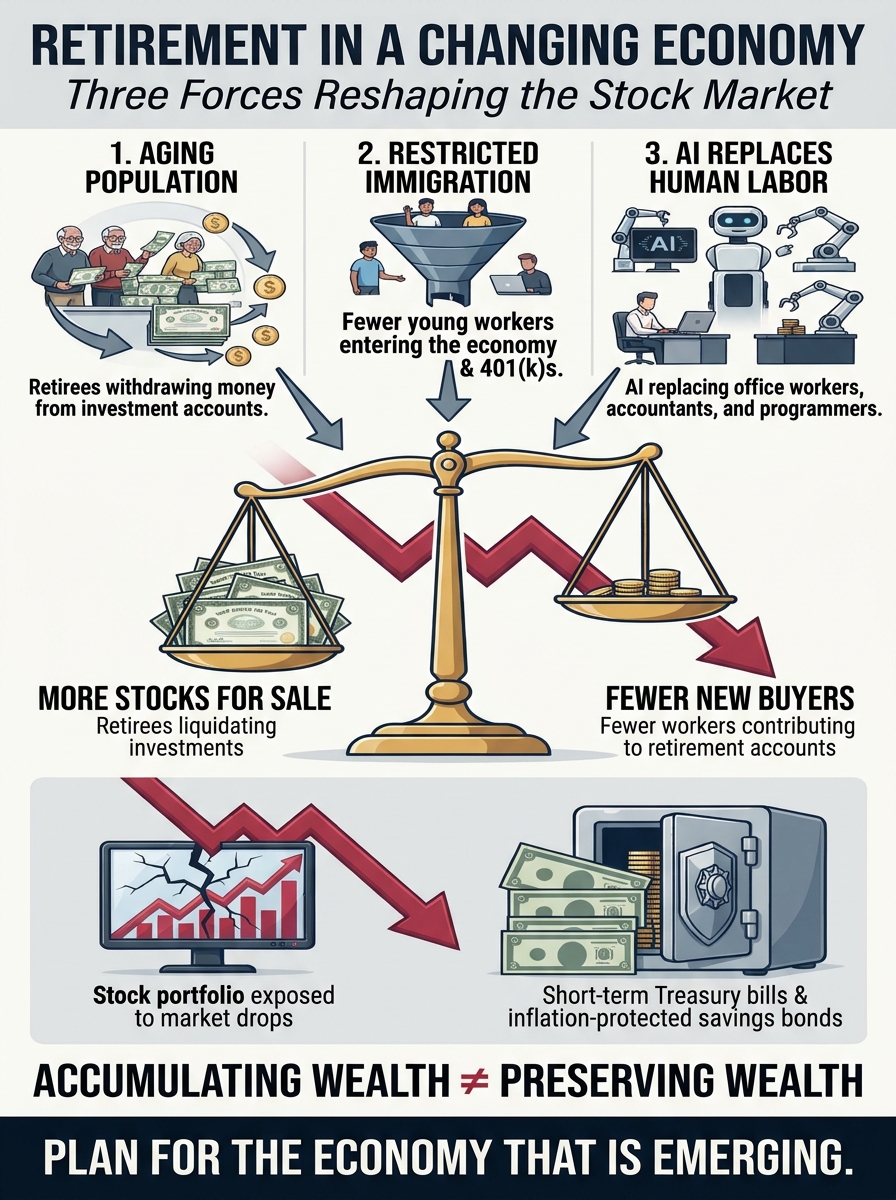
An aging population is increasing retirement withdrawals. Restrictive immigration policies are narrowing the future workforce and investment base. Meanwhile, artificial intelligence is transforming the labor market, allowing corporations to increase productivity while reducing their dependence on human workers.
These forces create a fundamental contradiction: Corporate profits can rise even as the number of workers earning wages, contributing to 401(k) plans, and investing for retirement declines.
For decades, expanding employment and investment contributions helped fuel the stock market. That foundation is changing. More retirees are drawing down accumulated wealth while technological disruption reshapes the next generation of investors.
The stock market can continue rising while the economic foundation supporting widespread retirement investing weakens.
Retirement planning must account for more than market history. It must recognize the demographic, technological, and financial changes now reshaping the economy.
My recommendation: Read the entire article. It explains why these converging forces matter, how they may affect retirement portfolios, and why traditional retirement strategies deserve a fresh examination. Don’t plan for the economy of yesterday—prepare for the one emerging today.
Introduction
Historically, your current age, anticipated retirement age, and life expectancy were the dominant determinants of retirement planning. However, the times are changing.
The United States faces a demographic double whammy: an aging population and an increasingly anti-immigration political climate. Now, a third force is accelerating the transformation of the economy: artificial intelligence (AI) and the replacement of human labor.
These trends are converging at precisely the wrong time for traditional retirement planning.
Millions of Baby Boomers are transitioning from accumulating investments to liquidating them. Restrictive immigration policies are limiting the growth of the workforce and the next generation of investors. Meanwhile, AI is increasing productivity while eliminating the need for human workers across an expanding range of occupations.
This creates a fundamental shift in the supply and demand for stocks. The market is transitioning from decades of expanding investment contributions to an environment characterized by growing retirement withdrawals and a shrinking pool of human workers earning income and investing in retirement accounts.
The economic consequences extend beyond employment. AI can increase corporate productivity and profitability while simultaneously reducing the number of people receiving wages, contributing to retirement plans, and purchasing financial assets.
The implications extend well beyond retirement planning. They challenge the underlying demographic, employment, and economic assumptions supporting historical stock market returns.
Why This Matters
Four major structural changes are reshaping the financial landscape:
- An aging population is shifting investment capital from accumulation to liquidation.
- Restrictive immigration policies are limiting workforce growth and reducing the potential pool of new investors.
- Artificial intelligence and automation are replacing human labor, reducing the number of workers earning wages and contributing to retirement accounts.
- The transition from traditional pensions to individually managed 401(k)s is transferring investment risk from institutions to individuals.
Historically, stock market returns benefited from population growth, expanding workforces, increasing retirement contributions, rising consumer demand, and institutional pension accumulation.
Those conditions are changing.
The combined effect is an increasingly unfavorable relationship between the supply of stocks being sold and the demand for stocks being purchased. At the same time, individual retirees are becoming increasingly exposed to market volatility and the risk of exhausting their retirement savings.
The central economic problem is that productivity, corporate profitability, employment, household income, and investment demand are no longer necessarily moving in the same direction.
AI can make companies more profitable without creating an equivalent number of new jobs or retirement investors.
1. An Aging Population Reverses the Flow of Investment Capital
The United States is experiencing a major demographic transition. The Baby Boomer generation is firmly entering retirement, and Generation X is approaching retirement age.
This is not simply a change in the age distribution of the population. It represents a fundamental change in the direction of investment capital.
A Growing Supply of Stocks
Working-age adults traditionally provide a steady stream of new investment capital through payroll deductions, 401(k) contributions, and personal investments.
Retirees increasingly do the opposite. They liquidate equities to finance living expenses, healthcare, and other retirement needs. Required Minimum Distributions (RMDs) further accelerate withdrawals from tax-deferred retirement accounts.
As millions of Americans transition from accumulating investments to withdrawing them, the supply of stocks being offered for sale increases.
A Shrinking Pool of Buyers
The number of working-age Americans relative to retirees is declining. Consequently, the traditional source of new investment capital is weakening relative to the growing demand for retirement withdrawals.
This creates a fundamental demographic imbalance:
- More retirees are selling accumulated investments.
- Fewer new workers are entering their peak investment-accumulation years relative to the retiring population.
- Retirement withdrawals are increasingly competing with new investment contributions.
- The domestic pool of potential stock buyers is growing more slowly than it would under a younger, expanding population.
Supply and Demand Determine Market Prices
Stock prices are ultimately determined by supply and demand.
When the number of shares investors want to sell increases relative to the capital available to purchase them, downward pressure on prices follows.
This demographic transition changes the underlying market dynamics that helped drive decades of stock market appreciation.
The effects extend beyond investment flows. An older population generally has different consumption patterns, including reduced demand for housing, automobiles, and other major purchases.
Slower workforce growth and changing consumption patterns can constrain economic expansion, corporate revenue growth, and earnings expectations.
The result is a combination of increasing retirement-related selling pressure and potentially slower earnings growth.
2. Restrictive Immigration Policies Shrink the Future Workforce and Investment Base
Immigration has historically helped offset declining U.S. birth rates by supplying workers, consumers, entrepreneurs, taxpayers, and new participants in financial markets.
Immigration is not simply a labor-market issue. It is also a financial-market demand issue.
Immigrants contribute to the economy as workers, consumers, entrepreneurs, and investors. They expand the pool of people earning wages and contributing to retirement accounts.
Restricting immigration while the domestic population ages compounds the demographic imbalance.
The United States is effectively reducing the growth of its future workforce and investment base at the same time that an enormous generation of existing investors is entering its withdrawal years.
A Smaller Pool of New Buyers
Fewer working-age immigrants mean fewer potential contributors to 401(k)s, fewer new consumers, and fewer participants in the domestic investment market.
At the same time, millions of retirees are withdrawing accumulated savings.
This creates a two-sided financial-market problem:
- Increasing numbers of retirees are liquidating accumulated investments.
- Fewer new workers and investors are entering the system to replace that investment demand.
Foreign investment and institutional capital can influence the balance, but they do not eliminate the underlying demographic shift in domestic investment flows.
3. Artificial Intelligence and Human Workforce Replacement Change the Economics of Retirement
Artificial intelligence introduces another structural change that traditional retirement planning models have not adequately incorporated.
Previous technological revolutions generally increased productivity while creating new industries and employment opportunities. AI is different in an important respect: it can directly perform cognitive and administrative tasks previously requiring human workers, while robotics and automation extend these capabilities into physical occupations.
The result is an economy increasingly capable of producing more goods and services with fewer human workers.
Productivity Gains Without Equivalent Employment Growth
AI can increase corporate productivity by automating tasks, reducing administrative expenses, accelerating research, improving logistics, and replacing portions of existing workforces.
Businesses can increase output without proportionally increasing payrolls.
For shareholders, this can be extremely beneficial:
- Lower labor expenses.
- Higher operating efficiency.
- Increased production capacity.
- Reduced administrative overhead.
- Improved corporate profit margins.
- Greater output per employee.
However, the benefits to shareholders do not automatically translate into equivalent benefits for workers.
When AI replaces human labor, the wages previously paid to those employees can disappear or decline. The economic value created by automation increasingly accrues to businesses, technology owners, and shareholders rather than being distributed through traditional employment income.
Fewer Workers Mean Fewer Retirement Contributions
This creates a serious problem for a retirement system dependent on human employment and payroll contributions.
Traditional 401(k) accumulation depends heavily on people receiving wages and contributing a portion of their income to retirement accounts.
When AI eliminates jobs or reduces the number of employees needed to perform existing work:
- Fewer people receive employment income.
- Fewer workers participate in employer-sponsored retirement plans.
- Payroll-based retirement contributions decline.
- Employers may reduce matching contributions as their workforces shrink.
- Younger generations face greater difficulty accumulating retirement savings.
- The pool of new investors supplying capital to financial markets weakens.
Even when displaced workers find new employment, lower compensation, interrupted careers, or extended periods outside the workforce can reduce their lifetime retirement contributions.
The consequences extend beyond unemployment statistics. They affect the future flow of investment capital.
Corporate Profitability Versus Household Income
One of the most important economic consequences of AI is the potential separation of corporate profitability from broad-based household income growth.
A company can increase revenue and profits while employing fewer people. Its stock can appreciate even as the number of workers contributing to retirement accounts declines.
This creates an increasingly unequal distribution of economic gains.
Shareholders benefit from productivity improvements and lower labor costs, while displaced workers lose wages, purchasing power, and opportunities to accumulate retirement assets.
The problem is not that AI reduces productivity. The problem is that productivity gains do not automatically replace lost employment income or generate equivalent investment contributions.
The Retirement Investment Paradox
AI creates a fundamental contradiction for financial markets.
On one side, automation can increase corporate earnings and make stocks more attractive to existing investors.
On the other side, replacing human workers reduces the number of people earning wages, contributing to retirement plans, and supplying new investment capital.
The economy can therefore experience rising corporate profitability alongside weakening household investment demand.
This is particularly consequential when millions of existing investors are simultaneously withdrawing their retirement savings.
AI and the Future of Consumer Demand
Employment income also supports consumer spending.
If AI-driven workforce replacement reduces aggregate household income without an equivalent redistribution of productivity gains, consumer purchasing power can weaken.
Businesses may become more efficient and produce more goods and services, but they still need customers capable of purchasing those products.
This creates another potential economic imbalance: increasing productive capacity accompanied by insufficient household income growth to sustain demand.
The long-term consequences depend heavily on how productivity gains are distributed through wages, ownership, taxation, and public policy.
However, traditional retirement models cannot assume that productivity growth will automatically produce expanding employment, household income, or retirement contributions.
Labor Shortages, AI Productivity, and Higher Operating Costs
Restrictive immigration policies and an aging population reduce the available human workforce. AI and automation provide businesses with an increasingly powerful means of compensating for those shortages.
This creates two competing economic effects.
First, a shrinking workforce increases competition for human workers in occupations that remain difficult to automate. Labor shortages can increase wages and operating expenses, particularly in healthcare, construction, transportation, agriculture, and other labor-intensive industries.
Second, AI productivity and automation allow companies to replace workers, reduce payroll expenses, and increase output with fewer employees.
Businesses that successfully adopt these technologies can offset labor shortages, improve productivity, and protect or expand profit margins.
However, the financial benefits of this transition come with a broader economic cost if human labor income and employment opportunities decline faster than new industries and occupations replace them.
The consequences extend directly into financial markets:
- AI can increase corporate profitability.
- Human workforce replacement can reduce household income.
- Reduced employment can weaken retirement contributions.
- Lower household purchasing power can constrain consumer demand.
- Fewer retirement investors can reduce the flow of new investment capital.
The central distinction is that AI can solve a company’s labor-cost problem while simultaneously worsening the economy’s retirement-investment and household-income problems.
4. The Shift from Pensions to 401(k)s Transfers Risk to Individuals
Decades ago, many private-sector workers relied on Defined Benefit (DB) pension plans. These institutional arrangements provided retirement income based on established formulas, with employers and pension funds responsible for managing investment risk.
Today, many workers depend on Defined Contribution (DC) plans, particularly 401(k)s.
This transition fundamentally changes who bears the financial risk.
| Risk Factor | Traditional Pensions (Defined Benefit) | Self-Managed 401(k)s (Defined Contribution) |
|---|---|---|
| Investment Risk | Primarily employer or pension fund | Individual account holder |
| Investment Horizon | Institutional, potentially spanning generations | Individual retirement lifetime |
| Sequence-of-Returns Risk | Distributed across the pension fund | Directly affects the individual’s account |
| Investment Management | Institutional professionals | Individual or hired investment manager |
| Behavioral Risk | Primarily institutional | Individuals may panic-sell during downturns |
| Retirement Income | Established benefit formula | Depends on accumulated assets and withdrawals |
Sequence-of-Returns Risk
One of the greatest dangers facing individual retirement investors is sequence-of-returns risk.
A major stock market decline immediately before or during the early years of retirement can permanently damage an individual’s retirement savings.
Consider what happens when a retiree must sell investments to pay living expenses during a market downturn.
Selling shares at depressed prices permanently reduces the number of shares remaining in the account. Even if the market eventually recovers and historical average returns are restored, the individual’s portfolio may never recover because too much principal was liquidated during the downturn.
This is fundamentally different from the experience of an investor who is still working, contributing regularly, and accumulating shares at lower prices.
Forced De-Risking
Institutional pension funds generally have longer investment horizons and can distribute investment risk across large pools of participants and assets.
Individual 401(k) investors have a finite retirement horizon. As retirement approaches, conventional investment strategies encourage them to reduce stock exposure and increase fixed-income holdings to protect accumulated principal.
When millions of individuals follow similar age-based investment strategies, this creates another source of widespread selling pressure.
The important distinction is that institutional funds can manage investment risk across generations, while individual retirees must manage it against their own remaining lifetimes.
The transition from pensions to 401(k)s compounds the demographic problem. Not only are more Americans entering their withdrawal years, but the responsibility for managing market risk has shifted from large institutions to individual households.
AI-driven employment disruption adds another layer of risk by weakening the future income and contribution streams on which individual retirement accounts depend.
Summary: Why History May Not Repeat Smoothly
Historical stock market outperformance occurred during periods characterized by population growth, expanding workforces, increasing retirement contributions, rising consumer demand, and substantial institutional pension accumulation.
Today’s financial environment is fundamentally different.
The United States is experiencing:
- An aging population withdrawing accumulated investments.
- A growing supply of stocks being liquidated to fund retirement.
- Slower domestic workforce growth.
- Immigration restrictions that reduce potential workforce expansion.
- A smaller pool of new domestic investors relative to the retiring population.
- AI-driven automation and human workforce replacement.
- Reduced dependence on human labor for corporate production.
- Potential declines in employment income and payroll-based retirement contributions.
- A retirement system increasingly dependent on individual investment accounts.
- Greater exposure to sequence-of-returns risk.
- Increasing pressure on retirees to transition from growth investments to capital preservation.
These are structural changes, not simply temporary economic fluctuations.
The demographic transition is altering the relationship between the supply of stocks being sold and the demand for stocks being purchased. AI adds another dimension by separating corporate productivity and profitability from traditional employment and household income growth.
The result is a financial system in which companies can become increasingly profitable while the broader population has fewer opportunities to earn income and accumulate investments.
The greatest mistake in retirement planning is assuming that the economic, employment, and demographic conditions responsible for historical stock market performance will continue indefinitely.
The United States is entering a fundamentally different economic era. The largest generation in modern American history is transitioning from accumulating wealth to consuming it. Restrictive immigration policies are limiting workforce expansion. AI is changing the relationship between human employment, corporate productivity, and household income.
This is a structural change in the supply and demand for equities, not merely another economic cycle.
Retirement planning must adapt accordingly.
Suggestions: Retirement Risk Management at Every Age
Retirement planning should not be based exclusively on maximizing historical average returns. Protecting principal, maintaining liquidity, and ensuring access to funds during market downturns are equally important.
My recommendations emphasize diversification, short-term fixed-income investments, and protection against unexpected economic conditions.
1. Increase Allocations to Short-Term Treasury Securities
A larger portion of retirement savings should be allocated to short-term U.S. Treasury securities, including four-week and eight-week Treasury bills.
These securities offer several advantages:
- Backed by the full faith and credit of the U.S. government.
- Short maturities limit exposure to interest-rate fluctuations.
- Funds can be reinvested as securities mature.
- Provide predictable maturity dates and access to principal.
- Reduce dependence on selling equities during market downturns.
Short-term Treasury securities are particularly useful for maintaining a reserve of funds needed for near-term retirement expenses.
2. Maximize Series I Savings Bond Purchases
Another valuable risk-management tool is the Series I savings bond.
The annual electronic purchase limit is $10,000 per individual, subject to applicable Treasury rules.
I-Bonds provide several important protections:
- Interest adjusts with inflation.
- The fixed-rate component remains in effect for the life of the bond.
- The composite interest rate cannot fall below zero.
- They provide protection against inflation-related erosion of purchasing power.
The annualized composite rate is 5.51% for the first six months of the applicable rate period. The fixed-rate component is 1.40%, which remains in place for the life of bonds purchased at that rate. The composite rate subsequently adjusts according to the inflation component.
I-Bonds have a 30-year maturity, but they can be redeemed after 12 months. Redeeming before five years results in a three-month interest penalty.
The combination of inflation protection and a nonnegative interest rate makes I-Bonds an important component of long-term capital preservation.
3. Protect Against Negative Interest Rates
Although unlikely in the United States, negative interest rates have occurred in other countries.
Traditional fixed-income investments can expose investors to unusual risks when interest rates become negative.
Series I savings bonds have a significant advantage: their composite interest rate cannot fall below zero.
This provides a floor against negative nominal interest accrual, helping preserve the bond’s principal.
Although this is a less likely economic scenario, diversification should account for unusual financial conditions as well as conventional market risks.
4. Diversify Beyond Traditional Retirement Models
Retirement planning should account for more than age and historical investment returns.
Investors should consider:
- Their expected retirement duration.
- The timing and amount of anticipated withdrawals.
- Inflation and interest-rate exposure.
- Market valuations and demographic trends.
- AI-driven employment and income disruption.
- The stability of their own future employment and retirement contributions.
- Sequence-of-returns risk.
- Liquidity requirements.
- The proportion of assets that must remain available regardless of market conditions.
The objective is not simply to accumulate the largest possible retirement account. It is to preserve enough purchasing power and liquidity to maintain financial independence throughout retirement.
Conclusion: Protecting Wealth in a Changing Economic Environment
The retirement landscape is changing. Demographics, immigration, artificial intelligence, and the transition from institutional pensions to individual investment accounts are fundamentally altering the financial risks facing American households.
An aging population is increasing the number of investors transitioning from accumulation to liquidation. Restrictive immigration policies are limiting the growth of the workforce and the next generation of domestic investors. AI is replacing human labor and changing the relationship between corporate profitability and household income.
These forces are converging.
The supply of stocks being liquidated by retirees is increasing while traditional sources of new investment demand are under pressure. At the same time, AI can increase corporate earnings without generating equivalent growth in employment, wages, or retirement contributions.
The economy can become more productive while fewer people participate in the traditional system of earning income, accumulating wealth, and funding retirement.
This is the fundamental contradiction facing the next generation of retirement investors.
The greatest mistake in retirement planning is relying on yesterday’s economic conditions to plan for tomorrow’s financial realities.
A sound retirement strategy must recognize that accumulating wealth and preserving wealth are two different financial challenges.
The most successful retirement plan is not necessarily the one that produces the highest historical average return. It is the one that provides financial security when market conditions, employment patterns, economic growth, and demographic trends change.
Plan for the economy that is emerging, not the one that existed when today’s retirement models were developed.