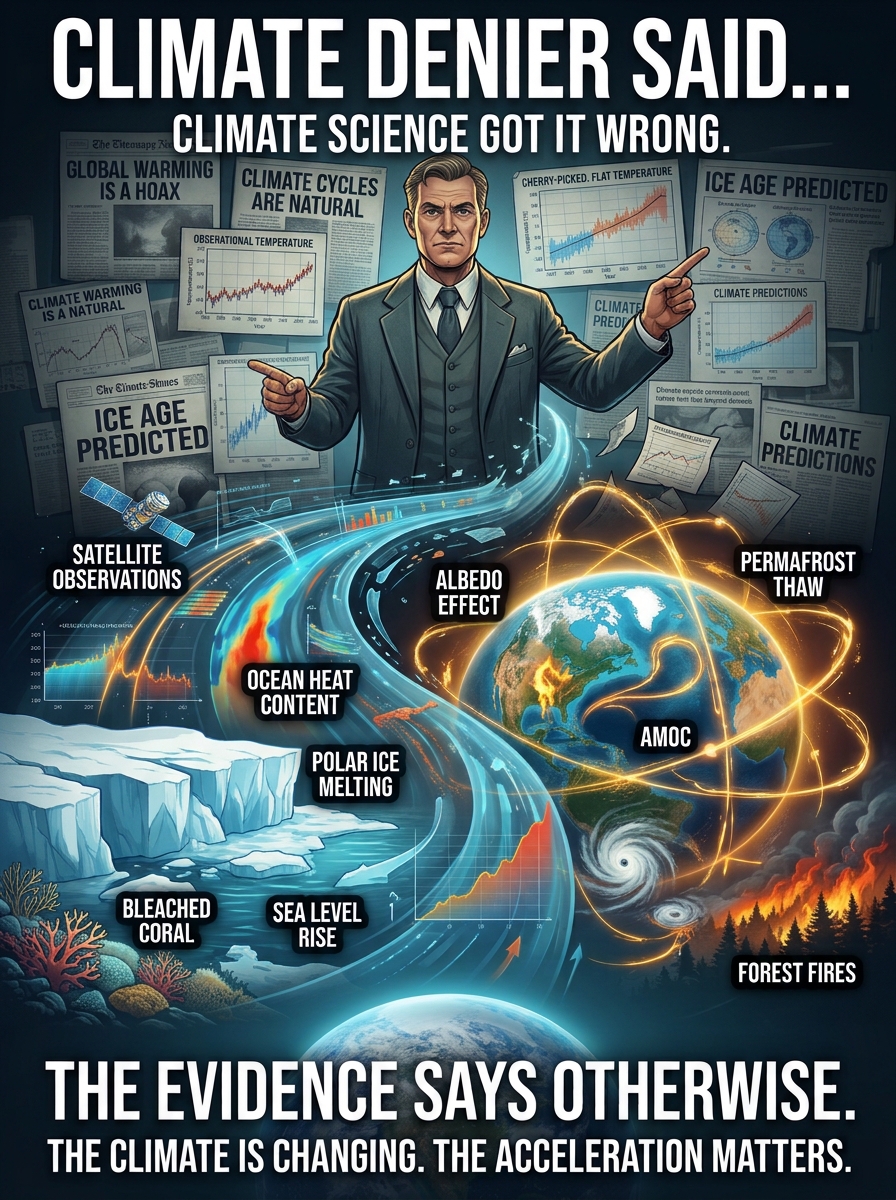
Climate denier said:
Scientist predictions and climate panic have always been wrong dating back to the 1930s.
I replied:
The argument that climate scientists have been getting their predictions wrong since the 1930s is a shameful misrepresentation of climate science. Climatologists develop evidence-based projections under specified emissions scenarios. Those projections are not unconditional predictions of exactly what will happen regardless of human behavior.
A particularly clear example is James Hansen’s June 23, 1988, testimony before the U.S. Senate Committee on Energy and Natural Resources. His original Scenario B projection has proven remarkably accurate. The fact that projections are conditional on emissions and other assumptions is not a weakness; it is fundamental to how climate science works.
The Geological Society of London—the UK’s professional association for geologists, founded in 1807—puts the rate of modern climate change into geological perspective:
“…the current speed of human-induced CO₂ change and warming is nearly without precedent in the entire geological record, with the only known exception being the instantaneous, meteorite-induced event that caused the extinction of non-bird-like dinosaurs 66 million years ago.”
And our own research points to an even more concerning development: acceleration itself.
The observed acceleration in Earth’s climate system is already alarming. But the possibility that this acceleration is itself increasing represents an even greater concern.
In 2025, we moved beyond relying primarily on second-derivative calculations to measure climate change, recognizing a shift from 2¹ to approximately 2⁵–2¹⁰ in acceleration behavior. Now, the evidence increasingly points toward third-derivative behavior.
Our climate model has consequently evolved into an adaptive, jerk-continuous growth-constant framework. It examines not just the velocity of warming and its acceleration, but how rapidly acceleration itself is changing as interacting feedback mechanisms amplify Earth’s energy imbalance.
Unlike conventional exponential models or simplified cubic approximations, our updated framework does not assume a fixed growth trajectory or constant climate jerk. It estimates the changing growth constant and its derivatives from observations, allowing the model to adapt to evolving climate conditions.
This represents a significant escalation in the level of concern. We are no longer examining simply exponential warming. We are investigating a climate system in which the rate of acceleration is itself changing, potentially amplifying an already alarming trajectory. — Daniel Brouse and Sidd Mukherjee
Conclusion
The historical record does not support the claim that climate science has been consistently wrong. It shows that scientists have refined their understanding as observations improved—and that some projections made decades ago have held up remarkably well. The real question is whether people are keeping up with the science.