Florida’s Flooding Is the Warning: How Polar Tipping Points Are Reshaping Climate Risk
How Is Climate Energy Hitting You?
Tipping Point Season at the Poles Comes to Florida
By Daniel Brouse and Sidd Mukherjee
Simplified Overview
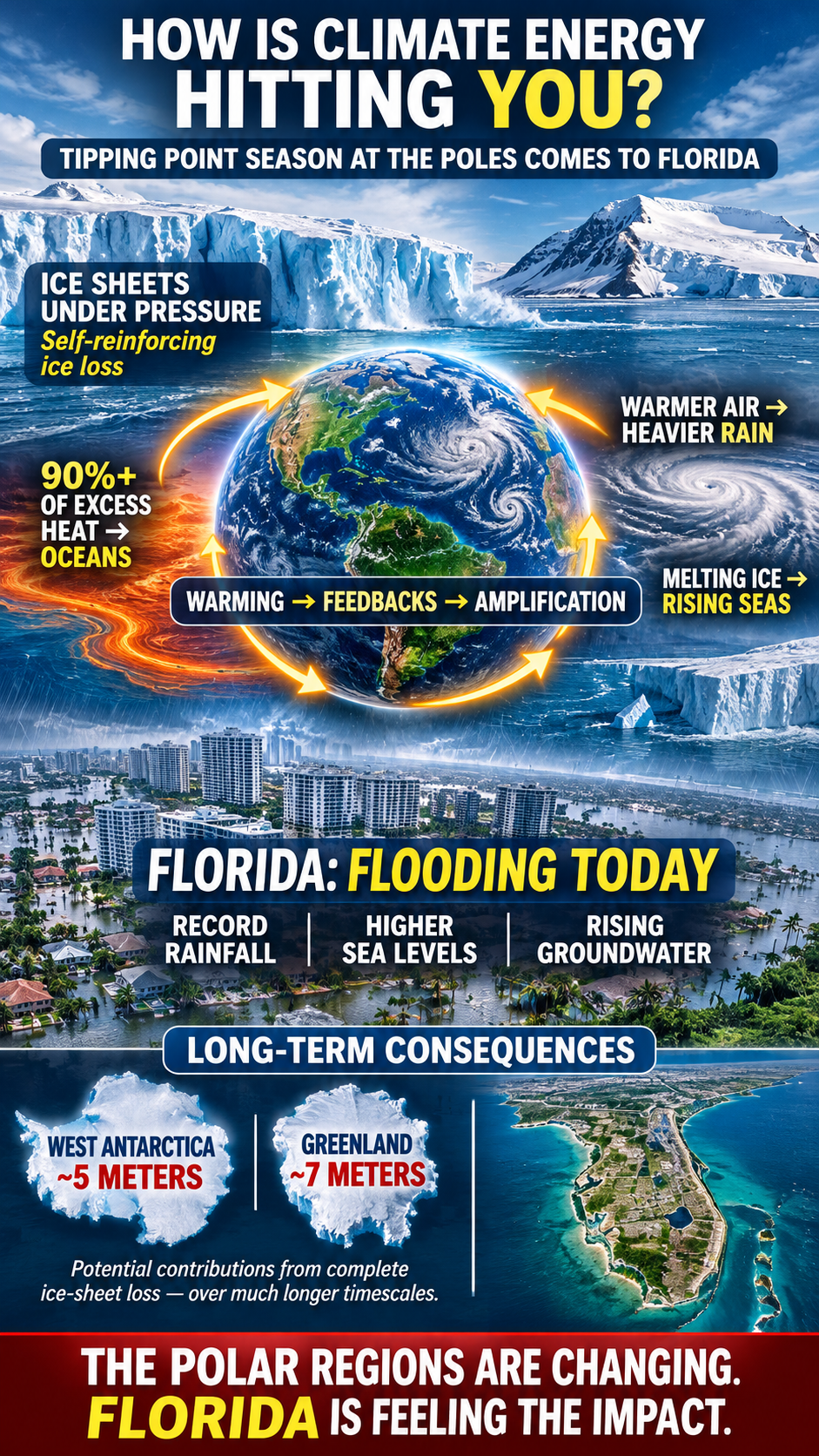
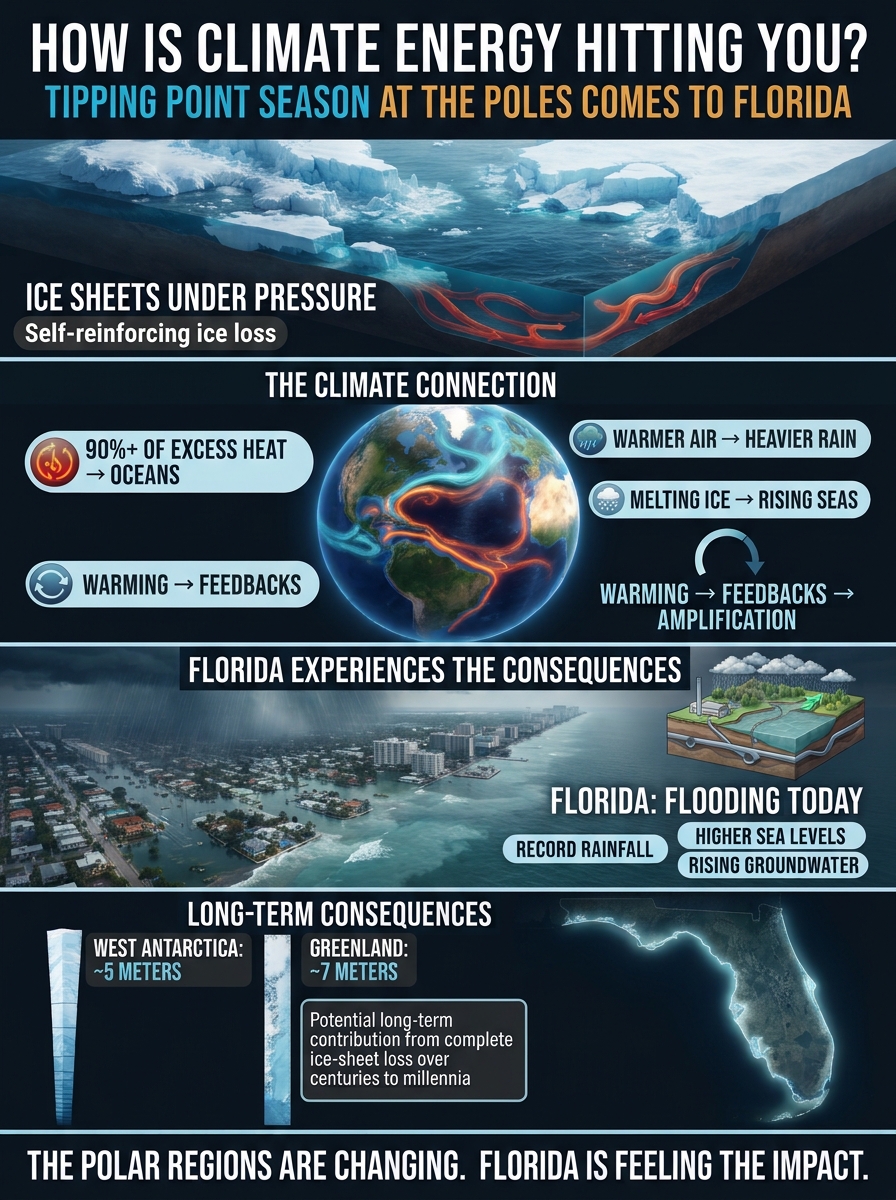
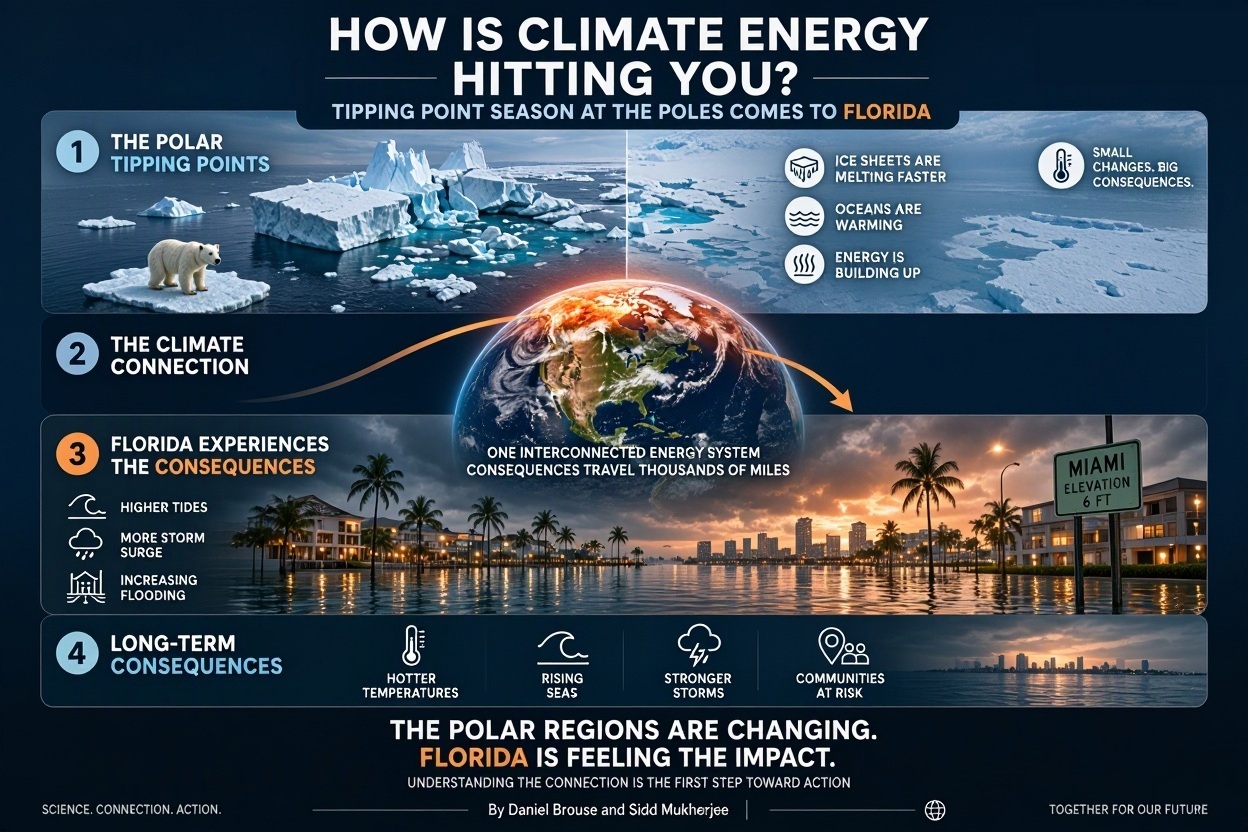
🌎 HOW IS CLIMATE ENERGY HITTING YOU?
Tipping Point Season at the Poles Comes to Florida
Florida’s flooding is not an isolated weather story. It is part of a larger climate system undergoing accelerating change.
The polar regions are absorbing and redistributing enormous amounts of climate energy. Melting ice, warming oceans, heavier rainfall, rising sea levels, and changing groundwater conditions are interconnected parts of the same system.
More than 90% of Earth’s excess heat is accumulating in the oceans. The consequences extend far beyond the poles.
This paper examines how polar ice-sheet destabilization, ocean warming, atmospheric feedbacks, and accelerating sea-level rise connect to the growing climate risks facing Florida.
We also examine the long-term consequences of complete ice-sheet loss. These are not forecasts of imminent sea-level rise; they represent contributions that would unfold over much longer timescales.
The polar regions are changing. Florida is feeling the impact.
Read the paper and explore the science.
Introduction
This paper connects two seemingly distant climate realities: accelerating changes in Earth’s polar ice systems and the immediate, increasingly severe flood risks facing Florida. The central message is that climate change is not simply a matter of rising temperatures. It is an energy-redistribution process that intensifies the hydrological cycle, raises sea levels, disrupts ocean circulation, and activates feedback mechanisms that amplify the consequences.
1. Historic Flooding in Florida — November 2026
Florida’s November 2026 flooding illustrates how changes in Earth’s climate system translate into immediate consequences for communities, infrastructure, property, and public safety.
The connection between Florida and the polar regions may not be immediately obvious. One is experiencing torrential rainfall, record river levels, and widespread flooding. The other is experiencing accelerating ice loss, thawing permafrost, and destabilizing ocean systems.
But these are not separate climate stories. They are interconnected consequences of an Earth system accumulating excess energy.
Climate change is raising the baseline for coastal flooding while increasing the atmosphere’s capacity to produce extreme precipitation. Meanwhile, destabilizing polar ice systems are committing the planet to additional sea-level rise that will continue unfolding over much longer timescales.
Florida is experiencing the immediate consequences of a changing climate. The polar regions reveal how much greater the long-term consequences can become.
Florida is experiencing an extraordinary combination of prolonged rainfall, record-breaking river levels, and widespread flooding during what is normally part of its dry season.
Among the reported developments:
- Record river levels: On November 19, the St. Johns River near Cocoa reached 18.19 feet, surpassing a record that had stood since 1953.
- Extreme rainfall: Parts of Central and South Florida have experienced exceptionally heavy rainfall. Fort Lauderdale and surrounding communities have also experienced significant flooding, while portions of the Space Coast have received exceptionally high rainfall totals.
- Widespread emergency conditions: Flooding has affected multiple counties, with additional rainfall and river rises prolonging the threat.
These conditions are not simply a matter of unusually heavy rain. They are occurring against a changing climate baseline that makes extreme rainfall and coastal flooding increasingly consequential.
Because flooding is an active emergency, consult the National Weather Service at https://www.weather.gov/ and local emergency management agencies for current warnings, evacuation information, and road conditions.
2. How Climate Change Intensifies Florida’s Flooding
Three interconnected mechanisms are increasing Florida’s exposure to flooding.
A. Thermal Expansion and Melting Land Ice
The oceans absorb more than 90% of the excess heat accumulating in Earth’s climate system. As seawater warms, it expands. Melting mountain glaciers and land-based ice sheets add additional water to the oceans.
According to the Florida Climate Center, global sea levels have risen substantially over the past century. Along U.S. coastlines, another 10–12 inches of relative sea-level rise is projected by 2050, on average, compared with 2020 levels. Local changes vary.
This means Florida’s coastal communities are starting from a higher water level before the next storm even arrives.
B. Higher Groundwater, Compromised Drainage, and Storm Surge
Florida’s low elevation and porous limestone geology create particular vulnerabilities.
Higher ocean levels raise coastal groundwater levels, reducing the capacity of drainage systems to move stormwater away from developed areas. Gravity-fed drainage becomes less effective when the receiving water level is already elevated.
Higher baseline sea levels also allow storm surges to reach farther inland, increasing the area exposed to coastal flooding.
The result is a compounding problem: rainfall has less room to drain, groundwater begins closer to the surface, and coastal flooding starts from a higher baseline.
C. Heavier Rainfall and an Intensifying Hydrological Cycle
A warmer atmosphere can hold approximately 7% more water vapor for every 1°C of warming, under the Clausius–Clapeyron relationship.
That additional atmospheric moisture provides more water for precipitation when weather systems produce the conditions necessary for rainfall.
The consequences include heavier precipitation events, greater runoff, overwhelmed drainage infrastructure, and increased flash-flood risk.
This does not mean every storm becomes stronger or that climate change alone explains any individual flooding event. It means the background conditions increasingly favor more extreme precipitation.
3. The Polar Connection: Tipping Points and Florida’s Future
A November 19, 2026 report from researchers at the University of Exeter and the British Antarctic Survey delivers an especially important warning.
The report identifies evidence that major components of Earth’s cryosphere—the frozen regions of the planet—may already be approaching or have crossed critical tipping thresholds.
These include:
- The West Antarctic Ice Sheet.
- The Greenland Ice Sheet.
- The Subpolar Gyre, an important North Atlantic ocean circulation system.
- Arctic permafrost regions, where localized tipping processes are already occurring.
The report warns that these changes can produce consequences extending far beyond the polar regions.
For Florida, three connections are particularly important.
A. Multi-Meter Sea-Level Rise Is Being Locked Into the Future
A climate tipping point occurs when a system crosses a threshold beyond which self-reinforcing processes drive further change.
For ice sheets, this means that ice loss can continue for centuries or longer, even if global temperatures eventually stabilize. Stabilizing temperatures does not immediately restore lost ice or reverse the physical processes already underway.
The scale of the long-term commitment is enormous:
- West Antarctic Ice Sheet: Complete loss would contribute approximately 5 meters (16.4 feet) of global sea-level rise.
- Greenland Ice Sheet: Complete loss would contribute approximately 7 meters (23 feet) of global sea-level rise.
These are separate contributions, not forecasts of imminent sea-level rise. Their complete loss would unfold over much longer timescales. However, sea-level rise is already accelerating, increasing the rate at which coastal communities are exposed to progressively higher baseline water levels. The long-term consequences of polar ice-sheet destabilization will compound this existing acceleration, committing future generations to substantially greater sea-level rise.
For Florida, the implications are profound.
South Florida, including the Everglades, Miami-Dade, and much of the surrounding coastal region, faces extraordinary long-term exposure to rising seas. Multi-meter sea-level rise would fundamentally redraw the state’s coastline, compromise freshwater resources, and permanently inundate extensive low-lying areas.
The critical distinction is that these changes do not have to happen within the lifetime of today’s residents to matter. The processes that commit future generations to those outcomes can begin much earlier.
B. Accelerating Feedback Loops Amplify Climate Change
The polar tipping-points report also highlights the importance of permafrost thaw and other interconnected feedback processes.
Permafrost contains enormous quantities of organic carbon accumulated over thousands of years. As frozen ground thaws, microorganisms decompose previously frozen organic material, releasing carbon dioxide and methane.
Wildfires can further accelerate carbon release and damage ecosystems that otherwise store carbon.
These processes create a reinforcing feedback:
- Global warming increases permafrost thaw.
- Thaw releases additional greenhouse gases.
- Additional greenhouse gases increase warming.
- Greater warming accelerates further thaw and ecosystem disruption.
This is an example of how climate feedbacks amplify the original warming influence.
The important point is that climate change is not simply a linear response to human emissions. The Earth’s interconnected systems can begin amplifying changes through their own physical and biological processes.
C. Ocean Circulation Disruptions Affect Regional Climate
The Subpolar Gyre is another important component of the polar tipping-point discussion.
Changes in North Atlantic circulation redistribute heat throughout the ocean and influence atmospheric circulation, regional temperatures, and weather patterns.
The Exeter report identifies the possibility that the Subpolar Gyre has crossed a critical threshold. This is not the same as establishing that the entire Atlantic Meridional Overturning Circulation (AMOC) has collapsed.
Nevertheless, changes in these interconnected circulation systems have implications well beyond the North Atlantic.
They can alter regional ocean temperatures, influence atmospheric circulation, and contribute to changes in coastal sea levels through dynamic ocean processes.
For the eastern United States, these developments deserve particular attention because ocean circulation and regional sea-level changes interact with existing coastal flood exposure.
4. The Bigger Picture: Climate Energy Does Not Respect Geographic Boundaries
One of the most important concepts in understanding climate change is that the Earth operates as an interconnected energy system.
The excess energy does not remain where it enters the climate system. It moves between the atmosphere, oceans, ice sheets, land, and biological systems.
More than 90% of accumulated excess heat enters the oceans. Ocean circulation redistributes that energy, atmospheric circulation moves heat and moisture, and changes in ice cover alter the amount of solar energy reflected back into space.
These processes interact through feedback loops.
The result is a climate system in which changes in one region can influence conditions thousands of miles away.
Florida’s flooding is one example of how these interconnected processes translate into local consequences.
The polar regions are another. Their changes affect global sea levels, ocean circulation, and the feedback mechanisms that govern Earth’s future climate.
This is why we cannot understand climate change simply by looking at local temperatures or individual weather events.
We must examine the movement of energy throughout the entire Earth system.
5. From Climate Warming to Climate Acceleration
The traditional discussion of climate change focuses on how quickly global temperatures are rising.
But that is no longer the only important question.
We must also examine how rapidly the rate of change itself is changing.
Our evolving Jerk-Continuous Growth-Constant Framework extends conventional acceleration analysis by incorporating the third derivative of the climate system’s changing energy state.
In simplified mathematical terms:
Temperature → Rate → Acceleration → Jerk
Where:
- First derivative: How quickly the climate indicator is changing.
- Second derivative: How quickly that rate of change is accelerating.
- Third derivative (jerk): How rapidly the acceleration itself is changing.
The significance is that climate feedbacks do not operate independently. As interacting systems become increasingly coupled, their combined influence can change the rate at which the climate system evolves.
This is the distinction between simply measuring warming and examining the changing dynamics of an increasingly interconnected climate system.
Our research explores this relationship through the nonlinear acceleration framework and its continuously evolving growth constant.
See: https://www.kingarthur.com/global_warming/Acceleration-Climate-Jerk-Continuous-Growth-Constant.html
6. What Does This Mean for Florida?
Florida provides a particularly clear example of why climate change must be understood in terms of both immediate impacts and long-term commitments.
The immediate concerns include:
- More frequent extreme rainfall and flooding.
- Higher coastal water levels.
- Increasing groundwater and drainage challenges.
- Greater exposure to storm surge.
- Damage to infrastructure, homes, businesses, and freshwater resources.
The longer-term concerns are even more consequential.
As polar ice sheets destabilize, additional sea-level rise becomes increasingly committed to the future. As permafrost thaws and other feedback mechanisms activate, additional greenhouse gases enter the atmosphere. As ocean circulation changes, the distribution of heat throughout the climate system changes with it.
These processes are interconnected.
Florida is not experiencing climate change independently of Antarctica, Greenland, or the Arctic. It is experiencing the consequences of changes occurring throughout the same planetary system.
And Florida is hardly alone.
Coastal communities throughout the United States and around the world face similar challenges, although their specific vulnerabilities differ.
Conclusion: The Climate System Is Changing. Are We Keeping Up?
The November 2026 flooding in Florida is a reminder that climate change is not an abstract scientific debate about temperatures decades from now.
It is a present-day problem involving water, energy, infrastructure, property, and public safety.
The polar tipping-point research adds another dimension to that reality. It demonstrates why the consequences of today’s warming extend far beyond today’s weather.
We are dealing with a dynamic Earth system in which warming activates feedbacks, feedbacks amplify warming, and interconnected systems can cross thresholds that are extraordinarily difficult to reverse.
The question is no longer simply how much warmer the planet will become. It is how rapidly the consequences of that warming are accumulating, how many interconnected systems are being destabilized, and how much change we are committing future generations to endure.
Florida is one place where those consequences are already becoming painfully tangible.
The polar regions are showing us why the future demands even greater attention.
How Is Climate Energy Hitting You?
Sources and Further Reading
- Brouse and Mukherjee: Tipping Point Season
https://www.kingarthur.com/global_warming/Tipping-Point-Season.html - Brouse and Mukherjee: Climate Change — Meeting of the Minds
https://www.kingarthur.com/global_warming/Climate-Change-Meeting-of-the-Minds.html#Climate-Energy - Brouse and Mukherjee: Climate Change Jerk — Continuous Growth-Constant Framework
https://www.kingarthur.com/global_warming/Acceleration-Climate-Jerk-Continuous-Growth-Constant.html - Oceanographic Magazine, November 19, 2026: Polar Tipping Points May Have Already Been Crossed, Report Warns
https://oceanographicmagazine.com/news/polar-tipping-points-may-have-already-been-crossed-report-warns/ - University of Exeter: Polar Tipping Points Research
https://news.exeter.ac.uk/faculty-of-environment-science-and-economy/polar-tipping-points-warning-as-global-warming-approaches-1-5c/ - Florida Climate Center: Sea Level Rise
https://climatecenter.fsu.edu/topics/sea-level-rise - National Weather Service
https://www.weather.gov/