by Daniel Brouse
HOW IS CLIMATE ENERGY HITTING YOU?
FLORIDA: THE 1-IN-1,000-YEAR RAINFALL DISASTER
Record Ocean Heat, Atmospheric Moisture, and Climate Feedbacks Fuel Catastrophic Flooding
A historic 1-in-1,000-year rainfall event slammed portions of Florida, unleashing catastrophic flash flooding and prompting state-of-emergency declarations across seven counties. A stalled weather boundary triggered relentless downpours over consecutive days, with isolated rainfall totals exceeding 20–24 inches.
The consequences were devastating:
- Casualties and Rescues: The extreme weather has been linked to at least two deaths. Emergency responders and local residents used airboats and kayaks to rescue stranded motorists and elderly neighbors trapped inside flooded homes.
- Infrastructure Disruptions: Massive water accumulation washed out roads and disrupted transportation. Brevard Public Schools canceled all classes because of building accessibility problems, while local officials relocated several polling sites just ahead of Election Day.
WHAT CAUSED THE EXTREME RAINFALL?
According to National Weather Service meteorologists, the extraordinary rainfall resulted from a powerful moisture plume interacting with a stationary frontal boundary over the Florida peninsula.
Because the front remained virtually motionless, successive intense storm cells repeatedly traveled over the same narrow corridors. This phenomenon, known as “training,” concentrated enormous amounts of rainfall over the same communities, shattering century-old single-day precipitation records.
The weather pattern triggered the disaster. Human-caused climate change amplified its severity.
Climate change is loading the atmosphere and oceans with additional heat and moisture, fundamentally increasing the intensity of extreme precipitation events. Three major climate mechanisms contributed to this disaster.
1. RECORD-BREAKING OCEAN HEAT
The extreme storms drew their energy directly from the Atlantic Ocean.
Sea surface temperatures off Florida were at record to near-record highs immediately before the event. According to Climate Central’s Ocean Shift Index analysis, ocean temperatures this extreme were made 10 to 100 times more likely by human-caused climate change.
Warm ocean water acts as high-octane fuel for atmospheric storms. Higher temperatures dramatically increase evaporation, supplying the atmosphere with an enormous and continuous source of moisture.
The result: more atmospheric water available to fuel extreme rainfall.
2. A MORE WATERLOGGED ATMOSPHERE
A fundamental law of atmospheric physics, known as the Clausius-Clapeyron relation, establishes that for every 1°C (1.8°F) increase in temperature, the atmosphere can hold approximately 7% more water vapor.
This has enormous consequences for extreme precipitation.
- Record Atmospheric Moisture: As global temperatures rise, Earth’s atmosphere is becoming increasingly saturated with water vapor. Recent months have established new records for atmospheric moisture.
- More Intense Downpours: When a stationary front encounters this increasingly moisture-laden atmosphere, storms have access to vastly greater quantities of water.
- Concentrated Rainfall: Repeated storm development over the same locations releases that accumulated atmospheric moisture in extraordinary volumes.
The physics is straightforward: a warmer atmosphere holds more moisture, and when conditions trigger precipitation, more water is available to fall.
3. COMPOUNDING CLIMATE AND LOCAL FACTORS
The atmospheric consequences of global warming collided with local environmental conditions, multiplying the severity of Florida’s flooding.
Slower-Moving Weather Systems
Emerging research highlighted by the Union of Concerned Scientists identifies changes in jet stream behavior associated with global warming as a factor contributing to persistent weather patterns.
When weather systems stall, rainfall can repeatedly concentrate over the same communities for days. The longer these systems remain stationary, the greater the potential for catastrophic accumulation.
Sea-Level Rise and Groundwater
Rising sea levels raise coastal groundwater levels and push the local water table closer to the surface.
In low-lying coastal Florida, this reduces the available capacity of porous ground to absorb additional rainfall and runoff. When the ground is already saturated and groundwater levels are elevated, enormous rainfall totals have nowhere to go.
The result is more water accumulating in streets, neighborhoods, and homes.
The El Niño Multiplier
This event also occurred during a potent, record-setting El Niño cycle.
El Niño naturally influences atmospheric circulation and winter jet stream patterns, favoring certain storm tracks and precipitation patterns across the southern United States.
But natural climate variability is operating within a fundamentally warmer climate system. Global warming adds heat and atmospheric moisture, amplifying the conditions under which natural climate patterns produce extreme weather.
THE BIGGER PICTURE: CLIMATE ENERGY IS HITTING HOME
Florida’s historic rainfall disaster demonstrates how multiple climate processes interact to produce extreme consequences.
Record ocean heat increases evaporation. Atmospheric warming increases moisture capacity. Stationary weather systems concentrate precipitation. Rising sea levels and groundwater reduce the capacity of coastal communities to absorb the resulting water.
These processes do not operate independently. They interact, compound, and amplify one another.
This is climate change translated into everyday consequences:
More water. More extreme rainfall. More flooding. More infrastructure damage. More disruption to people’s lives.
Climate change is not simply about rising temperatures. It is about the redistribution of enormous amounts of energy throughout Earth’s interconnected atmosphere, oceans, land, and water systems.
Florida is experiencing the consequences.
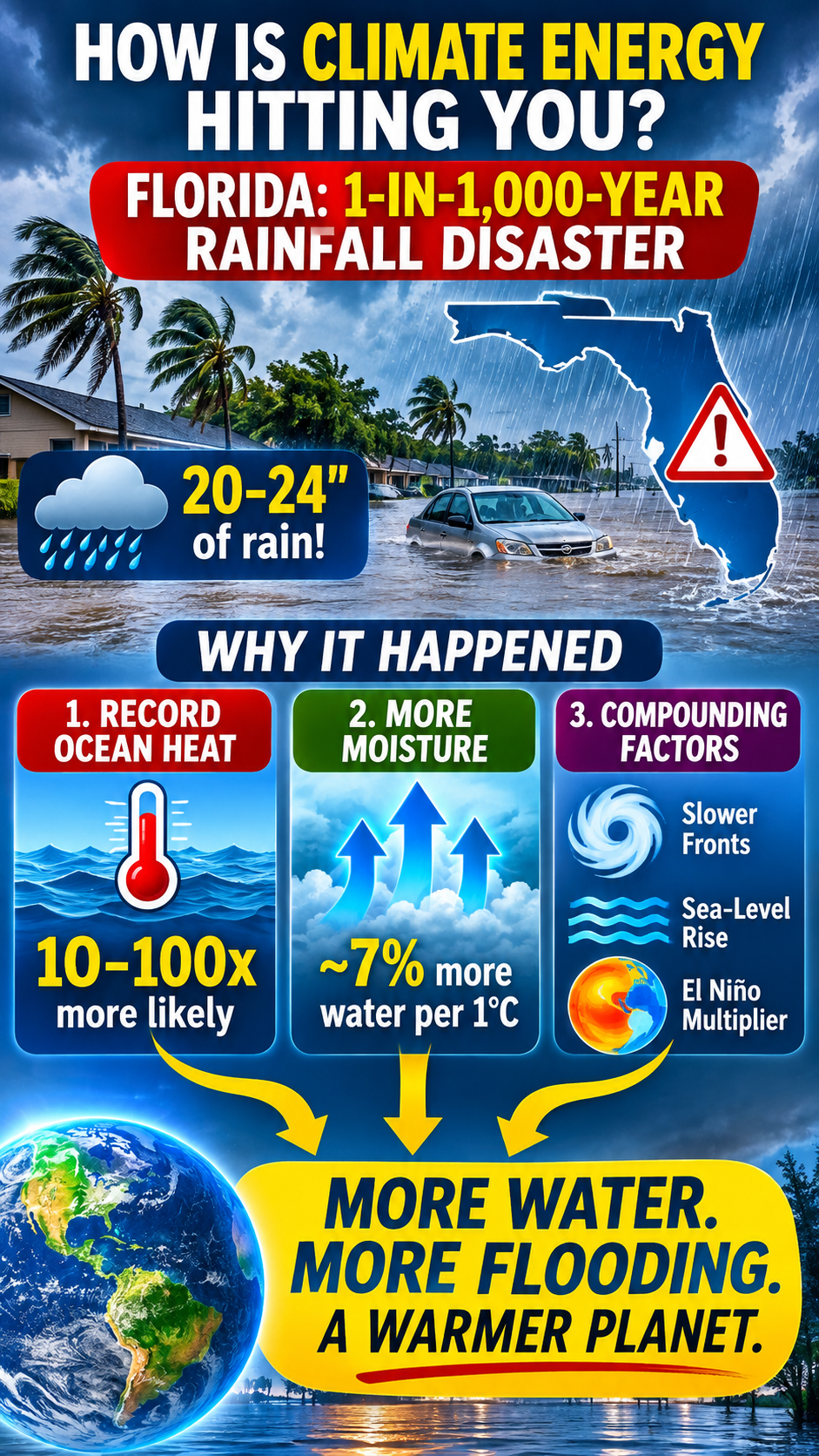
Social Media Announcement
🌧️🌎 HOW IS CLIMATE ENERGY HITTING YOU?
🚨 FLORIDA: THE 1-IN-1,000-YEAR RAINFALL DISASTER
More than 20–24 inches of rain. Catastrophic flash flooding. Roads washed out. Homes underwater. Lives lost. Emergency rescues across flooded communities.
Florida has experienced an extraordinary rainfall disaster, with seven counties under states of emergency.
But what powered this extreme event?
🔥 1. RECORD OCEAN HEAT
Atlantic waters near Florida reached record to near-record temperatures. Human-caused climate change made ocean temperatures this extreme 10–100 times more likely, according to Climate Central’s Ocean Shift Index.
💧 2. A WATERLOGGED ATMOSPHERE
For every 1°C of warming, the atmosphere can hold approximately 7% more water vapor. More atmospheric moisture means more water available to fuel extreme downpours.
🌪️ 3. COMPOUNDING CLIMATE FACTORS
• Stalled weather fronts concentrated rainfall over the same communities.
• Rising sea levels elevated coastal groundwater, reducing drainage capacity.
• El Niño interacted with an already warming climate system.
⚡ THE BIGGER PICTURE
These aren’t isolated climate processes. They interact, compound, and amplify one another.
Ocean heat → More evaporation → More atmospheric moisture → Extreme rainfall → Catastrophic flooding.
Climate change isn’t just about rising temperatures. It’s about the redistribution of enormous amounts of energy throughout Earth’s interconnected systems.
🌎 MORE WATER. MORE FLOODING. A WARMER PLANET.
Climate change isn’t somewhere else. It’s hitting home.
#ClimateChange #ExtremeWeather #FloridaFlooding #ClimateEnergy #GlobalWarming #ClimateScience #ClimateFeedbacks
Read the full report:
http://membrane.com/global_warming/Climate-Energy-Florida-1-in-1000.html