Daniel Brouse¹ and Sidd Mukherjee²
¹ Independent Climate Researcher, Economist
² Physicist
October 2026
Abstract
Tropospheric ozone is an air pollutant, a greenhouse gas, and a biologically active agent that damages vegetation and impairs terrestrial carbon uptake. Its climatic significance extends beyond direct radiative forcing: ozone damages the biological systems that remove carbon dioxide from the atmosphere, creating an observed connection between atmospheric pollution, ecosystem degradation, and climate change.
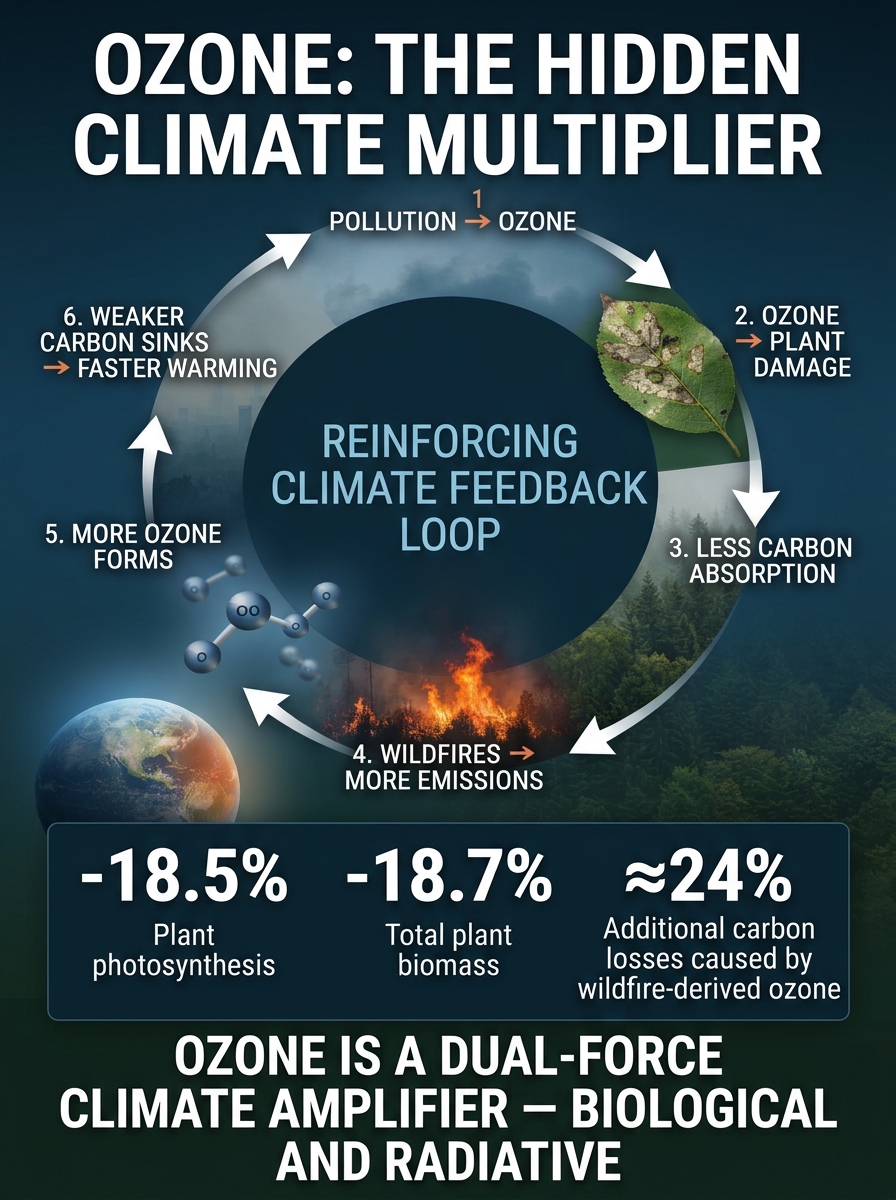
This paper integrates evidence from global plant-response research, ecosystem carbon-cycle modeling, and a 2026 study demonstrating that fire-derived ozone intensifies carbon loss in Amazon forests under extreme drought. A global meta-analysis of 144 studies reported mean reductions of 18.5% in net photosynthetic rate, 10.1% in stomatal conductance, and 18.7% in total plant biomass under elevated ozone exposure. The Amazon study estimated that carbon losses associated with fire-derived ozone were equivalent to approximately one-quarter of direct fire emissions.
Together, these findings establish that ozone damages vegetation and that ozone-mediated ecosystem effects extend beyond direct pollutant injury to influence carbon losses. The evidence supports the central mechanism of the Ozone Feedback Framework: ozone weakens terrestrial carbon uptake, while wildfire emissions can generate additional ozone that damages vegetation and contributes to further carbon loss. Drought, heat, atmospheric chemistry, and vegetation physiology modify the magnitude of these effects.
The synthesis identifies ozone-mediated carbon-sink impairment as an important biological climate feedback that deserves explicit representation in Earth-system research. Quantifying its full global contribution requires additional integration of observed ozone exposure, vegetation responses, ecosystem carbon budgets, and atmospheric feedbacks.
Keywords: tropospheric ozone; climate feedback; ozone feedback framework; carbon sinks; vegetation damage; Amazon rainforest; wildfire; drought; nonlinear climate acceleration; Earth-system coupling.
1. Introduction: Ozone Is More Than an Air Pollutant
Climate change is commonly explained through increasing greenhouse-gas concentrations, radiative forcing, and rising global temperatures. That explanation is essential, but it does not fully describe how atmospheric pollution affects the biological systems that regulate the Earth’s carbon balance.
Tropospheric ozone is central to this broader understanding. Formed through atmospheric chemical reactions involving nitrogen oxides, volatile organic compounds, and other precursors, ozone damages vegetation, impairs photosynthesis, alters stomatal function, and reduces plant growth.
These effects have consequences for climate because terrestrial vegetation is a major component of the global carbon cycle. Plants absorb carbon dioxide through photosynthesis and store carbon in biomass and soils. When ozone damages vegetation, this biological carbon-removal system is impaired.
The resulting connection is direct: ozone pollution damages vegetation, and that damage reduces the capacity of affected ecosystems to function as carbon sinks.
The Ozone Feedback Framework developed by Brouse and Mukherjee places this mechanism within a larger network of interacting climate processes. Atmospheric composition, vegetation health, drought, wildfire, hydrology, and carbon cycling do not operate as isolated systems. Changes in one component affect the conditions under which the others operate.
Research published in 2026 provides additional evidence for this framework. Brown and colleagues examined fire-derived ozone and carbon losses in Amazon forests under extreme drought, identifying an indirect pathway of fire-associated carbon loss beyond direct combustion emissions.
This paper integrates that finding with global evidence of ozone damage to plants and examines its significance for coupled climate feedbacks.
2. Global Evidence: Ozone Reduces Plant Productivity and Biomass
A global meta-analysis by Fang and colleagues (2026), synthesizing 144 studies, quantified the effects of elevated ozone exposure and other climate-related factors on plant gas exchange, biomass production, and biomass allocation.
The analysis reported the following mean reductions under elevated ozone exposure:
| Plant response | Mean reduction |
|---|---|
| Net photosynthetic rate | 18.5% |
| Stomatal conductance | 10.1% |
| Leaf biomass | 14.1% |
| Stem biomass | 11.5% |
| Root biomass | 13.8% |
| Total plant biomass | 18.7% |
| Root-to-shoot ratio | 5.8% |
These results document substantial ozone-related effects on plant physiology and growth across the studies examined. They do not imply identical responses in every species, ecosystem, or environmental setting.
The reductions in photosynthesis and total biomass are particularly significant for the Ozone Feedback Framework.
Photosynthesis transfers atmospheric carbon into biological material. Biomass accumulation stores part of that carbon in living vegetation. When ozone reduces these processes, affected plants assimilate less carbon and produce less biomass than they would under otherwise comparable conditions.
These effects establish the biological basis of ozone-mediated carbon-sink impairment.
A necessary distinction remains between individual plant responses and ecosystem-wide carbon balance. Long-term carbon storage also depends on respiration, decomposition, soil carbon, species composition, disturbance, and recovery. Nevertheless, the observed physiological damage establishes a direct mechanism through which ozone can alter terrestrial carbon cycling.
3. Ozone, Drought, and Climate Interactions
Ozone damage is modified by other environmental conditions, including drought, temperature, and atmospheric CO₂ concentrations.
Fang and colleagues found that elevated CO₂ partially alleviated some ozone-related reductions in photosynthesis. Drought reduced ozone damage in certain experimental conditions by restricting stomatal conductance and, consequently, ozone uptake.
This does not mean drought protects ecosystems overall. Drought independently reduces plant water availability, constrains growth, increases vegetation stress, and can contribute to wildfire risk.
The interaction is therefore more complex than a simple relationship in which every additional stressor uniformly increases ozone damage.
Stomatal closure illustrates the distinction. It can reduce ozone entry into leaves while simultaneously limiting gas exchange and exposing plants to water stress. The net effect depends on the severity and duration of drought, the characteristics of the vegetation, and the surrounding environmental conditions.
The Ozone Feedback Framework accounts for these interactions by examining the combined behavior of atmospheric chemistry, vegetation physiology, and ecosystem carbon cycling.
4. Fire-Derived Ozone: Evidence of an Additional Carbon-Loss Pathway
4.1 Findings from the 2026 Amazon study
Brown and colleagues (2026), in Fire-derived ozone intensifies carbon loss in Amazon forests under extreme droughts, investigated fire-derived ozone, drought, and vegetation responses across the Amazon during 1997–2024.
Their modeling analysis estimated that carbon losses associated with fire-derived ozone were equivalent to approximately one-quarter of direct fire emissions.
This finding establishes an important distinction between the carbon released by combustion and the additional carbon-cycle consequences associated with fire-derived ozone.
Wildfires release carbon directly as vegetation burns. Fire emissions also contribute precursors to atmospheric chemical reactions that produce ozone. That ozone can damage vegetation and impair its capacity to assimilate carbon.
The result is an additional pathway of fire-associated carbon loss:
- Direct carbon emissions from combustion.
- Ozone-related vegetation damage and associated carbon losses.
These pathways are related but distinct. Their combined contribution must be assessed using consistent carbon accounting to avoid double-counting.
4.2 Extreme drought does not eliminate ozone damage
The Amazon study also demonstrates that ozone-related vegetation damage can remain substantial during extreme drought.
Drought-induced stomatal closure can reduce ozone uptake, but this response does not eliminate the combined effects of drought, fire, and atmospheric pollution. Severe drought can coincide with elevated fire activity, changing atmospheric chemistry, and substantial vegetation stress.
This is an important observation for the Ozone Feedback Framework. A mechanism that reduces one type of injury does not necessarily reduce total ecosystem damage when several stressors operate simultaneously.
The relevant scientific question is how these interacting processes affect the overall carbon balance, not whether any individual mechanism increases or decreases in isolation.
4.3 Implications for forest carbon sinks
The Amazon is a major component of the global carbon cycle. Ozone-mediated vegetation damage adds a mechanism through which fires can affect the carbon balance beyond the areas directly burned.
The findings strengthen the case for including ozone-related vegetation responses in assessments of fire impacts and forest carbon-sink stability.
Fire-derived ozone contributes an identifiable pathway of carbon loss that complements direct fire emissions and must be considered when assessing the full ecological consequences of fire.
5. The Ozone Feedback Framework: From Observed Damage to Coupled Climate Effects
The evidence supports three connected conclusions.
First, elevated ozone exposure reduces photosynthesis and plant biomass, as documented by the global meta-analysis.
Second, ozone-mediated vegetation damage can contribute to ecosystem carbon losses beyond direct combustion, as demonstrated by the Amazon modeling study.
Third, the strength of these effects depends on interactions with drought, CO₂ concentrations, atmospheric chemistry, and vegetation physiology.
Together, these findings establish the biological mechanism underlying the Ozone Feedback Framework.
The framework connects the processes through the following sequence:
Ozone exposure → vegetation damage → reduced carbon uptake and biomass → impaired carbon-sink function → changes in atmospheric carbon balance.
Wildfire introduces an additional pathway:
Wildfire → direct carbon emissions and ozone precursors → ozone formation → vegetation damage → additional carbon losses.
These connections are supported by different types of evidence, including experimental plant research, meta-analysis, and ecosystem modeling. The complete global feedback must be quantified by integrating these components rather than treating them as interchangeable measurements.
5.1 Reduced carbon uptake and atmospheric CO₂
When vegetation absorbs less CO₂ than it would under comparable conditions without ozone damage, less carbon is transferred from the atmosphere into the biosphere.
The resulting atmospheric effect depends on the size and duration of the reduction in uptake, ecosystem recovery, and changes in other carbon sinks and sources.
Ozone-mediated reductions in photosynthesis therefore represent a measurable biological pathway affecting the carbon cycle. The precise contribution to atmospheric CO₂ accumulation requires regional and global carbon-budget analysis.
5.2 Coupling with wildfire and drought
Wildfire, drought, and ozone can reinforce one another under suitable environmental conditions.
Drought stresses vegetation and can increase fire susceptibility. Fires release carbon and ozone precursors. Fire-derived ozone damages vegetation, potentially reducing subsequent carbon uptake. Repeated disturbances can further constrain ecosystem recovery.
The strength of this sequence varies with fire intensity, atmospheric transport, chemical conditions, vegetation characteristics, and rainfall.
The framework identifies the connections among these processes as a research priority because evaluating each stressor independently can overlook important indirect effects.
5.3 Nonlinear behavior
The combined response of an ecosystem need not be proportional to the intensity of a single stressor.
For example, drought can simultaneously restrict ozone uptake, increase fire susceptibility, and impair plant growth. Fire-derived ozone can then affect vegetation across areas that were not directly burned.
Such interactions make it necessary to investigate whether combined effects are additive, antagonistic, or reinforcing under different conditions.
6. A Quantitative Research Program
The next step is a systematic quantitative synthesis that connects plant-level ozone damage with ecosystem carbon losses and global atmospheric consequences.
Four evidence categories should be evaluated.
Category A: Plant physiology and biomass. Studies measuring photosynthesis, stomatal conductance, leaf injury, biomass, and mortality under elevated ozone exposure.
Category B: Combined environmental stressors. Studies examining ozone interactions with drought, heat, elevated CO₂, and other climate-related conditions.
Category C: Ecosystem carbon cycling. Studies measuring or modeling gross primary productivity, net primary productivity, ecosystem respiration, net ecosystem exchange, and carbon storage.
Category D: Fire–ozone–carbon interactions. Studies quantifying direct fire emissions, ozone formation, vegetation damage, and associated indirect carbon losses.
For compatible treatment and control data, one possible effect-size measure is the natural logarithm of the response ratio:
ln RR = ln (X̄_ozone / X̄_control)
Here, X̄_ozone is the mean response under elevated ozone exposure, and X̄_control is the mean response under control conditions.
A random-effects meta-analysis can estimate average responses while accounting for variation among studies. The analysis should report confidence intervals, between-study heterogeneity, sensitivity to study selection, and differences among vegetation types and environmental conditions.
Separate syntheses should initially quantify plant physiological effects, ecosystem productivity changes, and ozone-mediated carbon losses. These results should only be combined through a model that accounts for differences in units, spatial scales, and causal relationships.
A further stage should use coupled carbon-cycle and atmospheric models to estimate how changes in vegetation uptake affect atmospheric CO₂ and climate.
This staged approach distinguishes established component effects from the larger climate consequences that remain to be quantified.
7. Implications for Climate Modeling and Mitigation
The evidence demonstrates that ozone affects vegetation and that fire-derived ozone can contribute to additional carbon losses. These processes deserve explicit evaluation in climate and ecosystem models.
Models that omit ozone-mediated vegetation damage may underestimate some ecosystem responses to atmospheric pollution and wildfire. The size of that bias must be evaluated through model comparisons and observational validation rather than assumed in advance.
A rigorous modeling program would compare simulations with and without interactive ozone–vegetation coupling while holding other conditions consistent. It would examine sensitivity to drought, fire emissions, atmospheric chemistry, and CO₂ concentrations.
Mitigation also has a clear role. Reducing ozone-precursor emissions can improve air quality and reduce vegetation exposure under appropriate chemical conditions. Protecting forests and reducing destructive wildfires can limit direct carbon emissions and associated ozone-precursor emissions.
These measures complement, rather than replace, reductions in greenhouse-gas emissions.
8. Conclusions
The evidence establishes that tropospheric ozone damages vegetation, reduces plant productivity, and affects the biological processes that regulate terrestrial carbon uptake. Research in the Amazon further demonstrates that fire-derived ozone contributes an indirect pathway of carbon loss beyond direct combustion emissions.
These findings support the central claim of the Ozone Feedback Framework: ozone is not merely an air pollutant or a direct climate forcer. It is also a biological climate amplifier that can weaken the natural systems responsible for removing carbon dioxide from the atmosphere.
The observed mechanisms connect atmospheric pollution, vegetation damage, wildfire, drought, and carbon cycling. Their interactions must be evaluated as a coupled system.
The next scientific challenge is to quantify the aggregate effect of these connections on global carbon uptake, atmospheric CO₂, and climate trajectories. That work requires a formal meta-analysis of compatible effect sizes and integrated Earth-system modeling.
The evidence already establishes why ozone-mediated carbon-sink impairment belongs in the broader analysis of climate feedbacks. The remaining task is to determine its full magnitude, variability, and contribution to climate acceleration.
Climate change is not only altering the Earth system. It is also affecting the biological processes that help regulate the climate. Ozone provides a measurable connection between those two developments.
References
Brown, F., Sitch, S., Folberth, G. A., Mercado, L. M., Cheesman, A. W., Barningham, S., Weber, J., Johnson, B., O’Sullivan, M., Artaxo, P., et al. (2026). Fire-derived ozone intensifies carbon loss in Amazon forests under extreme droughts. Communications Earth & Environment, 7, Article 790. https://www.nature.com/articles/s43247-026-04047-0
Fang, Y., Wang, D., Hui, D., Deng, Q., Ouyang, S., Tie, L., Wang, J., Duan, H., et al. (2026). Main and interactive effects of ozone and other climate factors on plant gas exchange, biomass production, and allocation: A global meta-analysis. Journal of Plant Ecology, 19(3), rtaf213. https://doi.org/10.1093/jpe/rtaf213
Brouse, D., & Mukherjee, S. (2026). The Ozone Feedback Theory: Tropospheric ozone as a driver of ecosystem decline, carbon sink failure, and climate acceleration. Membrane Institute. https://kingarthur.com/global_warming/Ozone-Feedback-Theory.html
Nowack, P. J., Abraham, N. L., Maycock, A. C., Braesicke, P., Gregory, J. M., Joshi, M. M., Osprey, A., & Pyle, J. A. (2015). A large ozone-circulation feedback and its implications for global warming assessments. Nature Climate Change, 5, 41–45. https://doi.org/10.1038/nclimate2451
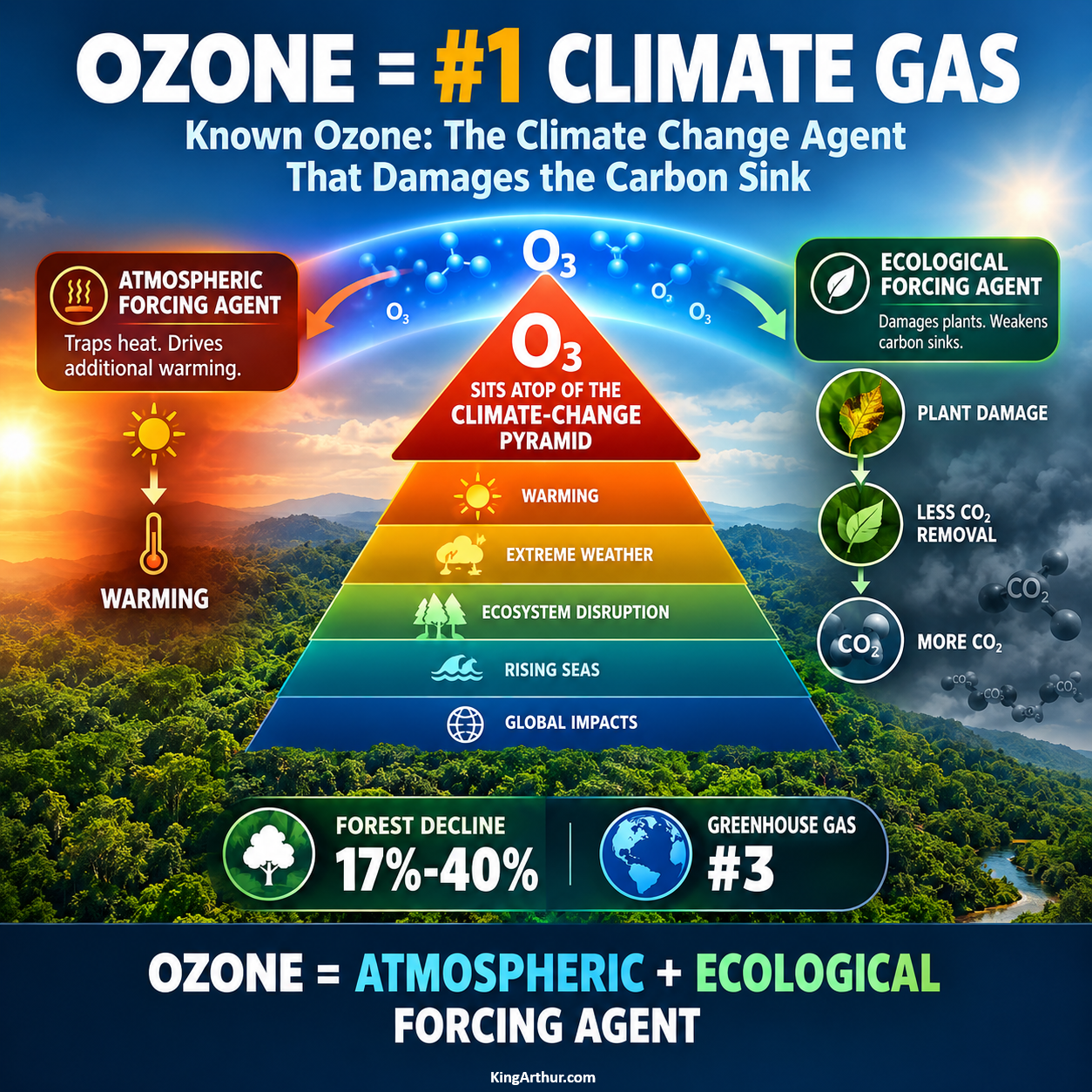
Known Ozone: The Climate Change Agent That Damages the Carbon Sink
Ozone: The Atmospheric-Ecological Climate Multiplier
- Introduction to the Ozone Feedback
- Low-Level Ozone: The Invisible Climate Pollutant Threatening Human Health and Accelerating Global Warming
- The Ozone Feedback Theory: Tropospheric Ozone as a Driver of Ecosystem Decline, Carbon Sink Failure, and Climate Acceleration
- The Ozone Climate Feedback: Fossil Fuel Combustion, Methane Emissions, Wildfires, and Ecosystem Degradation as Drivers of Self-Reinforcing Global Warming
- Lightning-Generated Tropospheric Ozone and Earth-System Feedbacks
- Ozone as a Climate Multiplier: Key Coupling Agent in Chemistry–Climate Feedbacks
- Ozone Feedbacks From Carbon Combustion: Tropospheric Ozone, Ecosystem Collapse, and the Failure of Biofuel Narratives
- Runaway Feedbacks and the Collapse of Natural Carbon Sinks: Emerging Evidence From Forests, Permafrost, and Tropospheric Ozone
- The Silent Unraveling of Forests: Ozone Stress, Climate Change, and Resilient Pennsylvania Tree Species
- The Domino Collapse: Amazon Rainforest Dieback and the Ozone Feedback Loop
- The Dangers of Tropospheric Ozone: A Silent Threat to Health and the Environment