The 1.5°C Tripwire and the Limits of Climate Manipulation
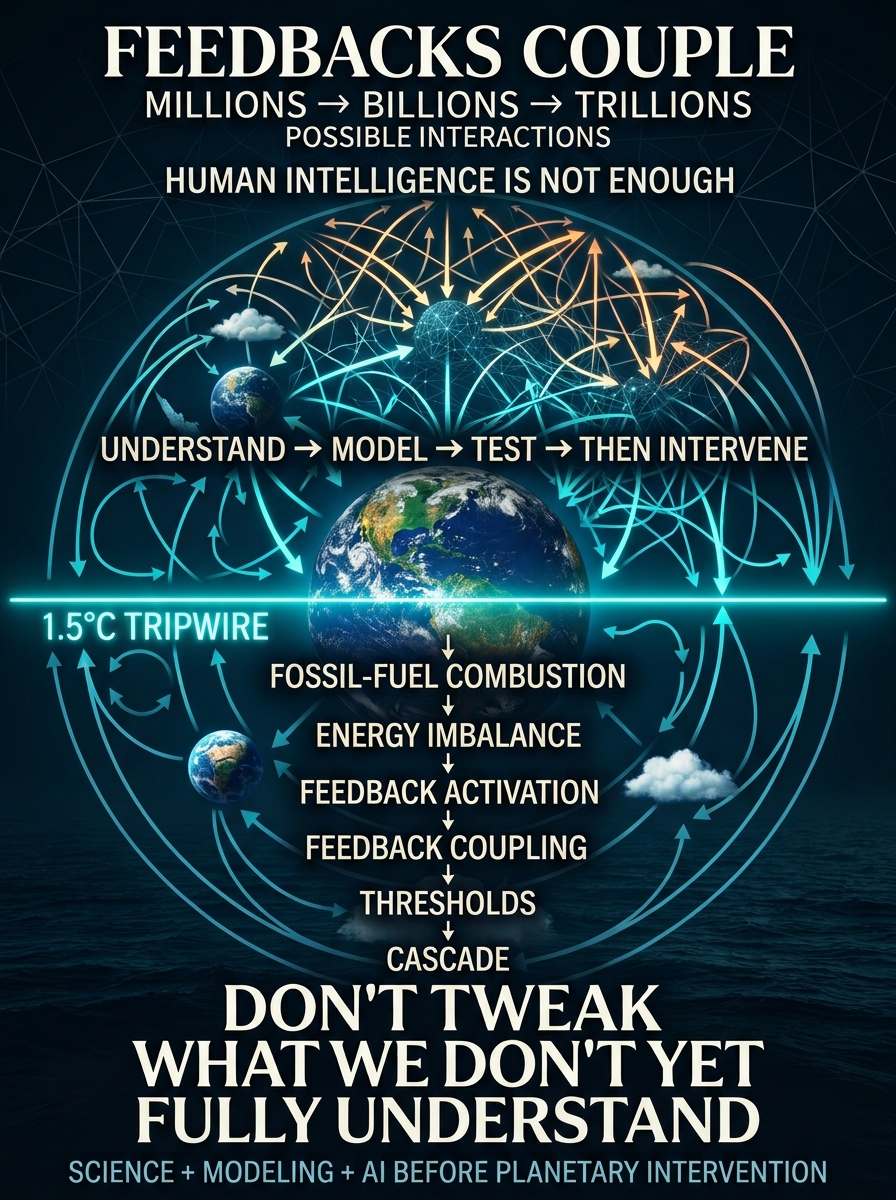
The 1.5°C threshold is more than a temperature target. It represents a critical point in the Earth system because crossing it increases the likelihood that multiple climate feedbacks and tipping elements will be pushed toward, or across, critical thresholds from which recovery is not straightforward.
Many climate tipping elements are already under significant stress, and there is currently no known way to simply reverse these processes once critical thresholds are crossed. More importantly, there is no known way to slow the underlying accumulation of climate-system energy without ultimately addressing its primary driver: the continued combustion of fossil fuels.
That does not mean we should give up on finding additional solutions. Quite the opposite. We should aggressively pursue them. But deliberately manipulating the climate system with today’s understanding is fundamentally different from developing solutions that reduce the underlying forcing.
The central problem is the extraordinary complexity of the Earth system.
The Feedback Loop and Tipping Point Network illustrates only a simplified representation of the feedback relationships that are currently understood. Each feedback can interact with multiple others, creating networks of interactions rather than isolated cause-and-effect relationships.
Once those interactions are combined across the atmosphere, oceans, cryosphere, biosphere, and carbon cycle, the number of possible pathways becomes enormous—potentially millions, billions, or even trillions of interactions across the Earth system.
It is highly inconceivable that human intelligence alone can calculate and predict all of those interactions with sufficient accuracy to safely manipulate the climate at planetary scale.
This is where artificial intelligence could become critically important.
If humanity is going to discover a genuinely safe way to intervene in the climate system—or determine with reasonable confidence that a proposed intervention is safe—we will need Earth-system modeling capable of exploring interactions far beyond what humans can individually calculate. AI could potentially help identify previously unrecognized feedback relationships, run vastly larger ensembles of simulations, detect nonlinear interactions, and expose consequences that conventional modeling or human analysis might miss.
That is not an argument against pursuing alternative solutions. It is an argument for pursuing them much more aggressively through science, modeling, and AI before deploying them.
The distinction is crucial:
We should not stop looking for ways to intervene in the climate system.
We should stop treating the climate system as though we already understand it well enough to safely manipulate it.
Until we can demonstrate that a proposed intervention will not trigger larger, faster, or more dangerous feedbacks elsewhere in the Earth system, deliberately tweaking the planet is an extraordinarily risky experiment.
The goal should be to understand the system first—and intervene only when the evidence shows that the intervention is safer than allowing the underlying problem to continue.