Daniel Brouse and Sidd Mukherjee
Introduction: The Global Feedback Cascade
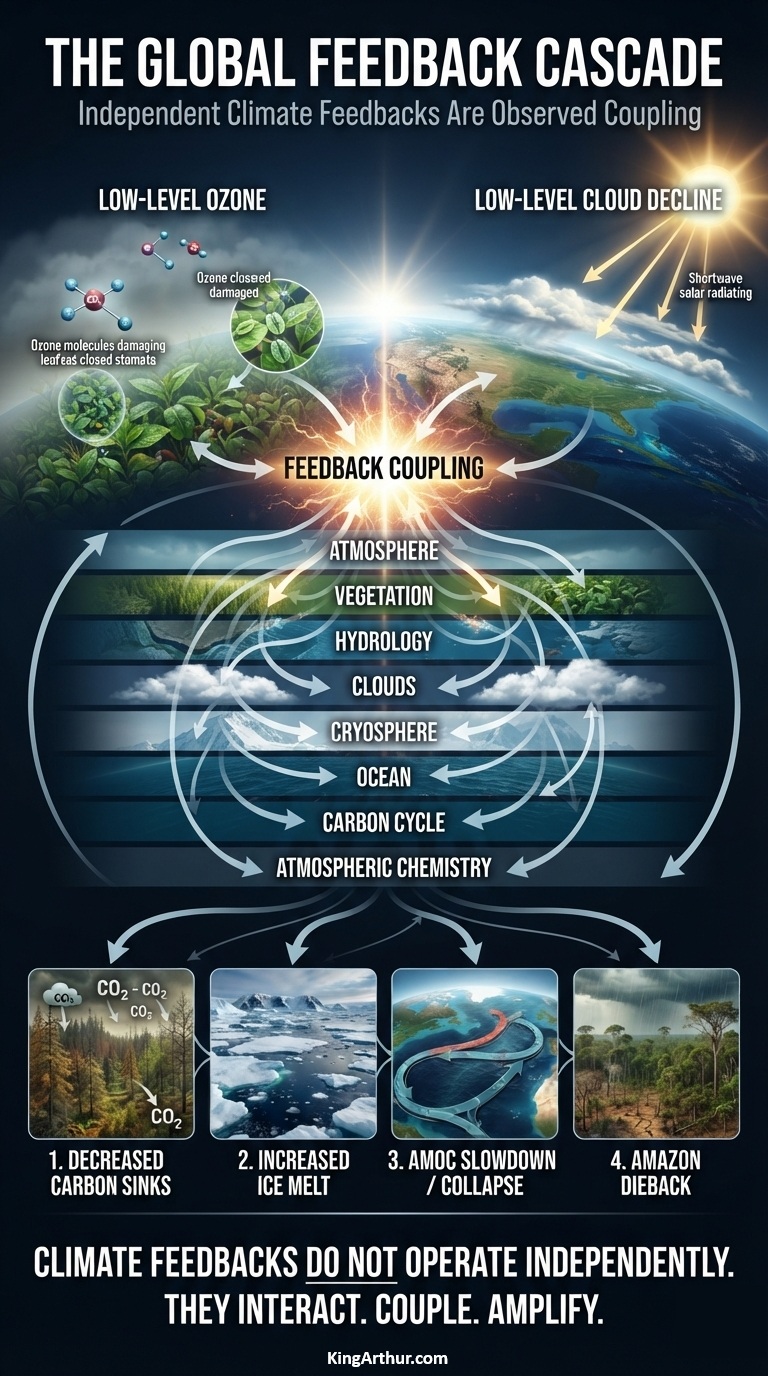
Two of the strongest emerging climate feedbacks are low-level tropospheric ozone and declining low-level clouds.
Independently, each can accelerate warming. But the more important discovery is that these independent feedbacks are observed coupling.
Once coupled, they can transfer energy and disruption across Earth-system boundaries, from atmospheric chemistry and vegetation to clouds, the cryosphere, oceans, and the carbon cycle.
The result is a cascading system that can contribute to decreased carbon sinks, increased ice melt, Amazon dieback, and a slowing or collapse of the AMOC.
Climate feedbacks do not operate independently.
They interact. Couple. Amplify.
Overview
Independently, low-level tropospheric ozone and declining low-level clouds are two of the strongest emerging climate feedbacks. Now, evidence is growing that these independent feedbacks are observed coupling.
The coupling between tropospheric ozone (O₃) and the decline of low-level clouds operates as a powerful positive climate feedback loop driven by the interaction between atmospheric chemistry, plant biology, hydrology, and meteorology.
The core mechanism connects ozone pollution, reduced plant transpiration, declining atmospheric moisture, and a subsequent decrease in low-level cloud cover, which ultimately accelerates global warming.
The Feedback Mechanisms
| Phase | Process & Mechanism | Climate Impact |
|---|---|---|
| 1. Vegetation Damage | Surface-level tropospheric ozone acts as a toxic greenhouse gas and phytotoxic pollutant. It enters plant leaves through stomata and damages cells, forcing plants to constrict their stomata to protect themselves. This severely reduces stomatal conductance and photosynthesis. | Decreases the plant’s ability to pull carbon dioxide out of the atmosphere, compounding warming. |
| 2. Moisture Suppression | Because plant stomata are restricted, the amount of water vapor released from land into the atmosphere through transpiration drops significantly. This suppresses the land-to-atmosphere moisture flux. | The lower atmosphere becomes drier, lowering regional atmospheric moisture and relative humidity. |
| 3. Cloud Decline | With less humidity and moisture rising from vegetation, atmospheric conditions necessary for the formation and persistence of low-level clouds are compromised. This triggers a reduction in shortwave cloud forcing. | Fewer clouds mean less sunlight is reflected back into space and more solar energy reaches Earth’s surface. |
| 4. Amplified Warming | The reduction in low-level cloud cover allows a massive influx of shortwave solar radiation to reach Earth’s surface instead of being reflected or scattered back toward space. Earth system modeling indicates that this specific feedback can produce regional temperature increases of up to +1.5°C. | The surface and lower atmosphere warm intensely. |
| 5. Closing the Loop | Photochemical production of tropospheric ozone relies on precursors, particularly NOₓ and VOCs, reacting in the presence of sunlight and heat. Increased solar radiation and higher temperatures can accelerate ozone formation under favorable chemical conditions. | Warmer, sunnier conditions contribute to additional tropospheric ozone, reinforcing the vegetation-damage and moisture-suppression cycle. |
The Chemical Destruction Counterweight
While the vegetation-to-cloud feedback creates a powerful positive warming loop, clouds also affect tropospheric ozone directly through atmospheric physics and chemistry.
Under a normal atmosphere:
- Aqueous-phase chemistry: When clouds are present, liquid water droplets absorb ozone precursors and provide an environment for chemical reactions that destroy or transform tropospheric ozone.
- The impact of cloud loss: As cloud cover declines, this natural chemical sink diminishes. Fewer clouds mean less aqueous-phase destruction, leaving more ozone to persist in the troposphere and further exacerbating the vegetation-damage cycle.
This creates another reinforcing connection:
Less cloud cover → less aqueous-phase ozone destruction → greater ozone persistence → greater vegetation damage → less transpiration → further cloud decline.
The coupling between tropospheric ozone and cloud decline therefore does not act in a vacuum.
It interacts with the broader climate system by stripping away cloud reflectivity, increasing solar energy absorption, disrupting terrestrial moisture cycling, and injecting additional thermal energy into an already warming Earth system.
This creates the potential for a cascading domino effect that accelerates some of Earth’s most vulnerable biosphere and cryosphere tipping points.
[O₃ & Low-Level Cloud Decline]
              │
       ┌──────┴──────┐
       ▼             ▼
Regional Drying   Increased Solar
 & Heat Waves      Absorption
       │             │
       ▼             ▼
[Amazon Dieback] [Ocean Albedo /
   Tipping Point] [Sea-Ice Collapse]
1. Accelerating the Amazon Dieback Tipping Point
The Amazon rainforest acts as a giant biological “air conditioner,” recycling moisture from the Atlantic Ocean and generating up to 75% of its own rainfall through transpiration.
The ozone-cloud coupling directly attacks this survival mechanism on two fronts.
The Double-Whammy on Water Cycling
Under high tropospheric ozone exposure, Amazonian trees constrict their stomata to prevent cellular damage, immediately reducing regional transpiration.
Simultaneously, the resulting decline in low-level clouds removes some of the shading that helps keep the forest cooler.
The forest therefore experiences two simultaneous stresses:
less transpiration + less cloud cover = less atmospheric moisture + more surface heating.
The Transition to Severe Drought
This combination increases local heating while reducing regional humidity.
Without sufficient moisture being transferred from vegetation into the atmosphere, and with fewer clouds moderating incoming solar radiation, the conditions necessary to sustain the Amazon’s rainfall cycle become increasingly compromised.
Wet-season rainfall can weaken or become delayed, increasing drought stress and fire susceptibility.
Crossing the Tipping Point
The Amazon is moving closer to a potentially irreversible tipping threshold, with some scientific estimates placing significant risk as early as 2050, depending on the degree of warming, deforestation, and hydrological disruption.
Once the forest can no longer sustain its own rainfall cycle, widespread dieback can become self-reinforcing.
Massive forest degradation, intense wildfires, and tree mortality would convert portions of the Amazon from a vital global carbon sink into a net carbon emitter.
That would release additional carbon into the atmosphere while simultaneously destroying one of Earth’s major biological mechanisms for removing atmospheric CO₂.
The result would be an additional acceleration of global warming.
2. Accelerating the Ocean Albedo and Sea-Ice Tipping Point
The reduction in cloud cover caused by the ozone-vegetation loop does not necessarily remain confined to land.
The broader warming and altered atmospheric circulation associated with the feedback can extend into marine environments, directly increasing pressure on polar and sub-polar sea ice.
Enhanced Downwelling Radiation
Low-level clouds normally reflect a substantial portion of incoming solar radiation back toward space.
As the low-cloud shield degrades, a significantly higher percentage of shortwave solar radiation penetrates the atmosphere and reaches the ocean surface.
Supercharging the Melting Cycle
Highly reflective sea ice has a high albedo, reflecting a large fraction of incoming solar energy back into space.
When the ozone-cloud feedback forces additional solar energy onto the ocean, sea ice melts more rapidly.
This exposes the dark open ocean beneath.
Open ocean has a dramatically lower albedo and absorbs far more solar radiation.
The feedback therefore becomes:
cloud decline → increased solar absorption → sea-ice loss → darker ocean surface → greater solar absorption → additional warming.
The initial cloud-driven increase in absorbed solar energy can therefore supercharge the existing ice-albedo feedback.
Thermal Cascades
As the ocean warms, heat can accelerate sea-ice loss from below as well as from above.
The loss of reflective ice exposes increasingly large areas of dark ocean, which absorb additional solar energy and further increase regional warming.
This creates a thermal cascade that can extend beyond the cryosphere.
Increasing ocean temperatures, freshwater input from melting ice, and changing temperature and density gradients can disrupt major ocean circulation systems, including the Atlantic Meridional Overturning Circulation (AMOC).
The result is a potential chain extending from atmospheric chemistry to vegetation, clouds, sea ice, ocean warming, and ocean circulation.
3. The Slowing AMOC and Collapse
The coupling of tropospheric ozone and declining low-level clouds can contribute to the weakening of the Atlantic Meridional Overturning Circulation (AMOC) by intensifying two fundamental stresses on its circulation: thermal suppression of surface-water density and freshwater-driven disruption of salinity and buoyancy.
The AMOC depends on a delicate balance of temperature and salinity—known as thermohaline circulation. For the ocean conveyor system to function, warm surface waters traveling northward must eventually cool and become sufficiently dense to sink in the subpolar North Atlantic.
The ozone-cloud coupling adds additional heat to this system while simultaneously accelerating cryospheric melting and freshwater input. Together, these processes can weaken the density-driven sinking that powers the AMOC.
An influx of freshwater can create a relatively fresh, buoyant surface layer over the subpolar North Atlantic.
That layer acts as a freshwater cap, increasing stratification and making it more difficult for cold surface waters to mix downward and participate in deep-water formation.
The vertical circulation loop is therefore disrupted from both directions:
warming reduces density through temperature, while freshwater reduces density through salinity.
The combined effect is substantially more dangerous than either mechanism acting alone.
The Danger of the “Salt-Advection” Catch-22
The most important threat from this interaction may be the possibility of triggering the AMOC’s own internal reinforcing feedback: the salt-advection feedback.
The AMOC transports relatively warm, salty water northward from lower latitudes. This northward salt transport contributes to maintaining the salinity of the North Atlantic and helps sustain the density required for deep-water formation.
When warming and freshwater input weaken the AMOC, the circulation transports less salt northward.
That creates a potentially self-reinforcing sequence:
AMOC slowdown → reduced northward salt transport → fresher North Atlantic → reduced surface-water density → weaker deep-water formation → further AMOC slowdown.
The ozone-cloud coupling can add additional forcing at the beginning of this chain by increasing solar absorption and warming while simultaneously contributing to cryospheric melt and freshwater input.
The result is a potential feedback within a feedback:
         [O₃–Cloud Coupling]
                  ↓
       ┌──────────┴──────────┐
       ↓                     ↓
[More Solar Heating]   [More Cryosphere Melt]
       ↓                     ↓
[Warmer Surface Water] [Freshwater Input]
       ↓                     ↓
[Lower Density]        [Lower Salinity]
       └──────────┬──────────┘
                  ↓
       [Weaker Deep-Water Formation]
                  ↓
             [AMOC Slows]
                  ↓
       [Less Northward Salt Transport]
                  ↓
       [North Atlantic Freshens]
                  ↓
       [Density Declines Further]
                  ↓
          [AMOC Weakens Further]
This creates a potentially dangerous AMOC tipping-point pathway.
The critical issue is not that the ozone-cloud coupling is the sole cause of AMOC weakening. It is that the coupling can add another reinforcing source of heat and freshwater to a circulation system already vulnerable to warming, ice-sheet loss, and freshwater disruption.
As independent climate feedbacks begin coupling, their effects can compound.
Ozone damages vegetation.
Vegetation loses transpiration.
Clouds decline.
Solar absorption increases.
The North Atlantic warms.
Greenland melts.
Freshwater increases.
Surface-water density falls.
Deep-water formation weakens.
The AMOC slows.
Northward salt transport declines.
The North Atlantic freshens further.
The feedbacks then begin reinforcing one another.
That is the danger of a coupled climate system: a feedback that begins in atmospheric chemistry and plant biology can ultimately reach deep into the ocean circulation system and accelerate the approach to an AMOC tipping point.
Probabilistic Climate Change Impacts
Under high-emissions, business-as-usual scenarios such as SSP5-8.5, the cumulative effects of the ozone–vegetation–cloud coupling could contribute an estimated additional 0.2°C to 0.4°C of global average warming by 2100. This should not be viewed as a simple linear addition. The interaction functions as a structural climate multiplier, with potentially much larger regional effects. The direct pathway—ozone damage to vegetation, reduced transpiration, declining low-level clouds, increased solar absorption, and subsequent warming—could account for approximately 0.15°C to 0.2°C of additional global warming, while the resulting suppression of the terrestrial carbon sink could contribute another ~0.1°C to 0.15°C.
The greater concern is the feedback’s potential to trigger secondary tipping points. Ozone-induced vegetation damage and cloud decline can reinforce regional drying, while increased solar absorption can accelerate sea-ice loss and ocean warming. These processes can interact with Amazon dieback, Greenland and Arctic melting, and AMOC weakening, creating additional carbon, albedo, hydrological, and ocean-circulation feedbacks. Because atmospheric chemistry, vegetation physiology, cloud dynamics, cryosphere processes, and ocean circulation are often represented separately in Earth-system models, the full effect of their coupling may not be captured by conventional projections. If the interaction accelerates one or more secondary tipping points, its contribution could therefore extend well beyond 0.5°C before the end of the century.
The critical issue is consequently not simply how much warming the ozone–cloud coupling produces directly, but how much additional warming it can trigger. The potential outcome exists along an asymmetric probability distribution: a lower-end response dominated by direct radiative and carbon-sink effects, a central estimate of approximately 0.2°C–0.4°C, and a high-end outcome in which coupled feedbacks push the contribution substantially higher. In a nonlinear climate system, the tail of that distribution matters enormously. The detailed evidence, modeling basis, uncertainties, and probability ranges for these estimates are examined separately in [Probabilistic Climate Impacts of the Ozone–Vegetation–Cloud Coupling].
The Global Feedback Cascade
Ultimately, the ozone–cloud coupling acts as a climate threat multiplier. Tropospheric ozone damages vegetation, forcing plants to restrict their stomata and reducing transpiration. Less transpiration suppresses the transfer of moisture into the atmosphere, contributing to declining low-level cloud cover. As the cloud shield weakens, more shortwave solar radiation reaches Earth’s surface, increasing surface and ocean heating. At the same time, declining cloud cover can reduce aqueous-phase chemical removal of ozone, while warmer and sunnier conditions can promote additional ozone formation under favorable atmospheric chemistry. The result is a self-reinforcing cycle:
O₃ → vegetation damage → reduced transpiration → cloud decline → increased solar absorption → warming → increased ozone formation and persistence → additional vegetation damage.
The consequences extend far beyond the original atmosphere–vegetation interaction. Over land, increased heat and reduced atmospheric moisture can accelerate Amazon drying and forest dieback, reducing one of Earth’s major carbon sinks and potentially converting portions of the Amazon into a net carbon source. Over the ocean and cryosphere, increased solar absorption accelerates sea-ice loss, exposing darker ocean water and strengthening the ice-albedo feedback. Additional high-latitude warming also increases pressure on the Greenland Ice Sheet, adding freshwater to the North Atlantic. At the same time, warming of North Atlantic surface waters and freshwater dilution reduce the density required for deep-water formation, potentially weakening the AMOC. A slower AMOC transports less salt northward, creating a further freshening and density-loss feedback that can reinforce the circulation slowdown.
These processes create feedbacks within feedbacks. The ozone–cloud coupling can therefore connect atmospheric chemistry to terrestrial carbon storage, hydrological cycling, sea-ice albedo, Greenland melt, ocean heat, and Atlantic circulation. The potential warming contribution is consequently not simply the sum of individual effects. Under high-emissions scenarios, the coupled ozone–vegetation–cloud system could contribute an estimated 0.2°C–0.4°C of additional global-average warming by 2100, while regional effects could be substantially larger. More importantly, if the coupling accelerates secondary tipping points such as Amazon dieback, rapid sea-ice loss, Greenland melt, or AMOC weakening, nonlinear amplification could push its contribution well beyond 0.5°C before the end of the century.
The resulting cascade can be represented as:
                    [TROPOSPHERIC OZONE]
                            │
                            ▼
                  [VEGETATION DAMAGE]
                            │
                ┌───────────┴───────────┐
                ▼                       ▼
       [LESS CO₂ UPTAKE]         [LESS TRANSPIRATION]
                │                       │
                ▼                       ▼
      [CARBON-SINK DECLINE]      [ATMOSPHERIC DRYING]
                │                       │
                │                       ▼
                │                [LOW-LEVEL CLOUD
                │                    DECLINE]
                │                       │
                │                       ▼
                │               [MORE SOLAR ENERGY
                │                   ABSORBED]
                │                       │
                └───────────┬───────────┘
                            ▼
                       [WARMING]
                            │
              ┌─────────────┼─────────────┐
              ▼             ▼             ▼
       [AMAZON DRYING] [SEA-ICE LOSS] [GREENLAND MELT]
              │             │             │
              ▼             ▼             ▼
       [FOREST DIEBACK] [LOWER ALBEDO] [FRESHWATER
              │             │            INPUT]
              ▼             ▼             │
       [CARBON RELEASE] [MORE OCEAN       ▼
                         HEATING]    [NORTH ATLANTIC
              │             │          FRESHENING]
              └──────┬──────┘               │
                     ▼                       ▼
              [ADDITIONAL WARMING]    [WEAKER DEEP-WATER
                                            FORMATION]
                                              │
                                              ▼
                                      [AMOC SLOWDOWN]
                                              │
                                              ▼
                                   [LESS NORTHWARD SALT
                                        TRANSPORT]
                                              │
                                              ▼
                                   [FURTHER FRESHENING]
                                              │
                                              ▼
                                      [AMOC WEAKENING]
                                              │
                         ┌────────────────────┘
                         ▼
                 [CLIMATE FEEDBACK
                     CASCADES]
                         │
                         ▼
              [NONLINEAR AMPLIFICATION]
The significance of this system is therefore not simply that ozone and declining low-level clouds represent two additional climate forcings.
The independent feedbacks are observed coupling.
Once coupled, they can transfer energy and disruption across Earth-system boundaries—atmosphere → vegetation → hydrology → clouds → cryosphere → ocean → carbon cycle → atmospheric chemistry—creating pathways for one feedback to activate another.
This is the fundamental danger of a nonlinear climate system.
Climate feedbacks do not operate independently. They interact, couple, and amplify one another.
The critical question is no longer simply how strong each individual feedback is.
It is whether the coupling among feedbacks is accelerating faster than our models, observations, and mitigation systems can respond.
If it is, then the climate threat is not merely warming.
It is accelerating climate disruption through a cascading system of interconnected feedbacks and tipping points.