by Daniel Brouse and Sidd Mukherjee
Public Access Version: Amazon Dieback Simplified
🌎 TIPPING POINT SEASON: THE AMAZON DIEBACK
The Amazon is more than a rainforest. It is part of Earth’s climate-regulating system—and one of the places where a regional disruption could become a global problem.
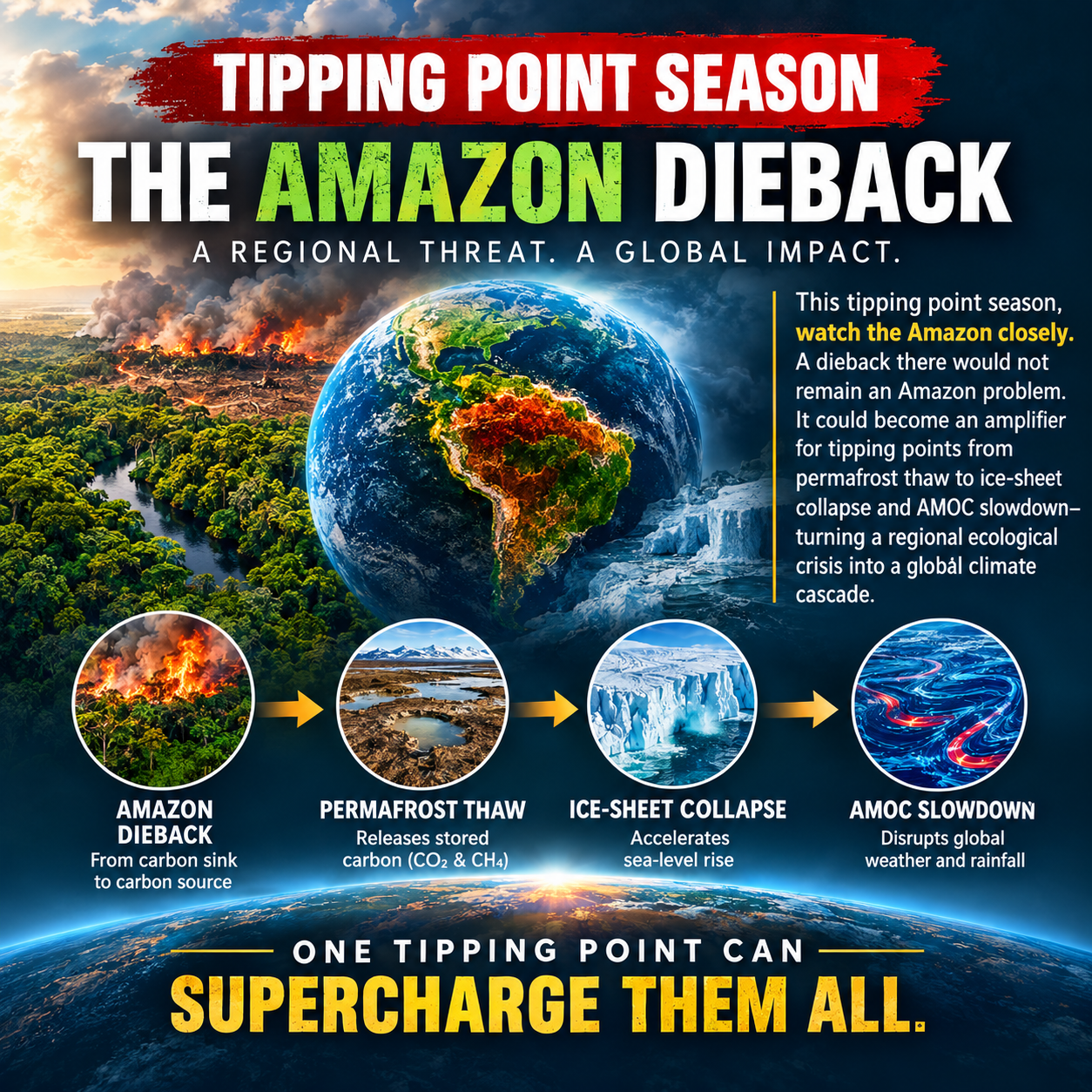
This tipping point season, watch the Amazon closely.
A major Amazon dieback would not remain an Amazon problem.
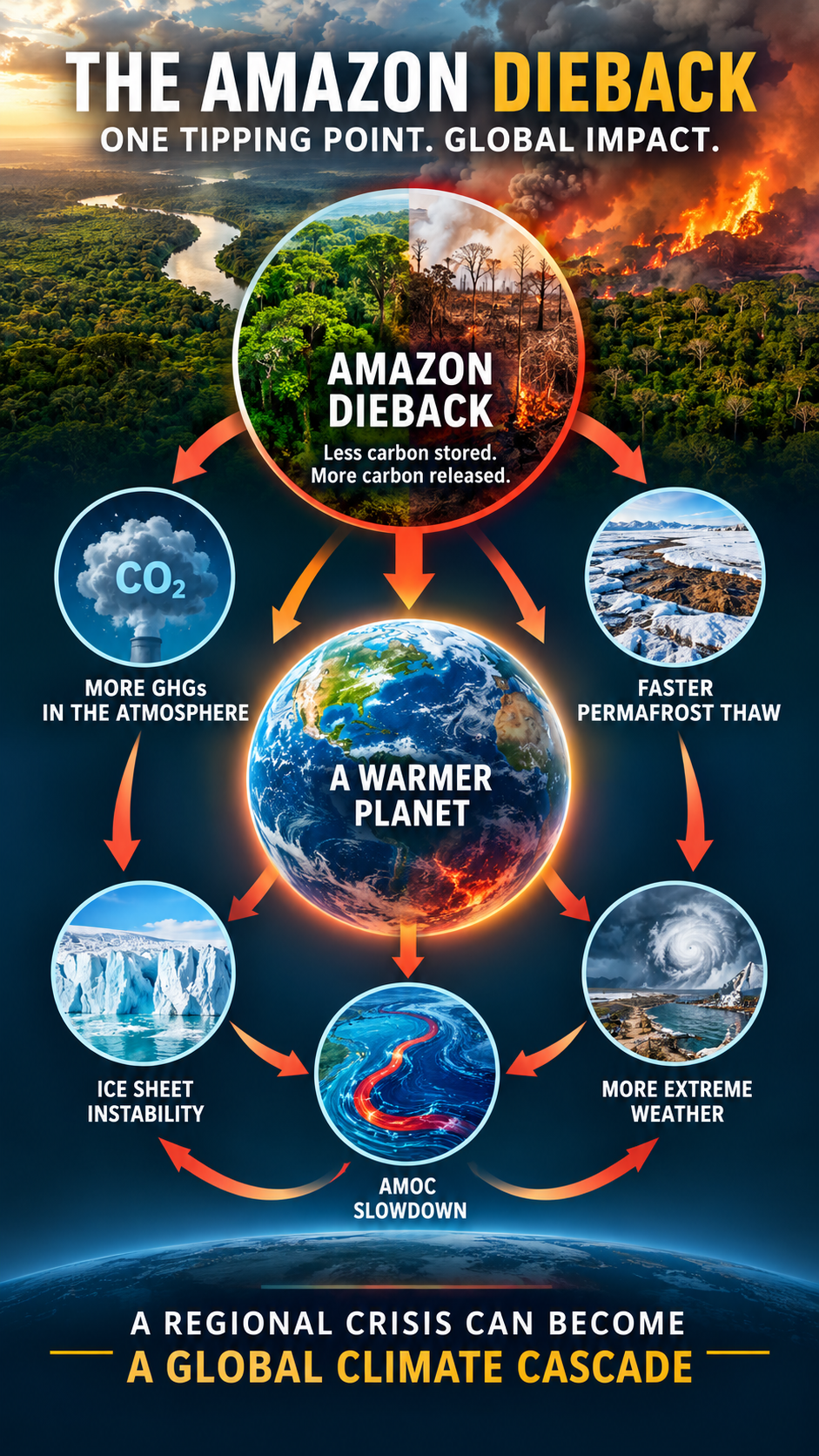
As forests lose resilience, carbon storage can decline, regional rainfall patterns can shift, and warming can intensify. Those changes could interact with other vulnerable parts of the Earth system—from permafrost thaw and ice-sheet collapse to AMOC slowdown.
That is the danger of tipping cascades:
One system destabilizes → amplifies warming and disruption → increases pressure on another → triggers further change.
The result could be a cascade that moves far beyond the Amazon.
🌳 Amazon dieback → carbon loss & rainfall disruption → additional warming → pressure on other tipping systems → global climate cascade
The critical question isn’t simply “Will the Amazon reach a tipping point?”
It is:
What happens when tipping points begin interacting with one another?
🔬 Tipping Point Season: The Amazon Dieback
A closer look at why the Amazon matters—and why what happens there may not stay there.
#TippingPoints #Amazon #AmazonRainforest #ClimateChange #ClimateScience #TippingCascades #Permafrost #IceSheets #AMOC #EarthSystem #ClimateRisk
Full Paper Introduction
The 2023–2024 El Niño was the first recorded instance of the Amazon shifting from a carbon sink to a net emitter. This makes Amazon dieback one of the most concerning climate tipping points. Some tipping points, such as coral reef die-off, though deeply concerning, have less of an amplification effect on climate change. The Amazon, however, is far more consequential. As its forests deteriorate, the Amazon can become one of the largest self-amplifying feedback loops in climate collapse.
The 2023–2024 El Niño
Brazil’s Pantanal wetlands are famous for their extraordinary biodiversity. There were 2,387 fires in the Pantanal during the first 13 days of November 2023—an increase of more than 1,000 percent from the entire month of November the previous year, according to satellite monitoring by the Brazilian space research agency INPE.
“The situation is completely out of control. And between the heatwave and the wind, it’s only going to get worse,” said biologist Gustavo Figueiroa, head of the environmental group SOS Pantanal.
What do you know about the Rio Negro as it relates to climate change and carbon sinks?
The Rio Negro gets its name from the color of its water. Its black water is caused by highly acidic, carbon-rich organic material. One scientist who lives on the river has compared its appearance to Coca-Cola. In 2023, the Rio Negro recorded record-low water levels.
Most of the carbon discharged into the water helps carbon eventually sink into the ocean, effectively contributing to a carbon sink. Lack of rain and drought conditions, however, result in more vegetation dying and contribute to a feedback loop: more plants die from reduced rainfall, while there is less rain to wash excess carbon toward the river system and ultimately into the ocean. The result is less carbon being removed from the atmosphere, contributing to additional global warming and further vegetation loss.
From March 16 through 18, 2024, Brazil experienced a severe heatwave, setting new records in Rio de Janeiro, with a reported wet-bulb temperature reaching 62.3 degrees Celsius (144.1 degrees Fahrenheit). Wet-bulb temperature reflects the body’s ability to cool itself through the evaporation of sweat. As heat and humidity increase, sweat evaporates less effectively, making it more difficult for the body to regulate its core temperature. A wet-bulb temperature of 35°C (95°F) at 100% humidity, or approximately 115°F at 50% humidity, represents the upper limit of safety, beyond which the human body cannot effectively regulate its core temperature through sweat evaporation.
On March 23, an atmospheric river event brought heavy rains to Brazil’s Rio de Janeiro state, resulting in at least nine fatalities, primarily in Petrópolis, which bore the brunt of the impact. An astonishing 270 mm (11 inches) of rain fell within a 24-hour period, significantly affecting the region and leading to numerous incidents, including landslides and house collapses.
Contributing Causes
The Amazon is under stress from multiple sources: ground-level ozone and carbon drawdown, deforestation, and climate-circulation breakdown.
A key and increasingly important feature of the observational record is that multiple climate and ecological indicators in the Amazon appear to be shifting into what can be described as “jerk” behavior—dynamics in which not only the state of the system is changing, but the rate of change itself is changing. In mathematical terms, this corresponds to increasing higher-order derivatives of system behavior, where acceleration is no longer stable but itself accelerates over time.
In practical terms, jerk behavior is observed when systems transition from relatively smooth or predictable trajectories into regimes characterized by rapidly compounding variability, abrupt shifts, and feedback amplification. In the Amazon context, this is suggested by signals such as increasing volatility in precipitation extremes, faster transitions between drought and recovery states, and weakening resilience following disturbances such as heat stress or fire events.
The 2026–2027 El Niño Amplifier
The Amazon is the most directly impacted tipping point from the 2026–2027 El Niño.
Amazon Rainforest Dieback — Most Directly Affected
Mechanism: Walker Circulation disruption
Warm ENSO phases shift the atmospheric ascent zone eastward into the Pacific, driving intense and prolonged atmospheric subsidence—dry air—over northern and central South America. This causes severe droughts, heatwaves, and fire outbreaks that exhaust soil moisture and degrade the forest toward a savanna-like state.
A developing super El Niño is compounding severe historical drought and deforestation stress, pushing the Amazon rainforest dangerously close to an irreversible dieback tipping point.
Current Pressures
Delayed Rains: The El Niño event threatens to delay the wet season.
Dry-Season Peak: Scientists expect El Niño to peak between October and December. This timing leaves forest undergrowth tinder-dry when river levels are lowest.
Loss of Resilience: Decades of logging and warming mean large parts of the forest take much longer to recover from seasonal dry spells.
Tipping Point Risks
Savanna Transition: Continuous dry shocks risk converting rich rainforest into open savanna.
Carbon Reversal: Stressed trees release massive amounts of carbon instead of storing it, accelerating global warming.
Unprecedented Threat: The combination of a super El Niño with rising greenhouse-gas concentrations creates an extreme and potentially unprecedented danger for the Amazon basin.
Human and Environmental Toll
Inhabited Areas Hit: Data highlights that more than 38% of human settlements in the Amazon experienced high exposure to recent El Niño droughts, as reported by Agência Brasil.
Megafire Risks: Hotter and drier conditions sharply increase the threat of uncontrollable wildfires that can damage primary forest areas.
Conclusion
The Amazon is not an isolated tipping point. Its potential dieback is dangerous precisely because it can amplify other tipping points across the Earth system.
As the rainforest loses biomass and its capacity to absorb carbon declines, more greenhouse gases remain in the atmosphere. At the same time, drought, heat, and fire can turn portions of the forest from a carbon sink into a carbon source. That additional warming does not stop at the borders of the Amazon. It adds pressure to already-stressed climate systems around the world.
The feedbacks can extend from tropical forests to permafrost. Additional warming accelerates permafrost thaw, releasing carbon dioxide and methane and creating another source of atmospheric warming. That warming further increases pressure on ice sheets, contributing to sea-level rise and potentially accelerating the destabilization of Greenland and West Antarctica.
The same warming also affects the ocean and atmospheric circulation. Changes in temperature, precipitation, and freshwater input can weaken major circulation systems such as the Atlantic Meridional Overturning Circulation (AMOC). A weakening AMOC can, in turn, alter rainfall patterns, ocean heat distribution, and regional climate, adding further stress to other tipping elements.
This is what makes the Amazon particularly important. A tipping point does not have to topple the entire climate system by itself. It can help push other systems closer to their thresholds. Once several tipping elements begin reinforcing one another, the Earth system can move from individual disruptions toward a cascading sequence of self-amplifying changes.
The Amazon therefore represents more than the potential loss of a rainforest. It represents the possibility of activating another major component of a global climate feedback network—one that can intensify warming, weaken resilience elsewhere, and make previously distant tipping points more likely to be crossed.
This tipping point season, watch the Amazon closely. A dieback there would not remain an Amazon problem. It could become an amplifier for tipping points from permafrost thaw to ice-sheet collapse and AMOC slowdown—turning a regional ecological crisis into a global climate cascade.