The Backyard Experiments: Hydroclimatic Whiplash, Soil Degradation, Insect Decline, and Ecosystem Collapse
By Daniel Brouse
Have You Looked Out Your Back Door for Climate Change?
It’s there.
I noticed an interesting phenomenon: an increase in dead earthworms and millipedes in the swimming pool.
It turns out this is connected to opposite extremes of a coupled feedback loop.
Too wet. Then too dry. Then too wet. Then too dry.
That is hydroclimatic whiplash, and it was destroying the ecosystem that is my backyard.
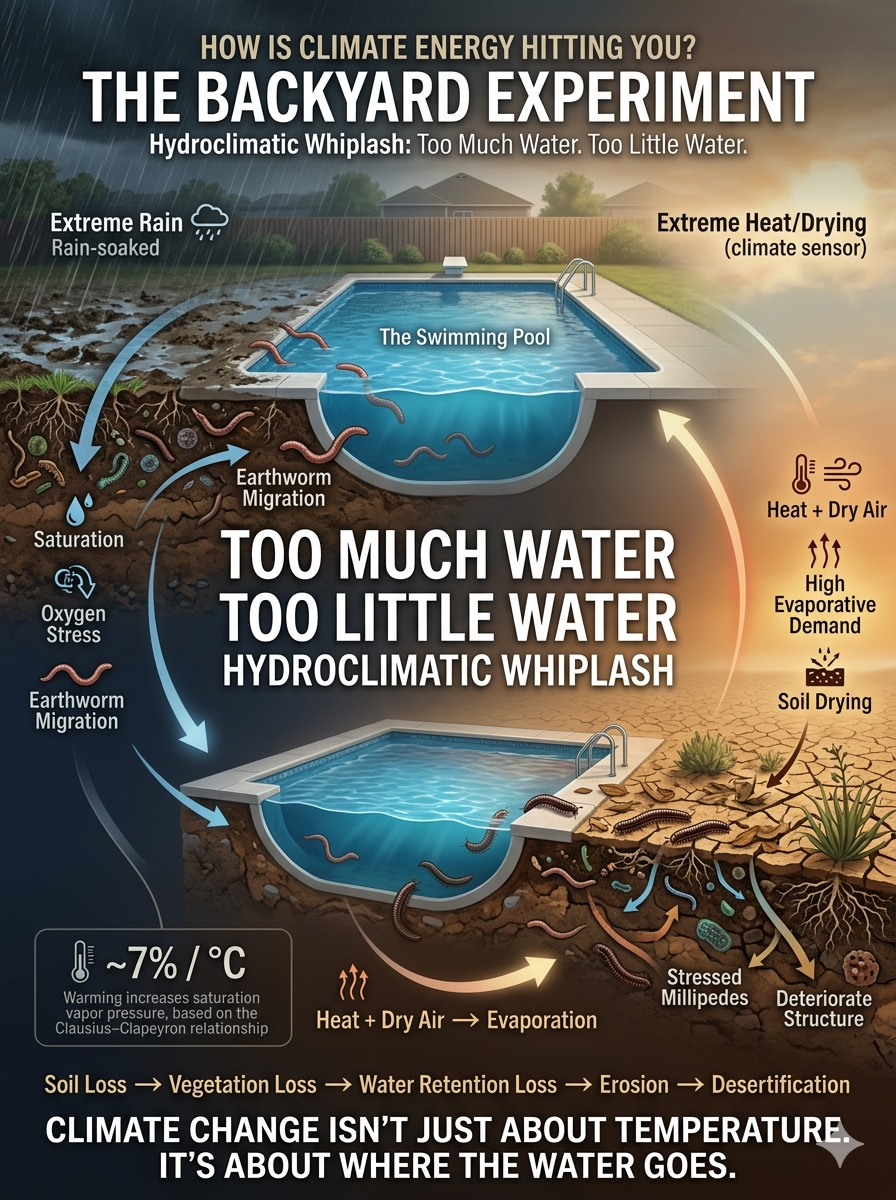
What initially appeared to be two unrelated observations—earthworms at the bottom of the swimming pool after extreme rainfall and millipedes at the bottom during periods of intense drying—began to look like two sides of the same climate-energy problem: too much water, followed by too little.
The backyard was being hit from both directions.
TOO MUCH WATER
Earthworms commonly move toward the soil surface when soils become saturated. Heavy rainfall can produce much larger and more rapid changes in soil moisture and oxygen availability than gentle, prolonged rainfall.
The swimming pool then becomes an accidental trap.
The basic sequence is remarkably simple:
[Extreme Rainfall] → [Soil Saturation + Oxygen Stress] → [Surface Migration] → [Accidental Pool Entry]
Once an earthworm reaches the pool deck, there is little it can do to escape the water.
What begins as a survival response to changing soil conditions can therefore end with a dead worm in the pool.
But the earthworms were only the visible part of a much larger biological response occurring beneath the surface.
TOO LITTLE WATER
Millipedes are fundamentally creatures of moist microhabitats.
They live in leaf litter, soil, rotting wood, and other environments where humidity remains relatively high. Their survival depends on maintaining water balance in an environment that is normally protected from direct solar heating and rapid atmospheric drying.
When extreme evaporative demand suddenly arrives, that microclimate can collapse.
The same atmospheric conditions that pull extraordinary amounts of water from a swimming pool can also pull moisture from the soil and leaf litter where millipedes live.
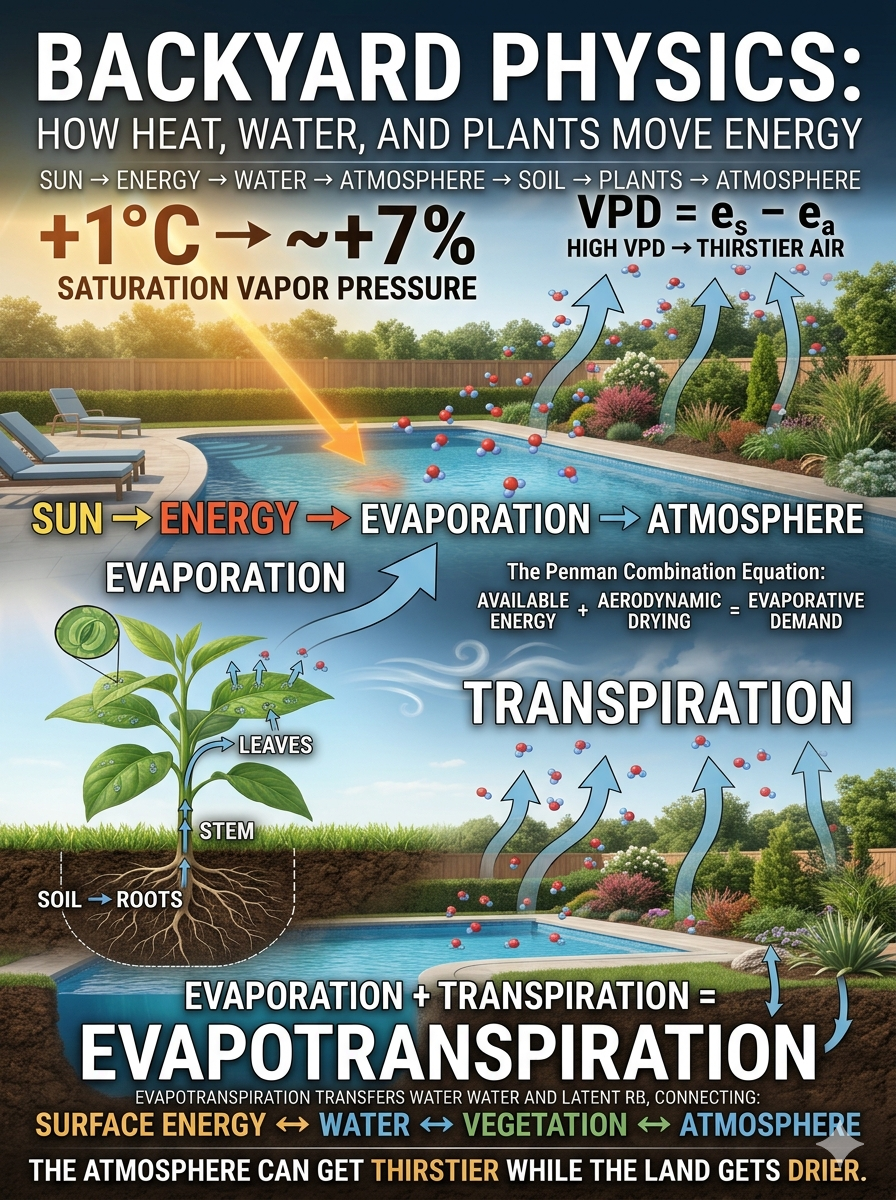
Extreme evaporative demand amplifies evapotranspiration, a core component of Earth’s climate system that links soil, vegetation, and atmosphere through continuous water and energy exchange.
The resulting feedback can be expressed as:
[Increased Evaporative Demand] → [Soil & Litter Drying] → [Vegetation Stress] → [Habitat Loss] → [Insect & Soil-Organism Decline]
And once vegetation begins to disappear, another feedback can emerge:
[Reduced Vegetation] → [Reduced Transpiration] → [Reduced Atmospheric Moisture Recycling] → [Reduced Rainfall] → [Increased Drought] → [Further Vegetation & Insect Loss]
The landscape begins losing the biological machinery that helped regulate its own water cycle.
THE CLIMATE ENERGY OF HYDROCLIMATIC WHIPLASH
Soil Worth Dirt
Soil is alive.
Hydroclimatic whiplash kills it.
Extreme rainfall can cause erosion, nutrient loss, oxygen stress, physical disruption, and mortality among soil organisms.
Extreme drying can produce an entirely different set of stresses: dehydration, vegetation loss, declining microbial activity, loss of organic matter, and collapse of moisture-dependent habitat.
This was evident across the soil layers in my backyard:
Epigeic — Surface Dwellers
Endogeic — Shallow Soil Dwellers
Anecic — Deep Burrowers
Both too much rain and not enough rain resulted in mass casualties within the same week—and on multiple occasions during a single season.
That is not simply a wet-dry cycle.
It is an ecological stress cycle.
The soil receives an extreme pulse of water, followed by extreme atmospheric demand for water.
Then the process repeats.
The organisms living in the soil are caught between extremes.
WHEN SOIL DIES
When soil dies, it undergoes desertification.
Desertification is the transformation of productive, biologically functioning land into degraded land with declining capacity to support vegetation and ecosystem processes.
As soil loses organic matter, biological activity, structure, and water-holding capacity, it becomes increasingly vulnerable to erosion and drying.
The feedback is vicious:
[Extreme Rainfall] → [Erosion & Soil-Organism Loss] → [Vegetation Decline] → [Less Soil Protection] → [More Erosion]
At the opposite extreme:
[Extreme Heat & Evaporative Demand] → [Soil Drying] → [Vegetation Stress] → [Vegetation Loss] → [Reduced Soil Organic Matter] → [Reduced Water Retention] → [Greater Drying]
The two pathways eventually converge.
The soil loses its ability to hold water.
When soil can no longer retain water effectively, rainfall increasingly becomes runoff rather than stored moisture. When the atmosphere demands water, there is less moisture available to sustain vegetation. The result is a landscape increasingly vulnerable to both flooding and drought.
That is the climate paradox of degraded soil:
Too much water can destroy its structure.
Too little water can destroy its biology.
Repeatedly alternating between the two can destroy its resilience.
As this process advances, the land can cross from a productive biological system into a degraded one.
That is desertification.
And once the soil’s biological engine begins to fail, its capacity to sequester and store carbon declines as well.
The climate feedback then becomes even more serious:
[Soil Degradation] → [Reduced Carbon Storage] → [More Atmospheric CO2] → [Additional Warming] → [Greater Evaporative Demand] → [More Soil Degradation]
Soil therefore acts as both a carbon reservoir and a climate buffer.
Destroy the soil, and you weaken both.
BACKYARD PHYSICS
The backyard observations can be connected to fundamental physical relationships governing Earth’s water and energy cycles.
Two of the most important are the Clausius–Clapeyron relationship and the Penman combination equation.
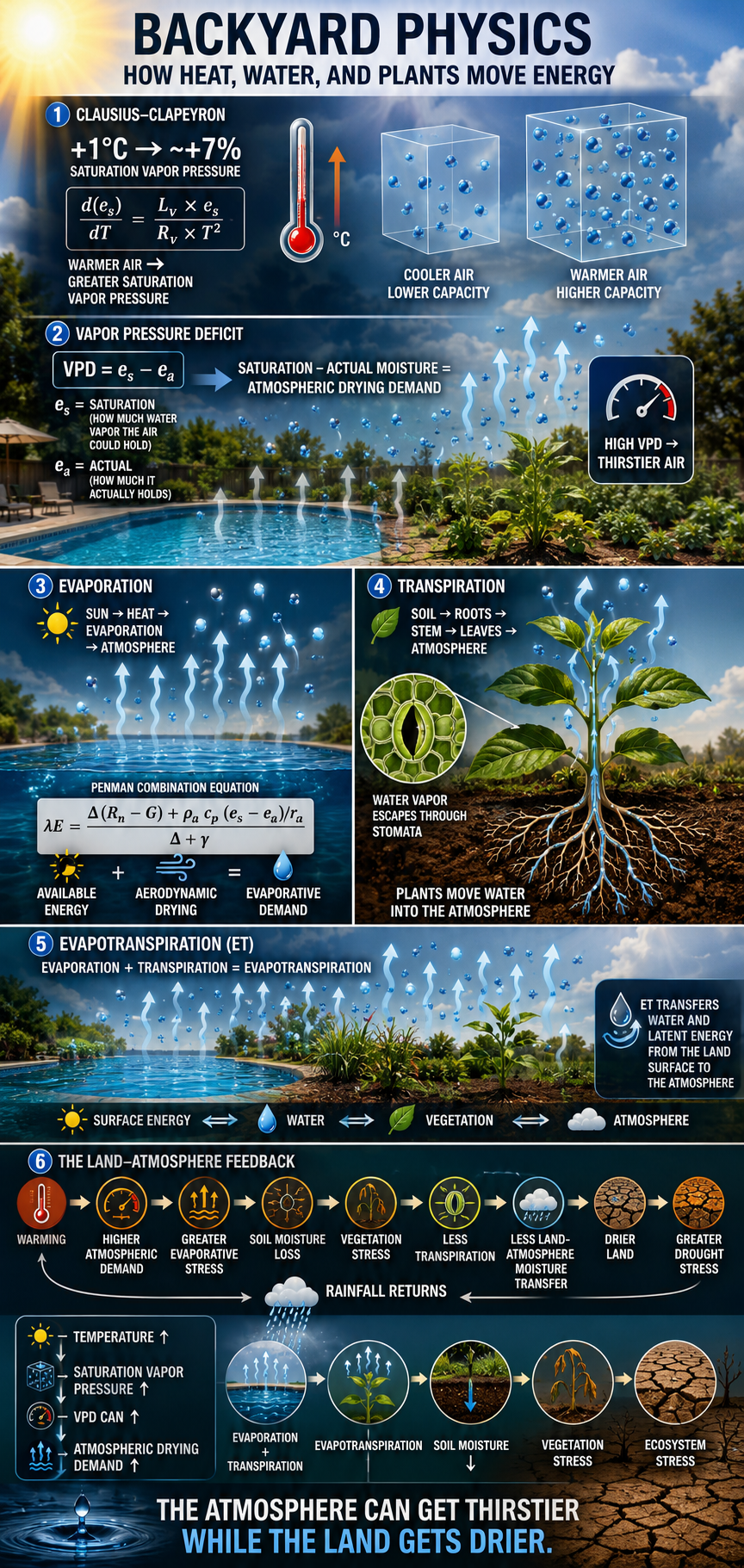
The Clausius–Clapeyron relationship describes how saturation vapor pressure changes with temperature.
The Penman combination equation describes how available surface energy and atmospheric drying conditions combine to determine evaporative demand.
Together, they help explain the physics behind extreme evaporation.
THE CLAUSIUS–CLAPEYRON RELATIONSHIP
The Clausius–Clapeyron relationship describes the temperature dependence of saturation vapor pressure.
In differential form:
d(e_s)/dT = (L_v × e_s) / (R_v × T²)
where:
- e_s = saturation vapor pressure
- T = absolute temperature in kelvins
- L_v = latent heat of vaporization
- R_v = specific gas constant for water vapor
Dividing both sides by e_s gives:
(1/e_s) × (d(e_s)/dT) = L_v / (R_v × T²)
Under typical near-surface atmospheric temperatures, this relationship corresponds approximately to a 7% increase in saturation vapor pressure per 1°C of warming.
In other words, a warmer atmosphere has a substantially greater capacity to contain water vapor before reaching saturation.
That increased capacity matters because it can increase the atmospheric demand for evaporation when water is available.
EXTREME EVAPORATION
For an open water surface such as a swimming pool, evaporation depends on several interacting variables.
A useful framework is the Penman combination equation, which incorporates both the available energy at the surface and aerodynamic drying.
One common form is:
λE = [Δ(R_n − G) + ρ_a × c_p × (e_s − e_a) / r_a] / (Δ + γ)
where:
- λE = latent heat flux associated with evaporation
- Δ = slope of the saturation vapor pressure curve
- R_n = net radiation
- G = ground or substrate heat flux
- ρ_a = air density
- c_p = specific heat capacity of air
- e_s = saturation vapor pressure
- e_a = actual vapor pressure
- r_a = aerodynamic resistance
- γ = psychrometric constant
The equation contains two major physical components.
1. Available Energy
The term:
Δ(R_n − G)
represents the energy available at the surface to drive evaporation.
Greater available energy generally means greater potential evaporation when sufficient water is available.
2. Aerodynamic Drying
The term:
ρ_a × c_p × (e_s − e_a) / r_a
represents the aerodynamic component.
The difference:
e_s − e_a
is the vapor pressure deficit (VPD).
A larger VPD means the atmosphere is farther from saturation and therefore has greater capacity to remove water from a wet surface.
Wind increases turbulent exchange and continually replaces moist air near the evaporating surface with drier air.
The result can be extreme evaporation.
WHERE THE PHYSICS MEETS THE BACKYARD
The connection between temperature, atmospheric moisture, and evaporation can be represented as:
[Higher Temperature] → [Higher Saturation Vapor Pressure] → [Potentially Higher VPD] → [Greater Atmospheric Drying Demand]
At the same time:
[Higher Available Energy] + [Greater Atmospheric Drying Demand] → [Greater Potential Evaporation]
A swimming pool has an abundant supply of water.
So when atmospheric evaporative demand increases, the water can continue evaporating.
Soil is different.
Once soil moisture becomes limited, evaporation can become water-limited, even while atmospheric evaporative demand remains extremely high.
This creates a critical climate paradox:
The atmosphere can become increasingly thirsty while the landscape becomes increasingly dry.
THE BACKYARD AS A CLIMATE SENSOR
The dead earthworms and millipedes in my swimming pool are not, by themselves, proof of climate change.
They are observations of biological responses to environmental conditions.
But observations become scientifically meaningful when they are connected to measurable physical mechanisms.
The backyard contains a miniature version of the larger climate system:
RAIN
↓
SOIL SATURATION
↓
BIOLOGICAL RESPONSE
↓
SURFACE WATER
↓
SOLAR ENERGY
↓
EVAPORATION
↓
ATMOSPHERIC MOISTURE
↓
SOIL DRYING
↓
VEGETATION STRESS
↓
HABITAT LOSS
↓
ECOSYSTEM STRESS
Then the rain comes again.
And the cycle starts over.
HYDROCLIMATIC WHIPLASH
The climate problem is not simply that the world is becoming warmer.
It is that warming can alter the intensity, timing, and interaction of water-cycle extremes.
A landscape can experience:
Extreme Rain → Saturation → Flooding → Erosion
followed by:
Extreme Heat → High VPD → Evaporative Loss → Drought
followed again by:
Extreme Rain → Runoff → Erosion → Soil Disruption
followed again by:
Extreme Drying → Vegetation Stress → Habitat Loss
The ecological damage can accumulate even when each individual event is temporary.
The ecosystem does not necessarily get enough time to recover before the next extreme arrives.
That is what makes hydroclimatic whiplash so dangerous.
FROM THE SWIMMING POOL TO THE PLANET
Though a swimming pool is not a climate model, it is an excellent reminder that climate physics is not abstract.
It operates in the backyard.
It operates in the soil.
It operates in the leaf litter.
It operates in every evaporating puddle.
It operates in every plant releasing water vapor through transpiration.
And it operates in every organism struggling to maintain its water balance as environmental conditions swing between extremes.
The physics begins with energy.
Solar energy warms surfaces.
That energy can become latent heat as water changes phase.
Temperature affects saturation vapor pressure.
Atmospheric dryness creates evaporative demand.
Water availability determines whether that demand can actually be met.
And biological systems respond to the resulting changes in moisture, temperature, oxygen, habitat, and food availability.
That is climate energy hitting the backyard.
Sometimes it arrives as too much water.
Sometimes it arrives as too little.
And sometimes the greatest damage comes from the violent transition between the two.
THE LESSON FROM THE POOL
The next time you find an earthworm or millipede in the swimming pool, don’t just ask:
“How did it get here?”
Ask:
“What was happening to the ecosystem before it got here?”
Because sometimes the most visible evidence of a changing climate isn’t in a satellite image or a global temperature graph.
Sometimes it is floating in the swimming pool.
And sometimes the smallest casualties are telling us something much larger:
The climate system is not merely changing the temperature.
It is changing the movement of water.
And when water extremes begin arriving faster than ecosystems can recover, the consequences can reach all the way down to the soil beneath our feet.