by Daniel Brouse
Why are millipedes showing up dead at the bottom of the swimming pool?
The answer may seem strange at first: extreme weather is changing the moisture dynamics of the tiny ecosystem around your home.
Earlier this summer, I wrote about earthworms turning up dead in the pool. Their appearance followed intense rainfall after several dry days—a small example of climate-change-driven hydroclimatic whiplash.
After prolonged dryness, intense rainfall can rapidly saturate the soil and displace oxygen from the pore spaces. Earthworms respond by moving toward the surface, where oxygen is more readily available. But when the surface is saturated, they can still be trapped in an inhospitable environment. As they search for better conditions, some ultimately end up in the swimming pool.
See: Urban Flooding — Unfortunately, Worms Can’t Swim
Millipedes are responding to the opposite extreme.
They are showing up after several days without rain, particularly during periods of unusually rapid evaporation. In my backyard, the microclimate can swing from flash rainfall to flash drought within a day or two.
And those swings matter.
When a Swimming Pool Becomes an Evaporation Gauge
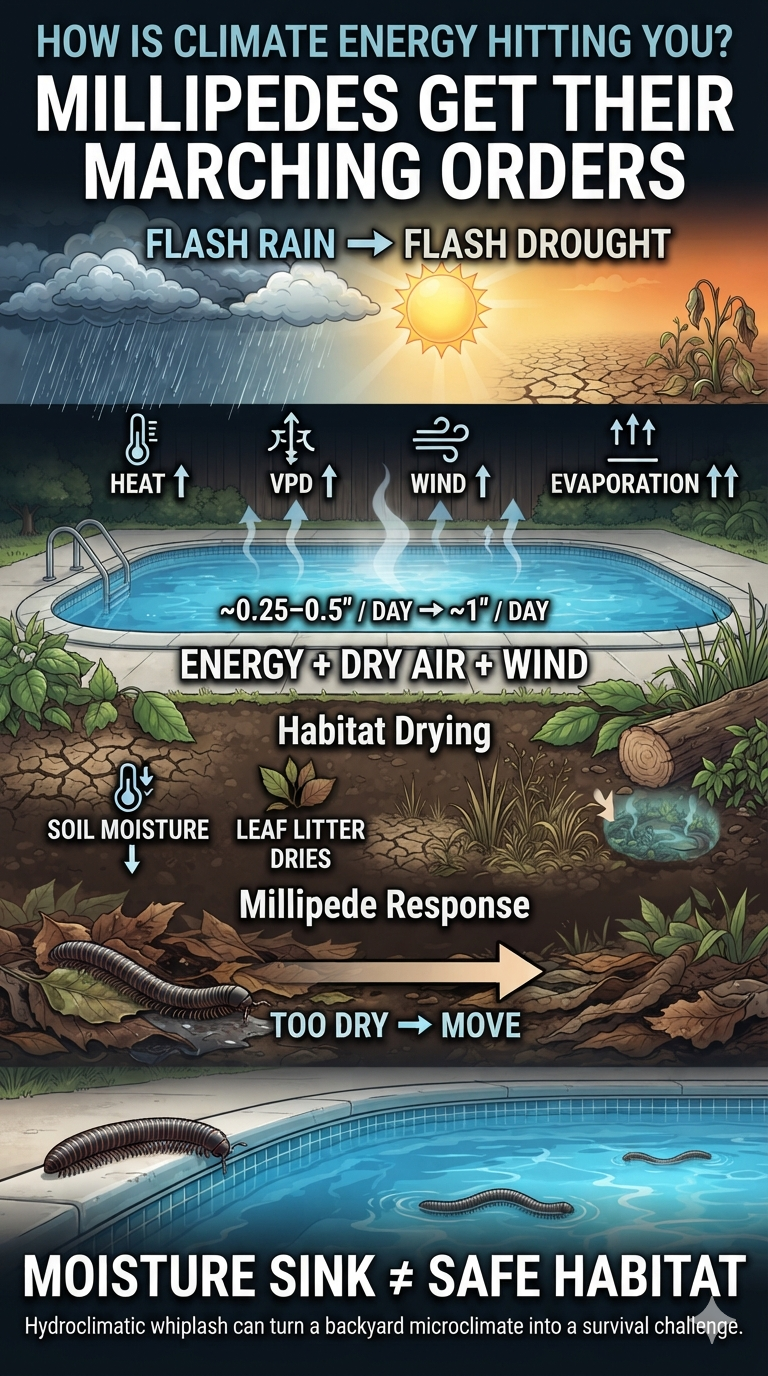
Under ordinary summer conditions, a pool might lose roughly 0.25 to 0.5 inches of water per day, depending on temperature, humidity, wind, solar radiation, pool temperature, and other factors.
During the recent extreme conditions, however, evaporation appeared to approach an inch per day—roughly two to four times a typical baseline.
That isn’t simply a story about hotter temperatures.
It is a story about energy and atmospheric demand for water.
The Clausius-Clapeyron relationship is a fundamental principle of thermodynamics. As temperature rises, the atmosphere’s saturation vapor pressure increases by roughly 7% per °C. A warmer atmosphere can therefore support substantially more water vapor.
But Clausius-Clapeyron alone does not explain a localized three- or four-fold increase in evaporation.
The missing piece is the interaction between temperature and the atmosphere’s ability to remove water from the surface.
The Physics of Extreme Evaporation
For an open water surface, evaporation depends on several interacting variables. A useful framework is the Penman combination equation, which incorporates both the available energy at the surface and aerodynamic drying:
The important point is that evaporation is not controlled by temperature alone.
Three major factors can amplify water loss:
1. Vapor Pressure Deficit
The difference between the saturation vapor pressure at the water surface and the actual vapor pressure of the surrounding air is the vapor pressure deficit (VPD):
When hot, dry air moves over a pool, VPD can become very large.
The water surface is effectively surrounded by air with a strong capacity to accept additional water vapor.
That creates a powerful evaporative gradient.
2. Wind
The aerodynamic term, , represents the influence of wind.
Immediately above a pool is a thin boundary layer of relatively humid air. Wind continually removes that moist layer and replaces it with drier air.
Think of it as nature’s hair dryer.
The stronger the atmospheric mixing, the more efficiently water vapor is transported away from the surface.
3. Solar Radiation
Net radiation, , supplies energy to the system.
Strong, cloudless sunlight transfers energy into the pool and surrounding surfaces. As the water warms, its saturation vapor pressure rises, increasing the potential for evaporation.
The result is not simply:
hotter = more evaporation.
It is:
heat + solar energy + dry air + wind = dramatically increased evaporative demand.
Visualizing the Whiplash Surge
During a normal summer week, these variables remain within a relatively familiar range.
But during hydroclimatic whiplash, they can change rapidly.
A sequence might look like this:
Dry period → intense rainfall → saturated soil → rapid drying → heat → low humidity → high VPD → wind → extreme evaporation
The same landscape can therefore move from waterlogged to severely moisture-stressed within days.
That is the physical signature of hydroclimatic whiplash.
The swimming pool becomes an unintended local measuring device for that atmospheric forcing.
The Pool as a Heat Sink
There is another interesting component: the pool’s thermal mass.
Water has a high heat capacity. After cool nights, the pool can retain substantial stored thermal energy. When brutally hot, dry air moves over that relatively warm water, the temperature and vapor-pressure gradients can become especially favorable for evaporation.
The atmosphere is essentially pulling moisture out of the pool while the pool supplies some of the energy required to make that phase change possible.
That is why an isolated observation of “one inch of evaporation” should not automatically be interpreted as a simple temperature effect.
It is the result of an energy-balance and mass-transfer process—and these are precisely the weather conditions we have been experiencing.
And that brings us back to the millipedes.
Evapotranspiration and the Penman Combination Equation
In hydrology and climate science, evapotranspiration (ET) is the standard term for the combined movement of water from the land surface into the atmosphere through soil evaporation and plant transpiration.
The topsoil experiences a process similar to what happens at the surface of a swimming pool. When the atmosphere becomes hot, dry, and windy, the vapor pressure deficit (VPD) increases, strengthening the gradient that drives water from the surface into the atmosphere:
Low humidity → high VPD → wind → extreme evaporation
But the process does not stop at the surface. Transpiration draws water from deeper in the soil through plant roots and transports it upward through the plant, where it exits as water vapor through microscopic pores called stomata.
During periods of extreme heat and atmospheric dryness, this combined evaporative demand can rapidly deplete available soil moisture, increasing water stress on vegetation and accelerating the drying of the entire soil–plant system.
The result is a powerful feedback:
Heat + dry air → higher VPD → increased evapotranspiration → declining soil moisture → greater vegetation stress
See: Transpiration, Atmospheric Moisture Recycling, and Climate-Driven Heat Stress in a Warming World
The Millipede Problem
Millipedes are fundamentally creatures of moist microhabitats.
They live in leaf litter, soil, rotting wood, and other environments where humidity remains relatively high. Their survival depends on maintaining water balance in an environment that is usually protected from direct solar heating and rapid atmospheric drying.
When extreme evaporative demand suddenly arrives, that microclimate can collapse.
The same atmospheric conditions that pull an extraordinary amount of water from a swimming pool can also pull moisture from the soil and leaf litter where millipedes live.
1. The Desiccation Trap
Millipedes are vulnerable to water loss because their bodies are not as well protected against desiccation as those of many terrestrial arthropods.
During periods of high VPD, water is lost more rapidly to the surrounding atmosphere.
The drier the air becomes, the stronger the gradient driving water out of the animal.
For a moisture-dependent organism, that can quickly become a physiological crisis.
2. Microclimate Collapse
Millipedes normally exploit the humid boundary layer beneath leaves, moss, vegetation, and decaying organic material. That tiny environment can be dramatically different from the air temperature and humidity measured a few feet above the ground. But extreme evaporation changes that.
As soil and vegetation dry, the humid refuge beneath the vegetation becomes progressively less effective. The millipedes are then faced with a choice:
Stay and desiccate—or move.
So they move. They may retreat deeper into soil, beneath logs, or into other remaining pockets of moisture. But when those refuges become unsuitable, some millipedes emerge and begin searching for a new moist environment.
3. Their Food Supply Dries Out
Millipedes are primarily detritivores. They feed on decaying plant material, leaf litter, fungi, and other organic matter.
That food web also depends on moisture.
When leaf litter becomes severely dried out, the physical and biological processes that make organic material available to decomposers and detritivores can be disrupted.
The result is a double problem:
The habitat is drying out—and the food system is changing with it.
4. The March Begins
This is where the swimming pool becomes relevant. A millipede doesn’t understand what a swimming pool is. It responds to its immediate environment. When its normal habitat becomes dangerously dry, it searches for a more favorable moisture environment.
A swimming pool represents an enormous source of water compared with the surrounding dry landscape.
Unfortunately for the millipede, a pool is a moisture sink but not a safe habitat. Once it reaches the water, the outcome can be fatal.
Millipedes are not strong swimmers. They can become trapped at the water’s edge, fall into the pool, and drown.
What appears to be a bizarre invasion of millipedes may therefore be the final stage of a much larger environmental chain.
Climate Energy Has a Marching Order
The important point isn’t that climate change “created” millipedes or directly ordered them into the swimming pool.
It is that changes in atmospheric energy and moisture transport can reorganize the physical environment in which they live.
The sequence looks something like this:
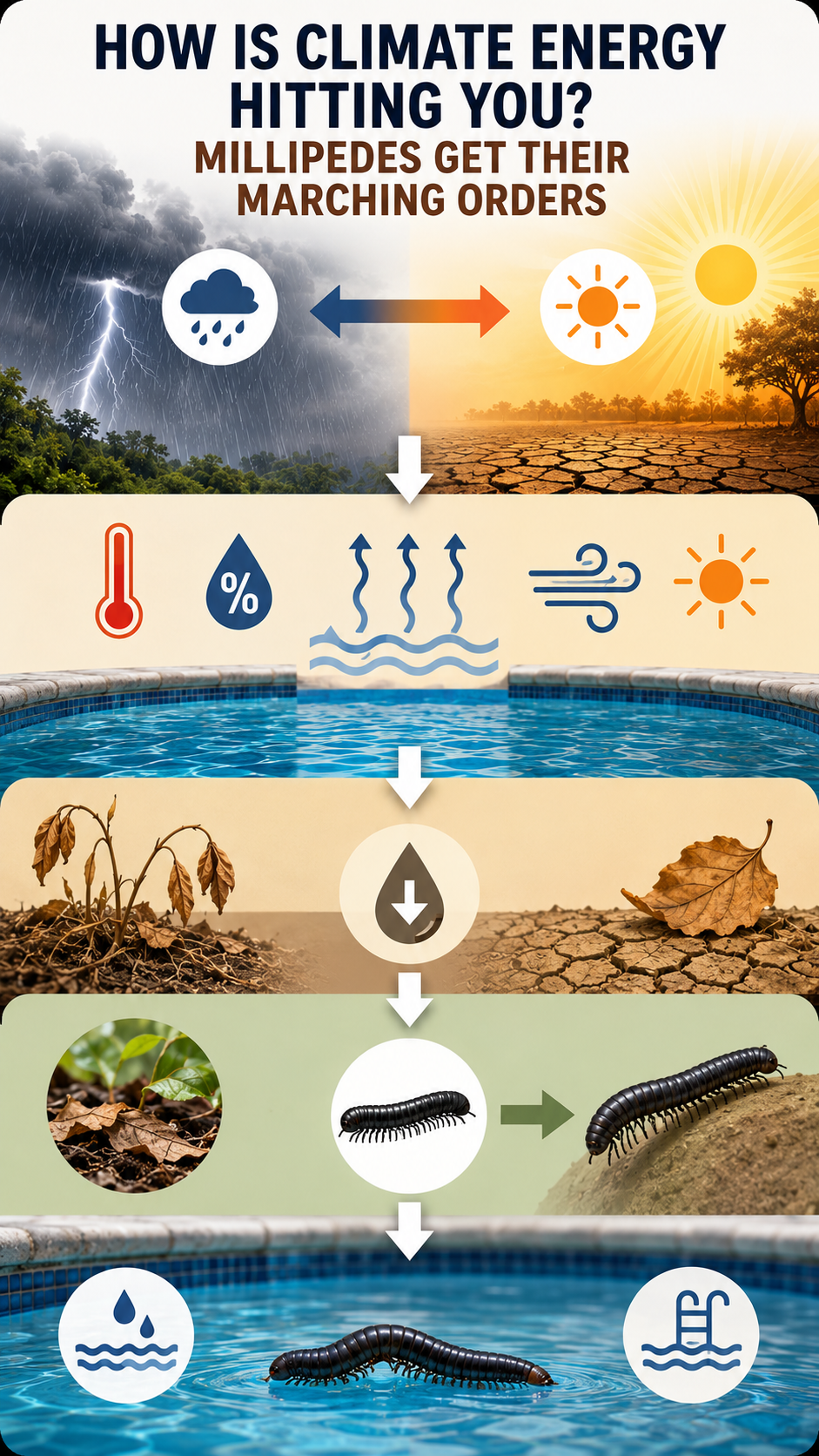
Heat → higher atmospheric moisture demand → higher VPD → increased evaporation → drying vegetation and soil → microclimate collapse → millipede migration → swimming pool
At the other extreme:
Dry period → intense rainfall → saturated soil → reduced pore-space oxygen → earthworm emergence → swimming pool
Same backyard.
Different extreme.
Opposite moisture conditions.
And both can produce the same strange result:
dead creatures at the bottom of the pool.
That is what makes hydroclimatic whiplash so interesting. Climate change isn’t always experienced as a dramatic hurricane, wildfire, or flood. Sometimes it arrives as something much smaller.
Sometimes it is measured in inches of water disappearing from your swimming pool.
And sometimes, if you pay attention, the millipedes get their marching orders.