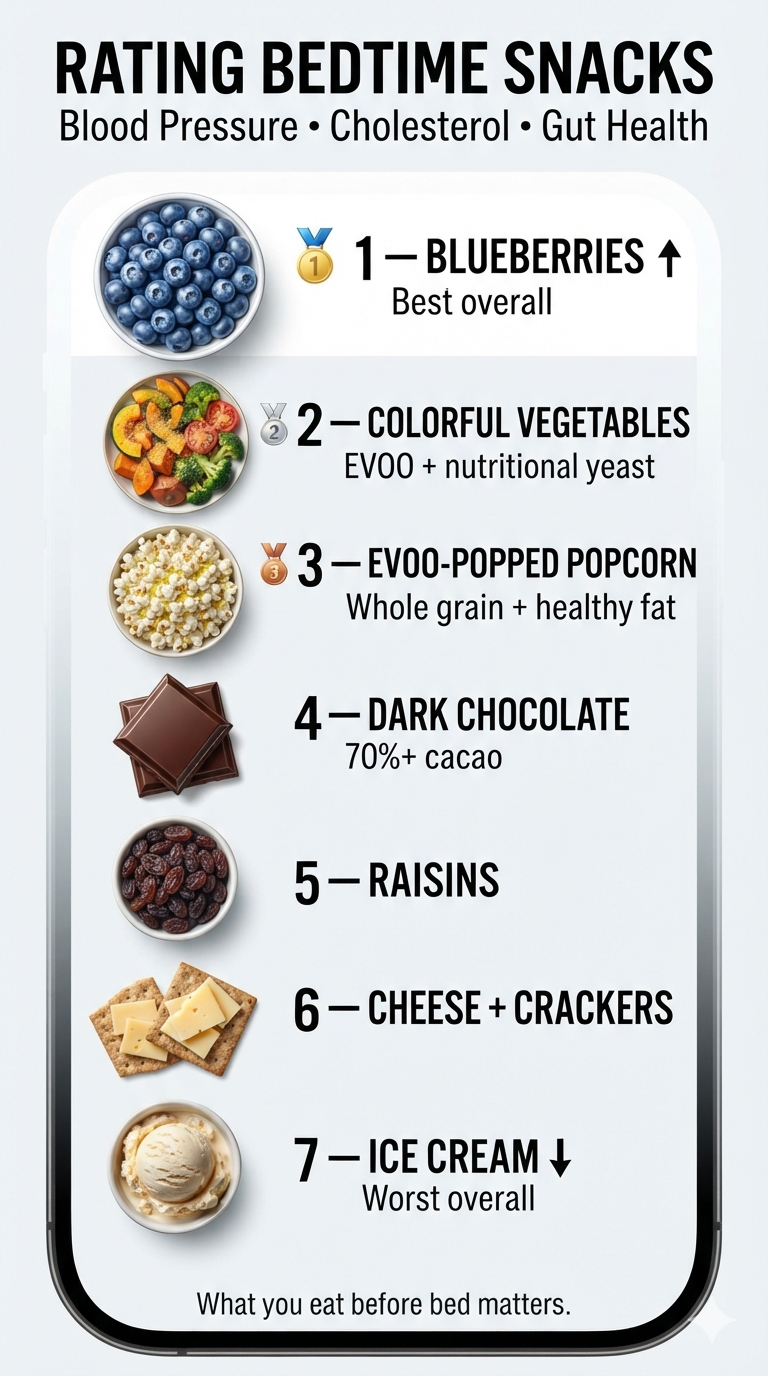
Rating Bedtime Snacks
The Best—and Worst—Bedtime Snacks for Blood Pressure, Cholesterol, and the Gut Microbiome
For general health, when you eat can matter almost as much as what you eat. A common approach is to consume the largest meal earlier in the day, make the afternoon meal smaller, and avoid eating late at night—often using a cutoff somewhere around 6–8 p.m. Much of the research on meal timing has focused on weight management and metabolic health, where limiting late-night calories can be beneficial.
There is also evidence that eating large meals late in the day may adversely affect blood pressure and metabolic regulation. At the same time, the body’s circadian rhythm appears to influence the gut microbiome, including the timing of microbial activity and, potentially, the composition of the bacterial community.
But there is an important distinction: if your weight is under control, your overall diet is healthy, and you are genuinely hungry at bedtime, does having a small snack necessarily undermine your health?
Not necessarily.
The question then becomes what you choose to eat. A small, nutrient-dense bedtime snack can provide an opportunity to add fiber, polyphenols, healthy fats, and other beneficial nutrients without turning late-night eating into a high-calorie event.
So, if you are going to have a bedtime snack, why not make it a healthy one?
Here is how these common bedtime snacks rank when considering their combined effects on blood pressure, cholesterol, and gut microbiome health.
1. Blueberries — Best Overall
Why they rank first: Blueberries are packed with polyphenols that can support beneficial gut bacteria. They also provide dietary fiber, including soluble fiber, which can contribute to healthy cholesterol levels.
Their high concentration of antioxidant compounds may also support endothelial function and cardiovascular health, making blueberries an excellent choice when blood-pressure and heart health are priorities.
Best choice: Fresh or frozen blueberries without added sugar.
2. Mixed Sautéed Vegetables
Why they rank second: Vegetables provide a diverse range of prebiotic fibers that support a healthy gut microbiome. They are also excellent sources of potassium and magnesium, minerals that help regulate blood pressure and support healthy blood-vessel function.
For added heart-health benefits, sauté your vegetables in extra-virgin olive oil (EVOO). Choosing a variety of colors helps broaden the range of plant compounds and nutrients in the meal.
A combination of squash, sweet potato, tomatoes, and broccoli makes an especially nutritious mix, providing different types of fiber, vitamins, minerals, and protective plant compounds.
For an additional nutritional boost, sprinkle on nutritional yeast. Nutritional yeast is a plant-based food ingredient that is often fortified with niacin and other B vitamins, making it an easy way to add nutrients along with a savory, cheese-like flavor.
Best approach: Use minimal added salt and let the vegetables, EVOO, herbs, spices, and nutritional yeast provide most of the flavor.
3. Popcorn Popped in Extra-Virgin Olive Oil
Why it ranks third: When prepared with a modest amount of extra-virgin olive oil, popcorn combines the benefits of a 100% whole grain with the heart-healthy monounsaturated fats and polyphenols found in EVOO.
Popcorn provides dietary fiber that supports digestive and gut health and can contribute to healthy cholesterol levels. EVOO adds oleic acid and polyphenols, providing beneficial plant compounds along with healthy unsaturated fat.
The key is portion control. Using approximately 1–2 teaspoons of EVOO provides its nutritional benefits without adding excessive calories. For an additional nutritional boost, sprinkle on nutritional yeast instead of salt.
Air-Popped vs. EVOO-Popped
Air-popped popcorn remains the better choice if minimizing calories is the primary objective. But for the broader combination of cholesterol, blood pressure, gut health, and nutritional density, popcorn prepared with a modest amount of EVOO is arguably the stronger overall snack.
The added oil does increase calories, but it also improves the nutritional profile by supplying healthy unsaturated fat and additional polyphenols.
Best preparation: Pop the corn in 1–2 teaspoons of EVOO, use minimal salt, and flavor with herbs, nutritional yeast, and spices rather than butter or heavily salted toppings.
4. Dark Chocolate
Why it ranks fourth: High-quality dark chocolate, particularly varieties containing 70% cacao or more, is rich in flavanols. These compounds can promote nitric oxide production and support healthy blood-vessel function and blood pressure.
Dark chocolate also contains polyphenols that may interact favorably with the gut microbiome.
It ranks below vegetables and EVOO-popped popcorn because it is considerably more calorie-dense and can contain meaningful amounts of saturated fat and added sugar, depending on the product.
Dark Chocolate Choices
Some examples of dark chocolate with relatively high cacao percentages include:
- Dove Promises Deepest Dark — 82% cacao
- Ghirardelli Intense Dark — 60%, 72%, 86%, 92%, and 100%
- The 72% and 86% varieties provide a good balance between higher cacao content and a smoother taste.
- Lindt Excellence — 70%, 78%, 85%, 90%, 95%, and 99%
- The 70% and 85% varieties are widely available options.
- Green & Black’s Organic — 70% and 85%
- Alter Eco / Endangered Species — approximately 72% to 88%
- Premium options with high cacao percentages.
5. Raisins
Why they rank fifth: Raisins provide potassium, fiber, and other nutrients, but drying concentrates their natural sugars.
A large serving immediately before bed can therefore provide a substantial sugar load. Fresh fruit generally provides more water and volume for the same amount of sugar, making it a stronger overall choice.
Raisins aren’t necessarily unhealthy—they simply don’t offer the same combination of benefits as fresh berries, vegetables, or whole-grain popcorn prepared with EVOO.
6. Cheese and Crackers
Why they rank sixth: Cheese provides protein and calcium, but many varieties are relatively high in saturated fat and sodium. Depending on the type and portion, these can work against efforts to maintain healthy cholesterol and blood pressure.
Standard crackers can compound the problem because they are often made with refined flour and contain significant amounts of added sodium.
Better choice: If choosing cheese and crackers, select a lower-sodium cheese and whole-grain, lower-sodium crackers, and keep the portion modest.
7. Ice Cream — Worst Overall
Why it ranks last: Ice cream is typically high in saturated fat and refined or added sugar, while providing relatively little fiber or other nutrients that support cardiovascular and gut health.
Regularly consuming large amounts can work against healthy LDL cholesterol levels and overall cardiometabolic health. Its combination of added sugar, saturated fat, and low fiber also makes it a poor choice for supporting a diverse and healthy gut microbiome.
An occasional small serving is unlikely to undo an otherwise healthy diet, but as a regular bedtime snack, ice cream is the weakest choice on this list.
The Final Ranking
BEST → WORST
🥇 1. Blueberries
🥈 2. Mixed Sautéed Vegetables
🥉 3. EVOO-Popped Popcorn
4. Dark Chocolate ≥70% Cacao
5. Raisins
6. Cheese & Crackers
7. Ice Cream
BONUS!
The #1 overall nut is also best eaten as a bedtime snack.
| Rank & Nut Type | Key Health Mechanisms | ⏰ Best Time to Eat |
|---|---|---|
| 🥇 1. Pistachios | Lowest fat but highest potassium of all tree nuts to aggressively manage blood pressure. Packed with prebiotic fibers and unique polyphenols that directly support the growth of gut-lining, anti-inflammatory bacteria like Roseburia. | Late Evening (1 hour before bed) — They contain natural melatonin and healthy fats that promote stable nighttime blood sugar and deep sleep. |
The Bottom Line
If you are going to eat before bed, the goal shouldn’t simply be to find the food with the fewest calories. Instead, look for foods that provide fiber, polyphenols, healthy fats, potassium, magnesium, and other beneficial nutrients while keeping portions reasonable.
For combined blood pressure, cholesterol, and gut microbiome health, the strongest choices on this list are blueberries, colorful vegetables prepared with EVOO, and EVOO-popped popcorn.
And if you want something sweet, a small portion of high-cacao dark chocolate is a substantially better choice than ice cream.
Late-night eating isn’t automatically unhealthy. What—and how much—you eat matters.