By Daniel Brouse and Sidd Mukherjee
The recent reports of rapidly warming waters off the coast of Peru have generated concern among climatologists that another powerful El Niño event may be developing. Most coverage frames El Niño as a periodic climate oscillation that temporarily boosts global temperatures, alters weather patterns, and disrupts fisheries.
While that description is correct, it may no longer be sufficient.
The larger story is not El Niño itself. The larger story is what El Niño reveals about the changing state of the Earth system.
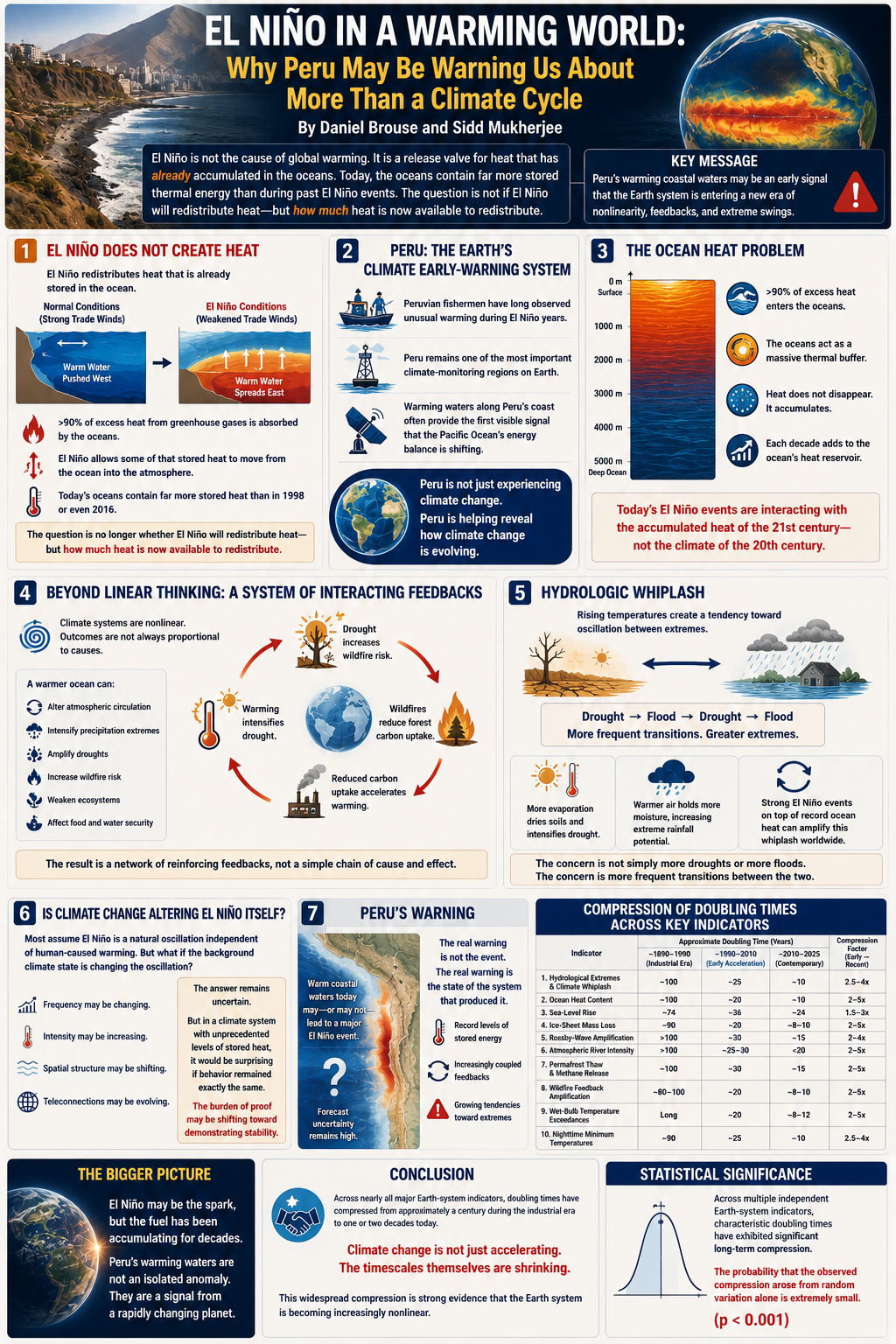
El Niño Does Not Create Heat
A common misconception is that El Niño causes global warming. It does not.
El Niño is best understood as a redistribution mechanism. The vast majority of excess heat trapped by greenhouse gases accumulates in the oceans. During El Niño events, changes in atmospheric circulation and weakened trade winds allow some of that stored heat to move from the ocean into the atmosphere.
In effect, El Niño acts as a release valve for heat that has already accumulated within the climate system.
Historically, this process has produced temporary spikes in global temperature. However, the climate system of 2026 is fundamentally different from the climate system of 1998 or even 2016.
The oceans now contain far more stored thermal energy than they did during previous major El Niño events.
The question is no longer whether El Niño will redistribute heat.
The question is how much heat is now available to redistribute.
Peru: The Earth’s Climate Early-Warning System
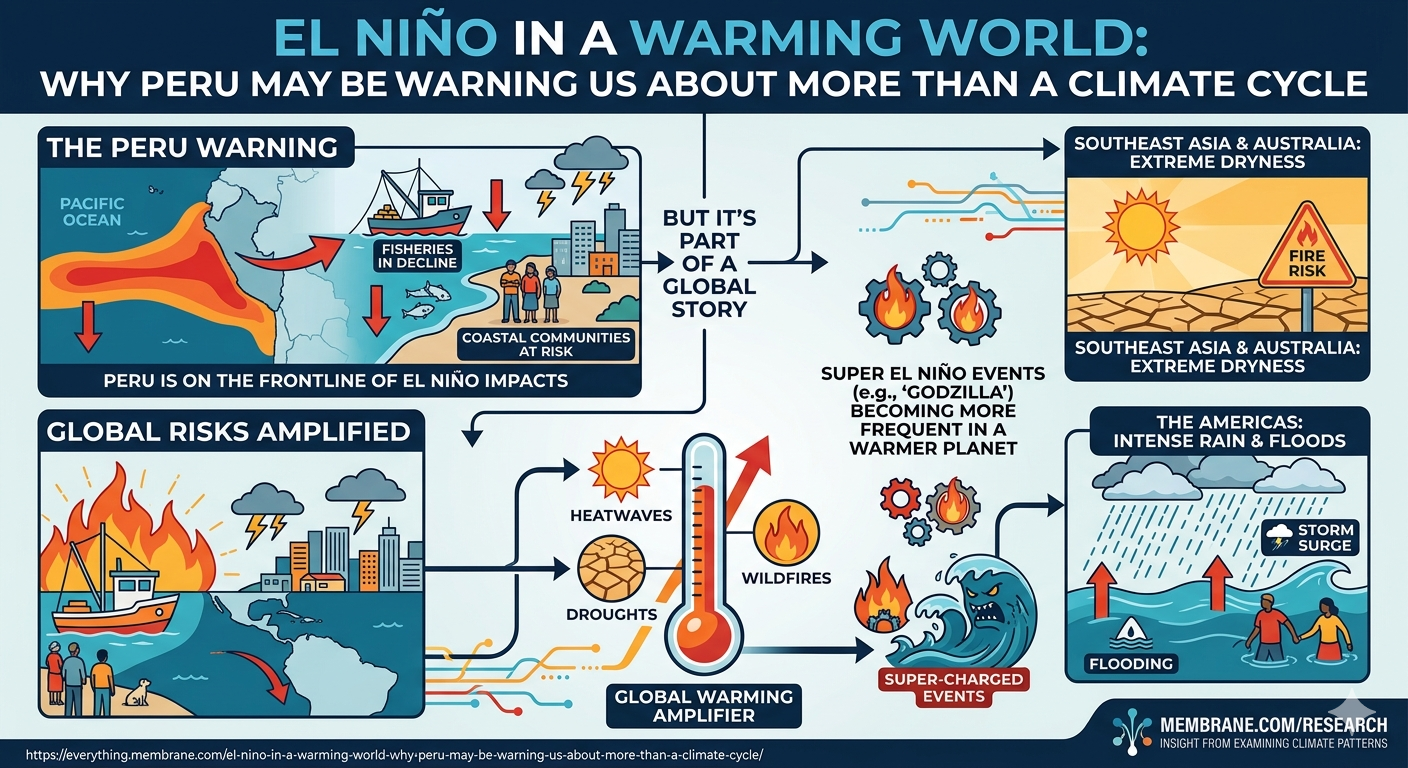
For centuries, Peruvian fishermen have observed unusual warming along the South American coast during El Niño years. The phenomenon was named after the Christ Child—”El Niño”—because it often emerged around Christmas.
Today, Peru remains one of the most important climate-monitoring regions on Earth.
What happens along the Peruvian coast often provides the first visible signal that the Pacific Ocean’s energy balance is shifting.
From a climate-systems perspective, Peru functions as an early-warning sensor embedded within the global climate network. The warming waters observed there are not merely a local anomaly. They may represent the first stage of a planetary-scale redistribution of energy.
In this sense, Peru is not simply experiencing climate change.
Peru is helping reveal how climate change is evolving.
The Ocean Heat Problem
Much of the public discussion surrounding climate change focuses on air temperatures.
This focus is understandable because temperature records are visible and easily communicated. Yet atmospheric temperatures tell only a small part of the story.
More than 90 percent of the excess heat trapped by greenhouse gases enters the oceans.
For decades, the oceans have acted as a massive thermal buffer, absorbing energy that would otherwise have produced much larger increases in atmospheric temperature.
But thermal energy does not disappear.
It accumulates.
Each successive decade has added to the ocean’s heat reservoir, creating conditions that differ substantially from those that existed during previous El Niño events.
Consequently, today’s El Niño events are no longer interacting with the climate of the twentieth century.
They are interacting with the accumulated heat of the twenty-first century.
Beyond Linear Thinking
Most discussions of El Niño assume that future impacts will resemble past impacts.
That assumption may be increasingly dangerous.
Climate systems are nonlinear systems.
In nonlinear systems, outcomes are not always proportional to causes. Small changes can produce large responses, while large changes can remain hidden until thresholds are crossed.
This is why climate scientists are increasingly concerned about compound and cascading risks.
A warmer ocean does not merely increase temperatures.
It can alter atmospheric circulation, intensify precipitation extremes, amplify droughts, increase wildfire risk, weaken ecosystems, and affect food and water security across multiple continents simultaneously.
The impacts interact.
Drought increases wildfire risk.
Wildfires reduce forest carbon uptake.
Reduced carbon uptake accelerates warming.
Warming intensifies drought.
The result is a network of reinforcing feedbacks rather than a simple chain of cause and effect.
Hydrologic Whiplash
One of the clearest manifestations of this changing climate system is hydrologic whiplash.
As temperatures rise, evaporation increases, drying soils and intensifying drought conditions. At the same time, warmer air holds more moisture, increasing the potential for extreme rainfall events.
The result is a growing tendency toward oscillation between extremes:
Drought → Flood → Drought → Flood
This pattern is increasingly evident around the world.
A strong El Niño developing on top of record ocean heat content could amplify this tendency by disrupting rainfall patterns across the tropics, subtropics, and mid-latitudes simultaneously.
The concern is not simply more droughts or more floods.
The concern is more frequent transitions between the two.
Is Climate Change Altering El Niño Itself?
An even deeper question remains unresolved.
Most climate discussions assume El Niño is a natural oscillation operating independently of anthropogenic warming.
But what if the background climate state is beginning to alter the oscillation itself?
Researchers continue to investigate whether climate change is affecting El Niño frequency, intensity, spatial structure, or teleconnections.
The answer remains uncertain.
However, from a systems perspective, it would be surprising if a climate system carrying unprecedented levels of stored heat exhibited exactly the same behavior as it did under preindustrial conditions.
The burden of proof may increasingly shift toward demonstrating stability rather than assuming it.
Peru’s Warning
The warming waters off Peru may ultimately produce a major El Niño event.
Or they may not.
The uncertainty surrounding any individual forecast remains substantial.
Yet focusing solely on whether a “Godzilla El Niño” develops risks missing the larger message.
The real warning is not the event itself.
The real warning is the state of the system that produced it.
Peru’s coastal waters are providing a glimpse into an Earth system carrying record levels of stored energy, increasingly interacting through coupled feedbacks, and displaying growing tendencies toward climatic and hydrologic extremes.
El Niño may be the spark.
But the fuel has been accumulating for decades.
And understanding that distinction may be one of the most important climate challenges of our time.